
Epoxy sanding without clogs: stearate smarts
You know the moment: the shop is quiet, the resin river table catches morning light, and all you can see are tiny ridges, dust nibs, and a faint orange peel across that once-glassy pour. This is where projects are made—or marred. Epoxy sanding isn’t glamorous, but it’s the step that decides if your final finish looks like a mirror or a fogged window. And if you’ve ever had sandpaper load up in seconds, smear epoxy into gummy streaks, or clog your discs so fast you start doubting your gear, you’re not alone. I’ve been there—hands on the sander, vac humming, wondering why the surface keeps fighting back.
The fix isn’t one trick. It’s a combination of understanding heat, choosing the right abrasives, and knowing when stearated papers help and when they hurt. Stearate coatings are designed to resist loading; they can be your best ally when you’re leveling cured resin. But they can also sabotage adhesion if you plan to recoat or apply a sensitive finish. The key is using them on your terms: control the heat, manage the dust, and choose the workflow that matches your next step—whether that’s a flood coat, a polyurethane topcoat, or a full polish to optical clarity.
In this guide, I’ll show you how to keep your paper cutting cleanly instead of clogging, how to set up your tools for predictable results, and how to navigate the stearate question without guesswork. You’ll get the exact grit progressions, pressure, and speed settings that I use in the shop, plus a few clutch moves for when things go sideways. When epoxy sanding becomes controlled and repeatable, your finishes stop being a gamble—and start looking like you planned it that way from the beginning.
Quick Summary: Keep epoxy cool, extract dust aggressively, use stearated papers strategically, and switch to non-stearated or wet methods before any step that requires perfect adhesion.
Why abrasives load and how to stop it
Loading happens when the material you’re removing clogs the abrasive’s spaces faster than it can be evacuated. Epoxy compounds the problem because it softens with friction heat and smears across the grit. Once those pores are packed, your disc stops cutting and starts burnishing, building more heat and compounding the mess. Break that cycle and everything gets easier.
The three levers you control are heat, dust removal, and abrasive geometry. Heat is enemy number one: slow your sander down, lighten up on pressure, and don’t linger. Dust wants an exit route: pair a high-flow dust extractor with a true multi-hole pad so the air moves through the abrasive instead of around it. And abrasive geometry matters more than most people think: open-coat papers and mesh-style abrasives have extra space between grains, so swarf has somewhere to go. Stearate (a dry lubricant coating) can be the final piece, reducing epoxy’s tendency to stick to the grit—but it’s not always appropriate if you plan to bond or finish afterward.
Here’s what I dial in before I make my first pass:
- Speed: Set a random orbital at 2–3 of 6. High speed cooks epoxy and loads discs.
- Pressure: Think “firm handshake,” not a press. Let the abrasive cut—don’t force it.
- Pattern: Slow, overlapping lanes with 30–50% overlap. Two passes per grit.
- Extraction: Real dust extraction, not a shop vac on a hose. You want airflow through the pad.
- Interface pad: Use a 3–5 mm foam interface for curves; go hard-back for flattening flood coats.
Actionable tips to prevent loading:
- Start cleaner than you think: wipe dust and chips before the first pass so you’re not grinding debris into the surface.
- Use fresh discs early: swapping a $1 disc beats fighting a hot, glazed one for 20 minutes.
- Hover clearing: lift the sander slightly off the surface for a second to pull air through and clear the disc mid-pass.
- Keep your hand on the workpiece: if it feels warm, it’s time to move, slow down, or switch discs.
Grits, tools, and setup for epoxy sanding
When you dial in the recipe ahead of time, epoxy sanding becomes predictable. The right tools, pads, and grit jumps create a controlled climb from flat and hazy to crisp and clear. Don’t guess; build the stack.
Tools and setup that never steer me wrong:
- Sander: 5" or 6" random orbital with variable speed; one hard pad and one with a 3–5 mm interface.
- Extraction: 130+ CFM dust extractor with a high-flow hose and proper adapter to your sander’s port.
- Discs: A mix of open-coat aluminum oxide (non-stearated), stearated paper for bulk removal (when appropriate), and mesh discs for heat-sensitive steps.
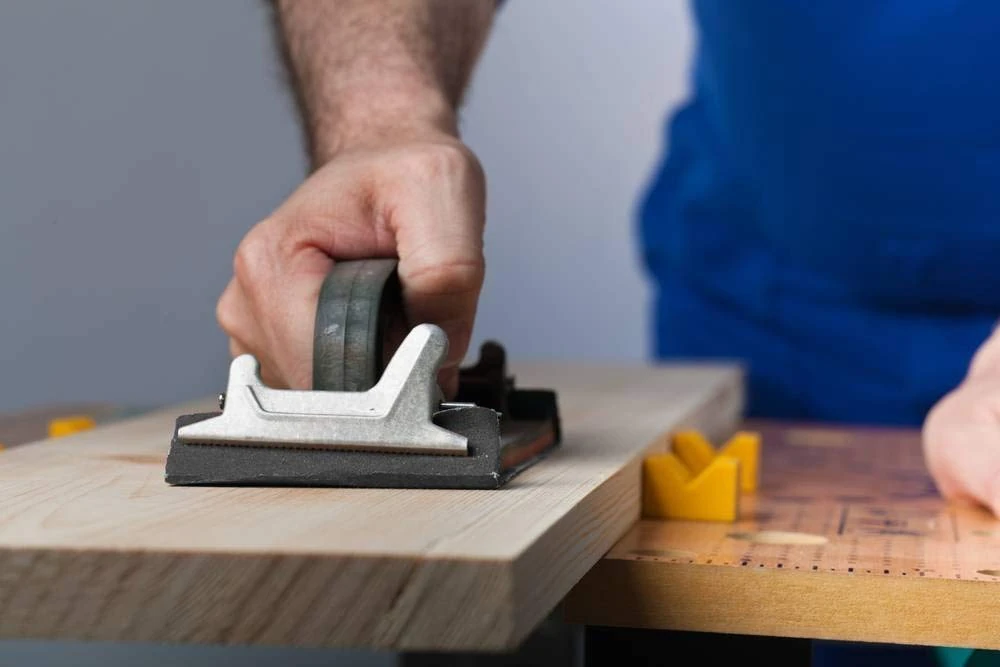
- Hand blocks: A hard, flat block for edges and a soft foam block for contours.
- Wet kit: Silicon carbide sheets (P800–P2000), spray bottle with water plus a drop of dish soap, microfiber towels.
Grit progression depends on where you’re starting and where you want to end:
- Leveling a flood coat with runs/dust nibs: 120 → 150 → 180 → 220 (switch to 320+ if you’ll topcoat with a clear finish).
- Smoothing a decent pour with minor orange peel: 180 → 220 → 320.
- Pre-polish to a gloss: 400 → 600 → 800 → 1000, then compounds.
- Matte/satin finish: stop at 600–800 and finish with oil-wax or a matte clear (if compatible).
Step-by-step workflow for reliably flat surfaces:
- Pencil grid: Lightly scribble a crosshatch on the cured epoxy to track low spots.
- Hard-pad, open-coat 120 or 150: Keep speed low and pressure light; vacuum lines should cleanly erase pencil marks.
- Check and mark: Wipe the surface, re-grid any remaining low spots, and take light passes only where needed.
- Swap to 180/220 non-stearated: Refine scratches and ensure an even, bright haze.
- Decide the fork: If you’re recoating or gluing, stay non-stearated. If you’re polishing or stopping here, you can bring in stearated discs to reduce loading at higher grits.
Three shop-tested tips:
- Align holes perfectly: Misaligned disc holes strangle airflow and accelerate loading.
- Disc discipline: If you feel drag or see smearing, stop, rotate or replace the disc, and lower speed.
- Edge insurance: Hand-sand edges with a block to avoid rolling them over with a soft pad.
Stearated vs non-stearated: when to use what
Stearated papers are coated with a dry lubricant (often zinc stearate) that discourages swarf from sticking to the abrasive. They excel at dry sanding finishes that tend to clog—exactly why they’re tempting for epoxy. Used strategically, they keep discs cleaner longer and lower your cost per square foot. But stearates can transfer to the surface, and that residue can interfere with adhesion or cause defects like fisheyes under some topcoats.
Here’s the rule of thumb I use in the shop:
- Use stearated when: You’re leveling fully cured epoxy prior to a polish-only workflow; you’re not applying a water-clear topcoat that’s sensitive to contaminants; you’ll follow with a thorough, non-stearated scuff before any bond line or finish coat.
- Avoid stearated when: You’ll recoat with epoxy for a chemical/mechanical bond; you’ll apply finishes known to telegraph contamination (certain varnishes, 2K clears, or waterbornes); or you’re in a high-adhesion prep step like bonding hardware or laminating veneers.
Process for using stearated discs without contaminating your finish:
- Bulk removal: Use stearated discs for the early “hogging” passes (e.g., 150/180) to stay cool and prevent loading.
- Clean transition: Vacuum, then wash the surface with warm water and a drop of dish soap to remove dust and potential stearate residue. Dry thoroughly.
- Non-stearated scuff: Switch to fresh non-stearated 220–320, and re-scuff uniformly. This creates a clean mechanical tooth for finishes or recoating.
- Final clean: Tack with a lint-free cloth or blow off with filtered air; avoid solvent wipes that can redistribute contaminants.
According to a article. That guidance aligns with what I see in the shop: contamination problems almost always start when we sand debris into the surface or leave a residue that topcoats don’t like. Stearate residue is just one variable. Amine blush—an oily film that can form on some epoxies—can also cause fisheyes. Wash blush with water and a mild detergent before you sand, then sand, then clean again. If you’re ever unsure, dress the surface with a final non-stearated pass and a detergent wash before finishing.
Pro tips to stay out of trouble:
- Two-step method: Stearated for the heavy lifting, non-stearated for finish prep. Simple and repeatable.
- Test panel: Wipe a small area with your intended finish; if it separates, you’ve got contamination. Wash and re-scuff.
- Fresh rags only: Reused solvent rags can back-contaminate epoxy with oils and waxes.
- Avoid waxed compounds until after your topcoats: If you plan to spray a clear, do your polish-and-wax routine only at the very end.
Wet sanding, mesh discs, and dust control
If you want to avoid loading without relying on stearates, wet sanding and mesh abrasives are your best friends. Both strategies reduce friction heat and give debris a clear escape route. They’re especially effective after you’ve leveled the surface and you’re refining scratches.
Wet sanding basics:
- Use silicon carbide waterproof paper, typically starting at P600–P800 on epoxy.
- Mix water with a drop of dish soap to break surface tension and keep the sheet gliding.
- Back your paper with a soft pad or rubber block to keep pressure even.
- Keep the surface absolutely flooded; the slurry carries away debris so grains can cut.
Technique that works:
- Spray the surface generously, then sand in straight, overlapping lanes.
- Wipe and inspect every couple of passes; look for a uniform, dull sheen with no shiny low spots.
- Move up in small steps: 800 → 1000 → 1200 → 1500 as needed for your finish goal.
- Rinse thoroughly between grits to avoid rubbing old grit into new scratches.
Mesh discs shine in dry conditions with extraction. Their open weave lets air and dust flow through the pad, minimizing loading even on heat-sensitive epoxy. They also excel at maintaining consistent scratch patterns because debris isn’t trapped under the pad.
Dust control makes or breaks the process:
- Use a dust extractor with automatic filter cleaning; airflow decay equals faster loading.
- Keep hoses short and smooth-bore if possible to maintain CFM.
- Seal your sander’s shroud to the pad and align holes precisely for maximum pull-through.
- Don’t sand on a dusty bench; grit from the table can ride up under the pad and gouge the epoxy.
Three actionable ways to stay clean and cool:
- Slurry discipline: During wet sanding, dump slurry often; clouded slurry cuts poorly and creates drag.
- Crepe block cleaner: For dry papers, especially non-stearated, use a crepe cleaning stick to de-gunk discs between passes.
- Interface spacer: On curved surfaces, a thin interface pad spreads pressure and lessens hot spots that cause loading.
From matte to mirror: finishing without swirl
Once you’re flat and consistent, you decide the finish lane. For a matte or satin look, stop after P600–P800 wet or P400–P600 dry and apply a compatible matte topcoat or oil-wax blend rated for use over epoxy. For a gloss that shows depth, you’ll move into fine abrasives and compounds. The goal is to methodically replace coarse scratches with finer ones until they become optically invisible.
Gloss workflow I rely on:
- Final dry pass: 320 → 400 non-stearated with dust extraction to ensure an even haze.
- Wet sequence: 600 → 800 → 1000 → 1500 (and 2000 if needed). Keep the surface clean and cool.
- Compound: Use a plastic-safe or resin-friendly cutting compound on a firm foam pad at low speed. Work in small sections until the haze clears.
- Polish: Follow with a fine polish on a softer pad to pop clarity and remove micro-swirl.
- Clean and inspect: Wipe with a damp microfiber (water only) and view under raking light.
Avoid swirls and haze with these habits:
- Pad pairing: Firm pad for cutting compound, soft or ultra-soft for final polish.
- Speed control: Keep your polisher or sander-polisher at low to medium speeds; higher RPM builds heat and prints swirl.
- Clean pads often: A loaded pad reintroduces scratches. Blow it out or swap to a fresh pad.
- Cross-hatch: Change direction between passes to even out the scratch network.
If you’re topcoating instead of polishing, prep with non-stearated 320–400 grit and a uniform scuff. Clean with water and a touch of detergent, rinse, and dry. Skip solvent wipes unless your finish manufacturer specifically allows them over epoxy—some solvents can drag contaminants into pores or soften marginally cured resin. Finally, keep the room clean and warm; dust and low temperatures are swirl’s cousins when you’re chasing that perfect finish.
Sanding 101: How — Video Guide
There’s a concise tutorial that mirrors this workflow: a maker de-molds a resin project, sees the inevitable nibs and texture, and then walks through how to level, refine, and polish without turning the surface cloudy. It hits on the real-world pain points—clogging discs, heat buildup, and inconsistent scratch patterns—and shows how to fix them with the right grit steps and tool speeds.
Video source: Sanding 101: How to sand epoxy resin projects | Alumilite
280 Grit Sandpaper Sheets (50-pack) — 9x11 in Silicon Carbide Abrasive for Wet or Dry Use — Fine finishing grit for delicate work—ideal for flattening varnish layers and creating a pre-polish smoothness on wood or resin. (Professional Grade).
Frequently Asked Questions (FAQ)
Q: Should I use stearated sandpaper on epoxy?
A: Yes, but strategically. Stearated papers reduce loading, especially at lower grits during bulk leveling. If you plan to recoat or apply a sensitive finish, follow with a detergent wash and a fresh non-stearated scuff (220–320) to remove any residue and restore adhesion.
Q: What grit should I start with when flattening a cured epoxy pour?
A: Start at 120–150 with a hard pad if you have clear high spots, runs, or orange peel. If the surface is already close, 180–220 is safer. Always verify with a pencil grid and low speed to avoid heat.
Q: How do I stop my sandpaper from clogging instantly?
A: Lower the sander speed, reduce pressure, and use aggressive dust extraction. Choose open-coat or mesh abrasives, and consider stearated discs for bulk removal. Swap discs early and clear them with a crepe stick. Wet sanding with silicon carbide also prevents loading at finer grits.
Q: Can I wet sand all epoxies?
A: Most fully cured epoxies handle wet sanding well. Confirm your product’s cure time, wash off any amine blush with soapy water before starting, and keep the surface flooded. Avoid water if the piece has unsealed edges or substrates that can swell.
Q: Why does my glossy polish look hazy under certain light?
A: Haze usually comes from incomplete scratch removal or heat micro-marring. Step back one grit, sand evenly, and keep temps low. Use a clean cutting compound on a firm pad, then a fine polish on a soft pad, wiping and inspecting between steps.