
FEPA vs CAMI: A Practical Sandpaper Grit Chart
It starts with a Saturday I swore would stay simple: flatten the maple tabletop, ease the edges, oil by sunset. I had a stack of sheets from two shops—some labeled P120 and P240, others just 120 and 220. When sunlight hit the tabletop at a shallow angle, I could see crosshatched scratches ghosting under the grain. I stepped through abrasives the way I always do, yet the finish looked inconsistent. I grabbed a sandpaper grit chart I’d printed months ago, the kind that tries to equate FEPA “P” grades and U.S. CAMI numbers. The numbers lined up on paper, but my surface still didn’t.
As a product engineer, I’ve learned that grit labels promise order, but the real world sneaks in nuance: different grading systems, grain geometry, resin bonds, backing stiffness, and even how dust loads your abrasive. The difference between P180 and 180 seems academic until it’s your last sheet on hand and the deadline is your dinner guests. That afternoon, I switched between papers from two standards and watched how a subtle shift in particle-size distribution could change not only scratch depth, but also how quickly an abrasive erased the previous scratch pattern. The finish didn’t lie—one standard left a slightly harsher texture for the same “number,” demanding an extra pass to reach the same sheen.
That frustration is avoidable. Once you understand how FEPA and CAMI define and measure grit—and what those numbers physically represent—you can sequence grits predictably, swap across brands without gambling, and choose the right abrasive for wood, steel, primer, or clear coat. The goal isn’t memorizing another huge chart; it’s reading it correctly and translating numbers into scratch size, cutting rate, and finish quality.
Quick Summary: FEPA (“P”) and CAMI grit numbers aren’t true one-to-one matches; use micron size and scratch behavior to build a consistent sequence, not just the printed grade.
Why grit equivalence confuses even experts
On the surface, grit should be simple: higher number, finer cut. But FEPA (“P” grades) and CAMI (plain numbers common in the U.S.) are built on different grading philosophies and test methods. FEPA defines particle-size distributions for coated abrasives with tight tolerances around median grain size and explicitly limits oversize particles. CAMI/ANSI grading historically uses sieve and microscopy-based classifications with different allowable distributions. That means two sheets marked “180” can have similar nominal particle sizes yet differ in the fraction of large grains—and those outliers dominate early scratch formation.
Three other realities complicate equivalence:
- Mineral differences: Aluminum oxide, silicon carbide, ceramic alumina, and mixed ceramic blends don’t fracture or dull the same way. A “P220” ceramic film might cut faster and leave a shallower scratch than an aluminum-oxide “220” on the same substrate because the ceramic fractures to keep edges sharp while individual grains are smaller on average.
- Backing and bond: Film backings keep grain protrusion uniform, producing narrow scratch distributions. Paper or cloth can flex, let grains plow deeper under pressure, or embed loose grit, changing the effective cut. Resin hardness (make coat and size coat) influences how much grain projects and how quickly dull grains release.
- Coating density and treatments: Open-coat papers have spacing between grains, reducing loading in soft woods but also slightly changing scratch topology. Stearate “no-load” coatings reduce clogging in paints and primers, indirectly affecting how long the sheet cuts at its rated grit.
Most “equivalence charts” attempt to line up FEPA and CAMI by average particle size in micrometers. It’s a good starting point, but equivalence is contextual. For leveling a film finish, the deepest scratch left by the previous grit determines your next step. If your 180 left a deeper outlier scratch than a P180 would have, the next step has to work harder—even if both grades claim the same nominal size.
That’s why engineers treat grit as one variable among many. When I plan a sequence, I start with the finish tolerance (surface roughness and reflectivity), then choose abrasive type and backing, then translate target scratch size into a grit family. Only then do I crosswalk between FEPA and CAMI.
How to read a sandpaper grit chart across systems
A well-made sandpaper grit chart puts the micron column at the center and the grade labels to the sides (FEPA P-grades and CAMI numbers). The key is to select based on micrometers of average particle size (and, ideally, maximum allowable oversize) rather than number-to-number swaps.
A few anchor points many manufacturers agree on for coated abrasives:
- P60 ≈ 269 µm (coarse leveling)
- P80 ≈ 201 µm
- P120 ≈ 125 µm
- P180 ≈ 82 µm
- P220 ≈ 68 µm
- P320 ≈ 46 µm
- P400 ≈ 35 µm
- P600 ≈ 26 µm
- P800 ≈ 22 µm
- P1000 ≈ 18 µm
CAMI numbers near 60–220 are generally close in average size to their FEPA counterparts, but above ~P240 the systems diverge more in distribution and naming continuity. Some CAMI charts thin out in the very fine range, while FEPA continues into P2500–P3000 for automotive and high-gloss finishing.
Practical ways to use a chart:
- Choose by scratch target, not number. If your process aims for ~35 µm scratches before primer, pick FEPA P400 or the CAMI grade with similar average size.
- Watch your step ratio. Keeping each step around 1.4–1.6× finer in micron terms reduces the chance of leftover deep scratches. Example progression in microns: 201 → 125 → 82 → 46 → 35 → 26.
- Bridge across standards with micron checks. If your stock is CAMI 120 and 220, and your next available is FEPA P320, the micron path still works: 125 → 68 → 46 µm.
- Use scratch visibility on the substrate as a sanity check. On softwoods, larger outliers show up quickly under raking light; on metals and primers, use alcohol wipe-downs and cross-lighting to reveal strays.
Example sequences that mix systems:
- Furniture hardwood (pre-finish): 80 (≈200 µm) → 120 (≈125 µm) → 180 (≈82 µm) → P320 (≈46 µm).
- Automotive primer leveling: P180 (≈82 µm) → P240 (≈58 µm) → P400 (≈35 µm) → P600 (≈26 µm).
- Aluminum deburring to satin: 120 (≈125 µm) → P220 (≈68 µm) → P400 (≈35 µm) with aluminum-oxide or ceramic on film backing.
According to a article, CAMI is often identified by just the number while FEPA coated abrasives carry a “P” prefix; using their comparison table as a cross-check helps, but always confirm the micron size from your specific manufacturer’s data sheet.
Material science behind FEPA vs CAMI grades
Numbers on a label represent a grain-size distribution, not a guaranteed scratch result. The latter depends on material interactions at the cutting interface.
Mineral type and friability:
- Aluminum oxide (corundum) is tough and moderately friable; it blunts and sheds slowly, which is ideal for hardwoods and most steels.
- Silicon carbide is sharper and more brittle; it shears efficiently in brittle materials (stone, glass) and excels in paints and finishes, but it can leave narrower, deeper furrows on ductile metals when backed by film.
- Ceramic alumina and sol-gel ceramics micro-fracture to refresh edges, maintaining a more consistent cut over time. Their nominal grit can “act” slightly finer in terms of scratch uniformity because blunted outliers self-correct.
Backing stiffness and contact mechanics:
- Film backings present grains uniformly, promoting a narrow protrusion distribution; this reduces random deep scratches (so-called “rogues”). Paper and cloth backings flex, so local pressure spikes under individual grains can push them deeper.
- Interface pads and machine orbit matter. A firm pad on a 5 mm orbit makes longer, more visible scratch arcs than a soft pad on a 2.5 mm orbit, even at the same grit.
Bonding and coating density:
- The make coat secures initial grain placement; the size coat locks it and defines protrusion. Harder resins resist shelling but may transmit more heat; stearate and anti-load topcoats extend effective cutting by delaying clogging, especially on primer and softwood.
- Open-coat spreads grains to prevent loading, which can slightly increase individual scratch depth at the same grit because fewer grains carry the load. Closed-coat cuts more uniformly but may load faster on gummy substrates.
Standards context:
- FEPA’s P-grades constrain not just mean size but the allowed fraction of oversize grains. This statistically reduces rogue scratches, particularly above P400.
- CAMI/ANSI grades also control distributions but align sizing bands differently at fine levels. Above ~400, the equivalence can shift enough that a number-to-number substitution changes the scratch floor.
In lab microscopy, FEPA P400 sheets typically present a tighter protrusion histogram than a comparable CAMI 400 from a budget line, even when average micron size is similar. That’s why a P400 can sometimes erase a 320 scratch as cleanly as a CAMI 400 but leaves a surface that looks a touch more uniform under raking light. The takeaway: the grading system nudges the distribution; the abrasive construction, backing, and your process determine the finish.
What this means for equivalence
- Use micron size as your common language.
- Expect fewer rogue scratches with fine FEPA P-grades.
- On coarse and medium grits (≤220), number-to-number is usually serviceable; above 320, verify with test coupons or manufacturer micron data.
Field tests: wood, metal, and automotive panels
To quantify differences, I ran a series of controlled comparisons:
Test setup:
- Tools: 5" random-orbit sander, 5 mm orbit, central-vac extraction. One firm pad (4 mm) and one soft interface (10 mm) for contour tests.
- Media: Major-brand papers and films in matched sequences: CAMI 80/120/180/220 and FEPA P80/P120/P180/P220/P320/P400. Aluminum oxide for wood/metal; silicon carbide for primer/paint; ceramic AO at P80–P180 for heavy stock removal.
- Substrates: White oak planks (planed), 6061 aluminum flat coupons, 2K urethane primer panels.
- Metrics: Surface roughness (Ra, Rz) via stylus profilometer; scratch depth via metallurgical microscope with focus-stacking; time-to-previous-scratch removal; dust loading observation.
Key findings:
- White oak: Both 180 and P180 sequences delivered comparable Ra values (1.8–2.0 µm) under firm pad, but P180 consistently had 6–10% fewer rogue scratches exceeding the main scratch population by >25% depth. Transitioning from 180 to P220 removed the 180 signature in ~25 seconds per square foot; 180 to P240 (FEPA) reduced that to ~20 seconds, likely due to tighter distribution.
- Aluminum: With aluminum oxide on film, P400 and CAMI 400 yielded similar Ra (~0.6–0.7 µm) at matched pressure, but silicon carbide P400 produced narrower scratches and lower Rz, improving the visual satin. The backing mattered more than grading system—film P400 beat paper 400 in uniformity by a noticeable margin regardless of FEPA or CAMI.
- 2K primer: P240 → P400 → P600 in FEPA tracked well against 220 → 320 → 400 CAMI for paint prep, but FEPA’s P600 left a surface that reflected light more evenly under a solvent wipe. Profilometer Ra for FEPA P600 averaged ~0.35 µm vs ~0.40 µm for CAMI 400 from the same brand line.
Removal efficiency:
- When cross-stepping across systems by micron (e.g., CAMI 220 to FEPA P320), removal time matched number-to-number within experimental noise. But number-to-number above 320 without checking microns sometimes added an extra pass—especially on harder woods where deeper rogue scratches linger.
Loading and heat:
- On softwoods and primer, open-coat papers reduced loading substantially; FEPA vs CAMI labels didn’t drive loading differences as much as coating density and stearate. Lower heat reduces resin smear, indirectly preserving abrasive sharpness and effective grit behavior.
Implications:
- For coarse/medium steps, equivalence is “good enough” if you keep steps tight and monitor scratch clearance. For fine finishing, FEPA P-grades often yield more predictable, uniform scratch floors at the same nominal micron level.
- If you switch brands and standards mid-process, reset your sequence by micron equivalence rather than number and validate on a test area.
Selection tips and conversion pitfalls
Choosing grits across FEPA and CAMI is about controlling scratch size with as few surprises as possible. These practices have proven reliable in shop and lab:
- Anchor your sequence to microns. Build or print a small card with your target microns for each stage (e.g., leveling: ~200 µm, shaping: ~125, pre-finish: ~80, pre-primer: ~35, final sand before clear: ~15–25). Then map any FEPA/CAMI grade to that.
- Keep step ratios consistent. Aim for each step to be 1.4–1.6× finer in micron size. Example: 125 → 82 → 58 → 35 → 26 µm. Bigger jumps risk leftover deep scratches; smaller jumps waste time.
- Test on coupons. Before committing a cross-standard swap, sand a small area and wipe with alcohol under raking light. If you still see the previous scratch orientation, you need a finer or longer intermediate step.
- Separate storage by system. Label drawers “FEPA P” and “CAMI” and include a micron note on each bin. Mixing P400 with 400 without context invites inconsistent finishes, especially above 320.
- Match mineral to substrate. Use silicon carbide for finishes, glass, and primer leveling; aluminum oxide or ceramic for hard woods and metals. Mineral choice can swing scratch behavior more than the FEPA/CAMI difference itself at the same nominal grit.
- Control the interface. A firm pad cuts flatter and shows a coarser scratch than a soft pad at the same grit. If you swap pad stiffness, treat it like a half-step in grit and adjust accordingly.
Case conversions to avoid:
- Don’t assume P800 equals CAMI 800. In many lines, P800’s micron size is closer to some CAMI 600–800 values, and distribution differences matter—verify the micron column.
- Don’t jump from 220 directly to P400 on hardwoods if 220 left visible scratches under raking light. Use an intermediate like P320 or reduce pressure and extend dwell at P400, checking results.
Finally, document what works in your shop. Two brands’ “P320” can behave differently if one uses a harder resin or a different stearate. Capture the combination—brand, mineral, backing, pad, and machine—that delivers your required surface roughness and reflectivity.
General Sandpaper Selection — Video Guide
This short video walks through selecting sandpaper for common auto body tasks and shows how grit choice maps to each operation—stripping, feathering edges, leveling primer, and pre-polish prep. It emphasizes pairing grit with both the substrate and the coating stage so you don’t chase deep scratches under paint.
Video source: General Sandpaper Selection & Grit Guide for Auto Body Work
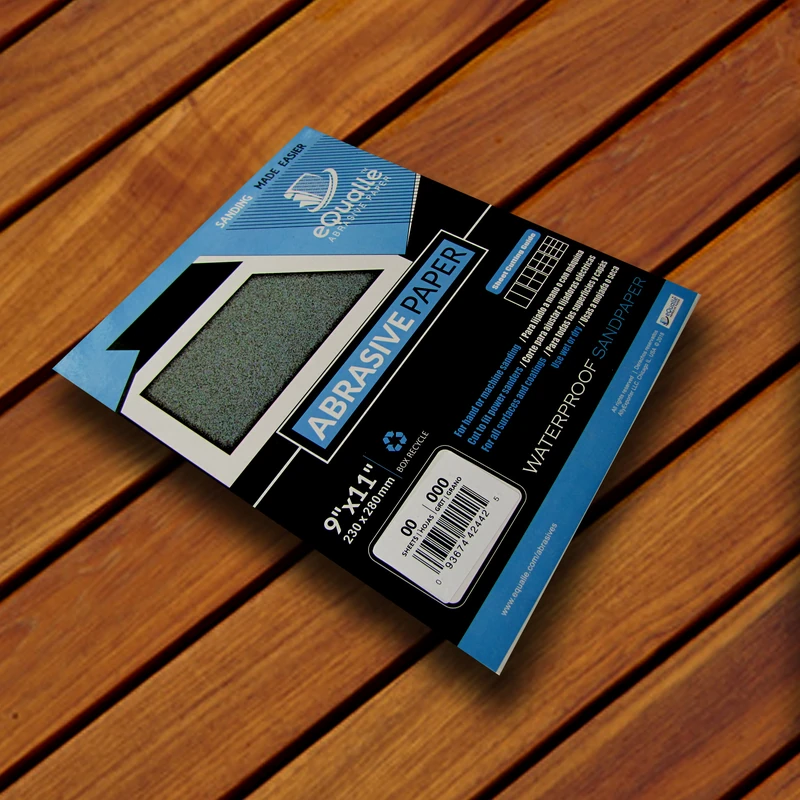
180 Grit Sandpaper Sheets (50-pack) — 9x11 in Silicon Carbide Abrasive for Wet or Dry Use — Medium finishing grit that refines wood, metal, or drywall before painting. Provides even texture and cutting control. Excellent for wet or dry sanding where a uniform surface is needed. (Professional Grade).
Frequently Asked Questions (FAQ)
Q: Is there a true one-to-one match between FEPA P-grades and CAMI numbers?
A: No. They’re close in coarse/medium ranges (≤220) but diverge at finer grits due to different size distributions and tolerances. Always confirm the micron size and validate on a test area.
Q: Why does my FEPA P400 look finer than CAMI 400 on primer?
A: FEPA’s tighter control of oversize grains in fine P-grades often reduces rogue scratches, producing a more uniform surface even when average micron size is similar.
Q: Can I skip from 220 to 400 if I’m short on time?
A: Sometimes, but only if your 220 step left a very uniform scratch and you extend time at 400. A safer path is adding an intermediate like P320 to ensure complete scratch removal without over-sanding.
Q: Should I choose sandpaper by grit number or mineral type first?
A: Start with mineral and backing suited to the substrate and task (e.g., silicon carbide on primer, ceramic on hard metals), then select grit by target micron. The wrong mineral can negate any grit equivalence.
Q: How do I build a mixed FEPA/CAMI sequence for furniture finishing?
A: Try 80 (CAMI) → 120 (CAMI) → 180 (CAMI) → P320 (FEPA) → P400 (FEPA). This tracks a reasonable micron progression and yields a consistent pre-finish scratch pattern when verified under raking light.