
Sanding Block vs Hand: When Each Wins
The first pass of the evening always tells you how the job will go. You clamp a pine shelf to the bench, switch on the task light, and run your fingertips across a coat of primer that’s not quite right—dust nibs, a few raised grain lines, a ridge where you filled a knot. The shop is quiet except for the small rasp of paper as you tear a new sheet. You think about reaching for your trusty sanding block, the one that’s squared a hundred edges and leveled just as many fills. Then you pause. The shelf has a soft, rounded front, and you can feel a subtle dip near the corner. A hard block might flatten more than you want. Your bare hand, wrapped around a fold of 320-grit, could trace the curve and polish it without flattening the profile. This is the moment that separates a good finish from a great one: choosing the right sanding approach for the surface in front of you.
I’m Lucas Moreno, and around here we don’t sand for the sake of sanding—we sand with purpose. The difference between a surface that sings under finish and one that shows ghosts and swirls often comes down to the decision you make before the first stroke: block or bare hand. A sanding block brings control, flatness, and even pressure; your hand brings sensitivity, finesse, and the ability to follow complex shapes without cutting corners—literally. In this guide, I’ll show you how to read the work, match the grit, and decide when to reach for a block and when to rely on your fingers. We’ll work through real scenarios—from tabletops and face frames to carved pulls and guitar bodies—so you can feel confident switching techniques mid-project without leaving a trace.
Quick Summary: Use a sanding block to flatten, level, and erase tool marks on broad or straight surfaces; switch to bare-hand sanding to blend curves, feather edges, and finesse delicate details without flattening profiles.
Read the surface before you start
Before you pick a grit or a tool, you need to diagnose what the surface needs. No fancy equipment required—just light, touch, and a methodical mindset. Angle a raking light across the piece and look for ridges, plane tracks, glue lines, and low spots. Then close your eyes and sweep the pads of your fingers along the grain; your skin will catch what your eyes miss, especially on raw wood and primer.
On large, flat fields—tabletops, cabinet sides, door panels—what you’re really doing is leveling. You want to remove the high spots and bring the whole plane into uniformity. That calls for controlled pressure and a flat reference: the wheelhouse of a sanding block. Even a cork-faced block can turn a slightly lumpy surface into a dead-flat plane when you work with the grain and overlap your strokes.
But not every surface is a plane. Consider a raised-panel bevel, a roundover on a stair tread, or a hand-shaped guitar belly cut. Those are shape-driven forms. Your goal shifts from leveling to blending—erasing transitions, easing edges, and preserving the sculpted geometry. Bare-hand sanding shines here. Your fingers conform to curves and transfer only as much pressure as the shape allows, reducing the chance of flats and facets where they don’t belong.
Three quick checks before you start:
- Shine across, not at: raking light reveals highs and lows.
- Feel the edge: sharp corners mean the block must be guided; fragile edges may prefer hand sanding.
- Map the mission: write a simple note on blue tape—“level,” “blend,” or “polish”—to define your goal and tool choice.
Be deliberate at this stage. Ten calm minutes of reading the surface will save you an hour of fixing mistakes later.
When a sanding block is essential
A sanding block is your straightedge with grit. Any time you need to make something flat, straight, or uniformly crisp, grab the block. It spreads pressure across its face, preventing your fingertips from digging trenches and bridging small depressions so highs are cut first. That’s the leveling you want.
Use a block on:
- Fresh joinery faces and end-grain flush cuts to bring glue-ups flush without dishing.
- Frame-and-panel stiles, rails, and face frames to keep edges square and consistent.
- Patches and filler areas where you must blend to the surrounding surface without hollowing the repair.
- Between coats of finish for scuff-sanding and nib removal on doors, shelves, and trim.
Material matters. A hard wooden or acrylic block with PSA-backed paper is excellent for keeping edges true. A medium-density cork or rubber block is more forgiving, still flattening while accommodating minor undulations. A soft foam block tracks gentle contours while maintaining more even pressure than bare fingers. For ambitious DIYers, carry all three in the shop—you’ll switch between them as often as you switch grits.
Technique drives results:
- Work with the grain in long, overlapping strokes; diagonal passes are fine for rough leveling, but finish with the grain to avoid cross-scratches.
- Let the block hang past edges evenly and maintain a neutral wrist. Tilting digs grooves; flat is flat.
- Use pencil guide lines—light squiggles across the work. Sand until they disappear uniformly, a simple check that you’re not overworking a spot.
If you see shiny low spots surrounded by a matte field, keep the block moving. When those islands fade evenly, you’ve hit level. That’s the block doing exactly what it’s built to do.
When bare-hand sanding is smarter
There are times when the best “tool” is your hand wrapped around a folded sheet. If your mission is to preserve shape and feel, your palm and fingertips can accomplish what no block can: flow. Bare-hand sanding is the finesse move for sculpted, fragile, or complex geometry where a rigid face would flatten detail or ride past subtle dips you want to blend.
Reach for bare-hand sanding when:
- Easing edges and breaking corners after milling. A few passes with 220–320 grit by hand creates a consistent, tactile soften without rounding too far.
- Blending carved profiles, roundovers, and coves. Your fingers can nest into the curve and maintain the radius.
- Feathering repairs on thin veneers or painted finishes where pressure control is critical. You can reduce pressure to a whisper at the edge of a patch.
- Pre-finish polishing on hand-shaped parts like instrument contours, tool handles, or chair spindles.
Grip matters. Fold a quarter-sheet into thirds so you keep a fresh face as you rotate, and wrap the paper around your index and middle fingers for tight profiles. For broad curves, lay the paper over your palm and use your whole hand to distribute pressure. Keep your wrist relaxed and move from the shoulder—this keeps pressure even and avoids hotspots.
A light touch does the most. If you feel heat, you’re pushing too hard or staying in one spot. Instead, “float” along the shape with small, overlapping arcs, checking with your eyes and fingertips after each pass. Err on the side of under-sanding; you can always take another pass, but you can’t put a profile back on.
Three hand-sanding tips to avoid mishaps:
- Back thin paper with a piece of craft foam when sanding delicate veneers—it adds cushion and saves you from cut-through.
- Mark edges with a pencil line; stop as soon as the line just begins to fade, not vanish, to avoid over-rounding.
- Rotate paper often. A clogged patch acts like a scraper and scratches more than it smooths.
The payoff is tactile. When a grip feels right or a curve flows under your fingers, you’ll know you chose well.
Pick the right grits and strokes
Choosing between block and hand is only half the battle; the grit sequence and stroke pattern finish the fight. Start coarse enough to remove the defect efficiently, but not so coarse that you create work you don’t need. For raw hardwood flattening with a sanding block, 120 grit is a safe starting point after milling or planing marks. If you’re dealing with deep defects, 80 or 100 can be appropriate—but commit to fully erasing those scratches before moving on.
A typical grit progression:
- Leveling with a block: 120 → 150 → 180 → 220.
- Pre-finish polish on hardwood: 180 → 220 → 320 (hand sanding for the last step on profiles).
- Between-coat scuff on lacquer or waterborne: 320–400 on a soft block, light pressure.
Stroke strategy:
- Use long with-the-grain strokes for the final passes. Diagonals can help flatten faster, but cross-scratches telegraph under clear coats if not erased.
- Overlap each stroke by half the block’s width to avoid striping.
- On hand-sanded curves, move in the direction the profile wants: around a roundover, not across it.
Know when to stop. Wood only gets so smooth before you burnish the surface and close the pores, which can hurt stain absorption. For oil or waterborne finishes on hardwoods, stopping at 180–220 is often ideal for flat fields; move to 320–400 for the last hand-polish on edges and touch points.
If you’re sanding paint or primer, be deliberate. Let primer build and use the block with 220–320 to knock down orange peel and nibs. Reserve bare-hand sanding for feathering edges and blending repairs so you don’t cut through. Keep fresh paper in rotation—loaded paper skates and leaves swirls that magically appear under gloss.
Pro tip: write your grit on the back of the paper with a marker and stack sheets in sequence. You won’t accidentally jump from 180 to 400 and spend twice as long chasing ghosts.
According to a article, even hobby rocketeers debate block versus hand on thin balsa fins: blocks excel at truing edges and faces, while finger-backed paper preserves fragile airfoil profiles. Different material, same principle—level with a block, shape with your hand.
Shop setup, ergonomics, and safety
Good sanding is as much about body mechanics as it is about abrasives. If your bench is too low or your light is flat and diffuse, you’ll fight your posture and miss defects until it’s too late. Set the work at a comfortable height—roughly at or just below elbow level—so you can drive the block with your forearm, not your wrist. For hand sanding, stand closer to the work and align your shoulder with the stroke; it reduces fatigue and improves consistency.
Lighting is your second set of eyes. Mount a movable, bright task light you can angle to create raking light; it turns subtle surface defects into obvious targets. A small headlamp can help when you’re working inside cabinets or under shelves.
Dust management is non-negotiable. Use a vacuum with a brush attachment to clean between grits; dust left on the surface becomes rogue grit that scratches in random patterns. If you’re dry sanding large areas, a shop air filter and a tight-fitting respirator rated for fine particulates keep your lungs happy. For small parts or when working off-site, a damp rag between grits is better than nothing—just let the surface dry fully before continuing.
Ergonomic habits that pay off:
- Keep your wrists neutral. Let your forearm align with the block; pivot at the elbow and shoulder.
- Take micro-breaks every five minutes. Shake out your hands, flex your fingers, and check the surface under raking light—resets prevent over-sanding.
- Secure your work. A wobbly piece invites uneven pressure. Use bench dogs, clamps, or a non-slip mat.
Safety specifics:
- For painted or unknown finishes (especially old furniture), assume lead risk until tested. Wet-sand or use a scraper with vacuum extraction rather than dry sanding, and wear a respirator.
- Don’t chase defects you can’t see under raking light; you might be sanding through veneer or a thin edge.
- Keep bandages around; paper cuts from sharp edges of sandpaper sneak up on you. A quick wrap keeps sweat and dust out of a nick so you can finish the job.
Set the shop up to help you see, breathe, and move well, and both your block and your bare-hand work will get an immediate upgrade.
Pro tricks for flawless edges
Edges and transitions are where finishes fail—or shine. A sanding block gives you crispness; your hand gives you feel. To get flawless edges, you’ll often use both in sequence.
Crisping without cutting through: On painted face frames and doors, a block is essential between coats to keep edges straight. Use a soft-faced block with 320 grit to scuff; let the block run half on, half off the edge so it doesn’t round over. Then switch to bare-hand with 400 grit just to ease the arris—one or two passes only. This keeps paint film thick on the corner while saving fingers from sharp edges.
Feathering repairs: When you patch a ding or fill a brad hole, start with a small, hard block and 180 to level the filler flush to the surrounding area. As soon as it’s nearly flush, stop and change to bare-hand 220–320 to feather the perimeter. This two-step prevents a shallow dish and disappears the repair.
Profiles and moldings: For crown or base with complex curves, make a custom sanding block that’s barely softer than the profile. Wrap paper around a scrap molding offcut or use a slice of dense foam backed by a thin plywood “shoe.” This hybrid gives you control on the peaks while your hand still guides pressure in the valleys.
Actionable edge-care tips:
- Draw a fine pencil line along sharp edges; sand until the line just breaks, not vanishes, to avoid over-rounding.
- For end grain edges, step one grit finer than face grain to keep scratch depth consistent before finishing.
- When in doubt, tape off edges with low-tack painter’s tape while block-sanding flat fields; pull the tape and hand-ease afterward.
Remember: corners catch light. A consistent, intentional edge treatment—crisp where it needs to be, softened where hands will touch—separates pro work from passable.
Finish Sanding Wood — Video Guide
I often get asked, “What grit should I stop at before paint or stain, and which tools should I use?” A concise video on guitar finishing breaks this down by demonstrating which grits to hit before painting, staining, or sealing, and it compares tools for the job. While the example is a guitar body, the logic applies to furniture, doors, and trim.
Video source: Finish Sanding Wood Before Paint (GRITS and TOOLS)
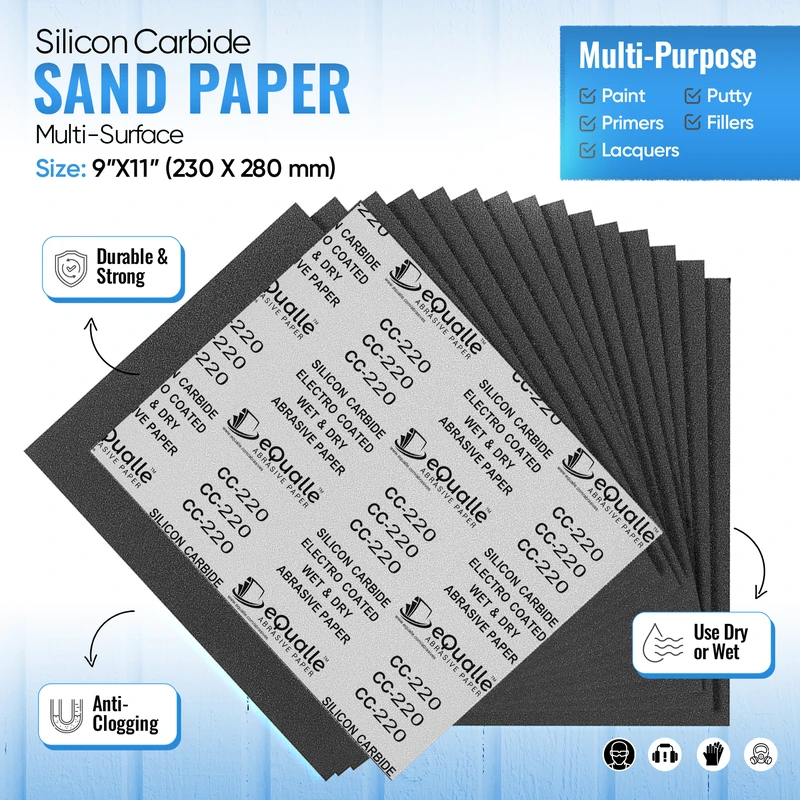
220 Grit Sandpaper Sheets (100-pack) — 9x11 in Silicon Carbide Abrasive for Wet or Dry Use — Refined medium-fine abrasive for final surface leveling on primed or sealed materials. Great for smooth touch-ups before finishing. (Professional Grade).
Frequently Asked Questions (FAQ)
Q: Should I always start with a sanding block on flat panels?
A: Yes, for leveling and consistency. Begin with a block at 120–150 grit to remove mill marks and highs. Once flat, you can hand-sand at 220–320 for a final touch if needed.
Q: When does bare-hand sanding risk over-rounding edges?
A: Anytime you linger along a sharp arris. Prevent this by marking edges with pencil, using very light pressure, and limiting passes to one or two with 220–320 grit.
Q: What’s the best sanding block material for general use?
A: A medium-density cork or rubber block is the most versatile. Pair it with a harder wooden or acrylic block for dead-flat work and a soft foam block for gentle contours.
Q: How high should I sand before applying stain or paint?
A: For stain on hardwood, stop at 180–220 on flat fields to maintain absorption; hand-sand edges to 320. For paint or primer, level with 220–320 on a block and polish edges by hand with 320–400.
Q: How do I avoid swirl marks when switching techniques?
A: Keep paper fresh, vacuum between grits, finish with the grain, and use the block for the final passes on broad flats. Reserve bare-hand strokes for blending and profiles, not large fields.