
PSA Sanding Discs vs Hook and Loop: Smart Use Cases
Saturday light spills across your bench. The coffee’s gone cool, but your focus is warm and steady. You’re halfway through a maple tabletop—the kind of project where each pass of the sander either reveals depth and clarity or buries it under tiny scratches you’ll chase for hours. You pause with a fresh disc in your hand, the choice still nagging: pressure-sensitive adhesive (PSA) or hook and loop. You’ve heard the arguments in every shop and forum. PSA sanding discs promise the firmest connection and dead-flat contact; hook and loop offers quick swaps and forgiving feel across curves and edges. Today, it isn’t about brand loyalty. It’s about getting this surface right the first time.
Maybe you’ve had hook and loop pads fuzz out after a long session. Maybe a PSA disc lifted at the edge, leaving a whisper-thin ridge you had to sand away. Tools have a way of teaching us, and sanding teaches patiently—one grit at a time. The right choice here isn’t theoretical; it touches the way you hold the machine, the heat that builds under your hand, the way dust clears through the holes, and the pattern your eyes can’t always see but your finish will magnify. Early in your process, while the surface is still unsteady and the grain is rising, you’re managing risk as much as material.
Here’s the quiet truth: both systems are capable. The difference shows up when you match their strengths to your work. Flat panel? Large disc grinder? PSA’s rigid bond can be the difference between flat and almost flat. Complex curves, frequent grit changes, finish sanding on a random orbit sander? Hook and loop keeps you nimble and clean. Rather than pledge allegiance, you build a small, smart routine for each. The goal is a surface that reads calm even under bright light—and a process that leaves you the energy to appreciate it.
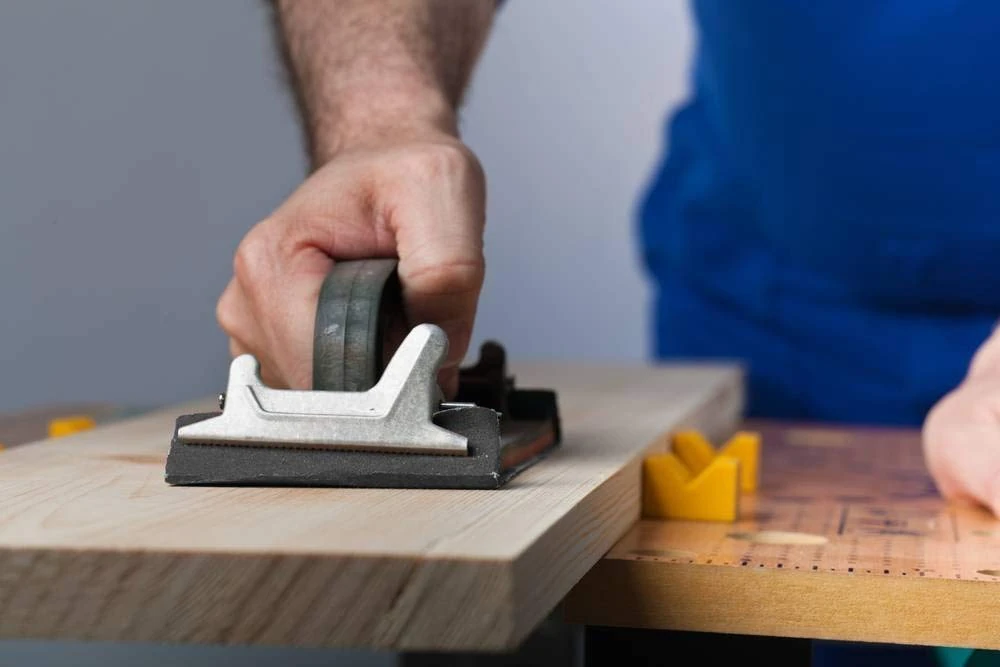
Quick Summary: Use PSA for rigidity, flatness, and heavy stock removal; use hook and loop for quick grit changes, curves, and finish passes—choose based on task, not habit.
Feel, grip, and the sanding interface
Every sanding choice boils down to one interface: abrasive against work, driven by a pad. A PSA disc bonds directly to the pad with a thin adhesive layer. That bond is stiff and short—there’s almost no cushion between pad and paper. Hand on the sander, you feel that as immediate response and slightly higher feedback. There’s less vertical compliance, so the abrasive rides flatter on a calibrated platen or disc. It’s why PSA is favored on large disc grinders and platen sanders where geometry matters. Microscopic deflection is lower, which can translate to more uniform scratch depth across the face of the disc.
Hook and loop, by comparison, introduces a fabric layer and tiny plastic hooks. That adds a touch of spring. The system is more forgiving across edges and contours because the backing can flex before the grain digs in. On a random orbit sander, this cushion helps prevent hard spots and reduces the risk of edge burn-through. It also interrupts vibration a bit, which some users find less fatiguing during longer sessions. The tradeoff is micro-chatter risk when the hook field ages or gets clogged with dust, and slightly less crisp flatness on a dead-flat platen.
Heat and dust extraction deserve attention, too. PSA’s thin bond transmits heat efficiently into the pad; on heavy cuts, that can raise pad temperature. Good dust extraction and a clean, flat pad face are critical to avoid adhesive softening. Hook and loop pads can run a touch cooler because the air space around the loop layer improves airflow, and many pads are designed with channels that encourage dust evacuation. On the other hand, a worn hook face diminishes grip, increasing slippage and heat.
In short: PSA is the rigid bridge for transferring power and holding geometry; hook and loop is the adaptable hinge for surfaces that change under your hand. Your choice starts with the workpiece, not the box.
When to choose psa sanding discs
PSA thrives when you need maximum contact fidelity and don’t plan on frequent disc changes. If you’re flattening end-grain cutting boards on a disc sander, squaring joinery cheeks, or leveling epoxy flood coats, that tight bond helps the abrasive sit uniformly across the surface. There’s no hook layer to compress, so you read the platen more closely. On metal work—deburring machine-cut edges or refining a bevel—PSA’s secure grip resists high shear forces and maintains tracking even at aggressive feed rates.
Large disc grinders (12–20 inches) are another natural home for PSA. The large rotating mass and wide sweep magnify any pad compliance. A PSA-backed paper adhered to a machined steel disc gives a rigid, predictable platform for truing edges and sneaking up on angles. In solid-surface fabrication—Corian, HI-MACS—PSA helps keep edges flat and seams tight. Automotive bodywork is mixed: for initial shaping on a rigid block or a hard backup pad, PSA is crisp; for blending contours, hook and loop wins later.
Real-world example: You’re truing the end of a cherry table leg on a 12-inch disc sander with a miter gauge set to 90 degrees. PSA keeps the abrasive face from “tilting away” at the last moment, preserving square across the entire face. Or switch to countertops: you’ve got a high spot in a poured epoxy coat. PSA on a hard interface pad lets you level the bump without dishing the surrounding area.
Five actionable tips for PSA success:
- Clean the pad face with mineral spirits and a lint-free rag before applying a new disc; any dust ridge can telegraph into your work.
- Warm the pad slightly with a heat gun on low for 10–15 seconds on cold days; mild warmth improves adhesive wet-out.
- Roll on the disc from the center out with a J-roller or a hardwood block to squeeze out air and seat the edge.
- Score the disc’s edge lightly with a plastic putty knife before removal; this minimizes pad stress and prevents adhesive tearing.
- Store spare PSA discs flat with parchment paper separators in a zip bag, away from heat and sunlight, to preserve adhesive tack.
Where hook and loop shines
Hook and loop shines when your workflow demands frequent grit changes and when the surface isn’t flat or predictable. Finish sanding on a random orbit sander is the classic case: you may climb the grit ladder—80, 120, 150, 180, 220, 320—sampling how the wood responds and adjusting to defects that appear under raking light. Swapping discs in seconds keeps you in the flow. The integrated cushion also reduces the chance of faceting on curved profiles like cabriole legs, chamfers, or crown molding.
Dust management is often better with hook and loop systems because the pads and discs are engineered together with matched hole patterns and air channels. Clean abrasives cut cooler and last longer, especially with stearated papers designed to resist clogging in resinous woods and paints. The lower profile of PSA can run cooler in theory, but in practice, well-vented hook and loop pads often win in a ROS environment thanks to steady airflow and fewer obstructions. Another win for hook and loop: specialty interface pads. Adding a 1/8-inch or 1/4-inch foam pad between the sander and the disc lets you blend contours and feather edges without introducing flats.
For touch-up work—knocking back dust nibs between coats, easing a profile, clearing mill marks on frame parts—hook and loop reduces the friction cost of experimentation. You can flip between a fresh and a used disc of the same grit to compare scratch quality, or keep a dedicated “break-in” disc for pre-finish scuffing. The tradeoffs are predictable: the hook face will wear and can accumulate dust, reducing grab over time. Replace pads when discs start to slip or “walk,” and avoid cheap discs with thin loop fabric that sheds.
According to a article, many woodworkers prefer hook and loop for random orbit sanders due to its speed of change and pad longevity, reserving PSA for fixed-disc machines and flat work.
Cost, lifespan, and surface quality
Choosing between systems affects more than feel; it shapes your cost and finish trajectory. PSA discs are often slightly cheaper per piece. They also tend to last a bit longer under heavy pressure because the backing can be stiffer (film and cloth PSA especially) and the bond doesn’t allow micro-slippage that dulls grains prematurely. But if your process involves frequent grit changes—say five or six swaps per panel—PSA’s adhesion becomes a penalty. Every peel risks curling the disc or picking up dust, making reapplication unreliable. That encourages single-use behavior, raising cost per project despite lower unit price.
Hook and loop discs typically cost more individually, but their reusability wins for iterative sanding. You can maintain a small rotation of partially used discs, labeled by grit and task, and get full value out of each. The hook pad becomes the consumable; figure on replacing it periodically. This shifts cost from each disc to the pad—a good trade if you’re finishing often. From a total cost of ownership perspective, heavy stock removal favors PSA; exploratory finish work favors hook and loop.
Surface quality (the part that shows) depends on scratch uniformity and heat control. PSA’s rigid bond helps maintain consistent grain engagement across the face, which can yield a more even scratch pattern at coarse grits. That matters when you’ll remove those scratches with the next grit; a consistent pattern is easier to erase. Hook and loop excels at the final half-dozen passes where pressure is lighter, dust is well-managed, and the slight cushion helps prevent micro-gouges across grain transitions.
Consider a simple math check: if a PSA disc removes material 10–15% faster at 80 grit due to stiffness and better contact, and you have four legs to square, that saves time and heat accumulation. But when you reach 150–220 grit on the tabletop, the ability to alternately test 180 versus 220 without fighting adhesive can prevent over-sanding and keep edges crisp. In practice, many shops keep both: PSA mounted on disc grinders and platen sanders; hook and loop on random orbit and detail sanders for everything after flattening.
Practical setup, storage, and safety
A smooth sanding day starts with setup and ends with safe cleanup. For PSA, the pad or platen must be flat, clean, and defect-free. Even a thin adhesive ridge from the last disc can telegraph a faint arc into your surface. If you see ghost lines repeating every rotation, stop. Peel the disc warm, clean with mineral spirits or a manufacturer-approved adhesive remover, and wipe dry. When applying a new disc, align carefully. On a random orbit pad, misaligned holes defeat dust extraction; on a disc grinder, off-center discs risk vibration and imbalance.
Removal matters. Warming the disc slightly with a heat gun on low softens adhesive and reduces pad stress. Pull steadily at a low angle rather than ripping upward. If residue remains, let the pad cool fully before cleaning—soft foam can tear if you work it while warm.
Storage is simple and often overlooked. Keep PSA discs flat, cool, and dry, using parchment or the original release liner. For hook and loop, store them dust-free in envelopes or clear sleeves by grit; fine dust on the loop reduces grip and can contaminate finishes. Label the backs with a marker: “Fresh,” “Broken-in,” or “Finish-only” to avoid accidental cross-use with coarse tasks.
Safety is the quiet foundation. Wear hearing and eye protection and a respirator appropriate to the material; epoxy and MDF dust are not “just wood.” Use dust extraction whenever possible; better extraction means cooler discs and longer life. On large disc grinders, check that the disc is fully adhered and the table square and clear. Keep fingers out of the exit path and maintain a light, controlled feed; forced pressure only loads the disc and burns the work.
Finally, be deliberate with pressure. Let the abrasive cut. Excess force folds edges, overheats adhesive, and drives swirls deeper. Your hands should feel the machine floating, not fighting.
Kalamazoo DS20 Disc — Video Guide
A 20-inch disc grinder is a masterclass in why rigidity matters. In a demonstration of a Kalamazoo industrial disc grinder, you can see the machined steel plate spin with remarkable stability. The machine is designed for PSA adhesive-backed sanding discs, and the choice is purposeful: the thin adhesive layer keeps the abrasive flat to the disc, so angles and edges can be trued with confidence.
Video source: Kalamazoo DS20 Disc Grinder - Trick-Tools.com
80 Grit Sandpaper Sheets (50-pack) — 9x11 in Silicon Carbide Abrasive for Wet or Dry Use — Durable coarse sandpaper made with Silicon Carbide for fast stock removal and surface leveling. Excellent for woodworking, metalwork, and fiberglass preparation. Works effectively for both wet and dry sanding before moving to 120 grit. (Professional Grade).
Frequently Asked Questions (FAQ)
Q: Can I use PSA discs on a random orbit sander designed for hook and loop?
A: Only if you swap to a PSA-specific pad made for your model. Sticking a PSA disc onto a hook and loop pad usually fails quickly and can damage the hooks. Use the pad the tool was designed for or change pads intentionally.
Q: Do PSA discs leave adhesive residue on the pad or the workpiece?
A: They shouldn’t when applied to a clean pad and kept within normal heat ranges. Residue on the pad is often from high heat or old adhesive. If you see transfer to the workpiece, stop—clean the pad, reduce pressure, and improve dust extraction to lower temperature.
Q: Which system lasts longer in heavy sanding—PSA or hook and loop?
A: In aggressive cuts on flat platens, PSA typically lasts longer because the backing and bond resist slippage. In finish sanding with frequent grit changes, hook and loop often delivers more usable life per disc because you can rotate partially used discs without damaging the bond.
Q: How do I prevent swirl marks with either system?
A: Move slowly, overlap passes by one-third, apply light, even pressure, and keep the abrasive clean with good dust extraction. Step through grits without skipping, and vacuum or tack-wipe between stages to remove stray abrasive particles.
Q: What backing should I choose—paper, film, or cloth?
A: Paper is economical and fine for wood. Film backings provide consistent surface finish and resist edge tear-out, great for higher grits. Cloth handles heat and heavy pressure well, making it a strong choice for metal and coarse grits on rigid setups.