
Hand Sanding With the Grain: Direction That Wins
The first pass across the old walnut dresser felt almost sacrilegious. Early light from the shop window caught the cathedral patterns in the veneer and made the scratches I’d inherited glow silver against the warm brown. Years of hasty refinishes had left low, cross-grain swirls that refused to disappear under fresh film. I set the random-orbit sander aside, reached for a cork block, and let the board tell me where it wanted me to go. In that moment, hand sanding was not about nostalgia—it was about control. Fingers learned the flow of the fibers, eyes trained on the raking light, strokes tracking the grain like a compass needle finally finding north.
If you’ve ever thought you could bury cross-grain scratches under a heavier finish, you already know the disappointment of witness lines that telegraph through stain and clear coat. Grain direction isn’t a superstition; it’s physics and anatomy. Wood is anisotropic—stronger and more elastic along its fibers than across them. When you cut across the fibers with an abrasive, you create torn pores and scratches that look fine at 120 grit but reappear like ghosts after dye, sealer, and topcoat stack up. By aligning your pressure and scratch pattern with the grain, especially via hand sanding in the final passes, you’re not just smoothing—you’re organizing the surface at the microscopic level so it reflects light transparently rather than scattering it.
The habit is simple but unforgiving: always end each grit sequence with long, even strokes with the grain. Use a block that matches the surface stiffness; let the abrasive cut instead of your muscles. That’s the difference between wood that glows under finish and wood that looks “worked.” With the dresser, the turning point was a switch to a skewed machine pass to level, then a committed return to the grain with the block, reading every curl and reversal before locking the surface under oil. By the time the last coat cured, the walnut stopped arguing. It sang.
Quick Summary: Grain direction controls scratch visibility and finish clarity; align cutting forces and final scratch patterns with the fibers—ideally via hand sanding—to achieve defect-free surfaces.
Why Grain Direction Governs Surface Quality
Understanding why direction matters starts with wood anatomy. Wood fibers (tracheids and vessels) run longitudinally; latewood bands are denser, earlywood lighter, and rays bridge across the tree’s radius. This creates a surface that’s inherently directional. Abrasive grains cutting parallel to the fibers shear cell walls cleanly with less lateral tear-out; cutting perpendicular tends to pry and fracture them, leaving micro-fuzz and troughs that are shallow but optically loud.
Scratch orientation is equally important. A random-orbit sander creates overlapping, multi-directional arcs; while efficient for leveling, its scratch vectors include cross-grain components that stand out in reflective films and pigment loads. These lines may be invisible dry at P180 but resurface after stain because the colorant accentuates valleys, and topcoat film builds raise the scratch-to-surface contrast. Under satin to gloss finishes, even low Ra (average roughness) values can look hazy if the scratch field is misaligned with the grain, increasing scatter.
Grain reversals complicate the picture. In curly maple, ribboned sapele, or interlocked mahogany, the apparent “with the grain” direction flips every inch. Machines will pull across the rising grain and tear fibers; hand control reduces this by adjusting stroke direction and pressure in situ. Likewise, edges and end grain invite compressive burnishing rather than cutting if you push too hard with a hard backer, sealing pores unevenly and causing blotch under stain.
From a materials standpoint, the winning sequence integrates fast, controlled leveling (where some cross-grain action is acceptable) followed by orientation of the final scratch field along the fibers. That last step is non-negotiable. If you align scratch vectors with the wood’s longitudinal axis and manage grit progression correctly, your finish clarity improves because light transmission and absorption align with the fiber structure instead of fighting it.
Hand sanding as a precision control method
Machines level quickly, but they are blunt instruments near edges, profiles, veneer seams, and complex grain. Hand sanding is where you decide the final optical quality. With the right backer and technique, you govern three key variables: pressure distribution, surface conformity, and scratch geometry. Cork or medium rubber blocks distribute force evenly over flat fields, preventing finger ridges; felt faces offer slight compliance for subtle curves; rigid hardwood blocks isolate high spots for targeted leveling without dishing.
Technique matters more than effort. Set your stance so your shoulders drive long, straight strokes parallel to the grain, not your wrists. Start each grit by lightly “erasing” the previous scratch field at 45 degrees to the grain for a handful of strokes (to confirm full coverage), then shift to strictly with-grain passes to orient the final scratches. Keep the sheet taut on the block; slack paper rounds edges and telegraphs finger grooves. Use a pencil crosshatch on the surface to visualize progress; sand until the marks uniformly disappear, then stop—over-sanding polishes earlywood and undercuts latewood, creating undulation that only shows after finishing.
On profiles, switch to shaped blocks or sanding sticks that match the radius. A soft backing pad and narrow strips of abrasive let you contour without flattening peaks. For veneers, limit pressure and rely on fresh, sharp sheets—tired abrasive burns through quickly. Between coats, de-nib by hand at P320–P400 with ultra-light pressure and a felt pad; the goal is to shear dust nibs and raise flow, not alter film thickness.
Dust control is part of precision. Vacuum frequently; loaded abrasive cuts hot and smears lignin, producing “glaze” that resists stain. If you’re wet-sanding post-seal for ultra-flat finishes, use silicon carbide on a lubricated felt block, but only on fully sealed films—not bare wood—to avoid fiber swell. When perfection matters, hand sanding is the brake and the steering wheel at once.
Selecting Abrasives and Grit Progressions
Abrasive selection governs cut rate, scratch depth, and loading. Aluminum oxide is the default for wood: tough, friable enough to renew edges under pressure, and available in open-coat papers that shed dust rather than clog. Ceramic alumina cuts aggressively at coarse grits (P60–P120) and lasts longer on dense hardwoods but can be overkill for hand work unless you’re correcting mill marks. Silicon carbide leaves a very fine, shallow scratch profile and excels for between-coat sanding or wet work on sealed surfaces; it fractures sharp but loads faster on resinous softwoods.
Coatings matter. Open-coat papers reduce clogging by spacing grains—best for softwoods like pine or cedar where pitch is a problem. Stearated (non-pigmented) papers further resist loading but can disrupt dye uptake if residues remain on bare wood; vacuum thoroughly before staining. Backing stiffness (A/C/D-weight papers vs cloth) changes how force transmits; stiffer backings hold flatter planes, while J-weight cloth conforms to profiles.
Grit progression is not the place for heroics. Each jump should reduce scratch depth by roughly half. From rough mill marks, start at P80 or P100, then P120, P150, P180, and P220 for most film finishes. For open-pore hardwoods slated for dye and a clear topcoat, stopping at P180 can actually increase stain penetration and figure pop; for waterborne finishes that raise grain, plan a light water raise, dry, then a P220 pass with the grain. Avoid skipping from P120 to P220; the remaining deep scratches will not magically vanish—they’ll simply hide until the finish goes on.
Sheet layout and usage are part of the system. Cut sheets into thirds to fit standard blocks; label the back with grit and a tick mark each time you flip or rotate to evenly wear the cutting face. Keep dedicated sets for pre-finish vs intra-coat work to avoid contaminating films with coarser grit. Replace paper at the first sign of burnishing; dull grains ride the surface and generate heat, polishing earlywood rather than cutting it—one of the fastest ways to create blotchy stain behavior.
Workflow: Along, Across, and Skew to the Grain
Choosing direction is not binary; it’s staged. Start by diagnosing. Under raking light, pencil a light grid across the surface. If you see planer ripple or cup, a skewed cut is efficient: with a sander or a block, run 10–15 degrees off the grain. That “micro-cross-grain” vector reduces tear-out compared to full cross-grain while encouraging the abrasive to bite high spots. Keep strokes long and even, vacuuming often to monitor scratch transformation. Once mill marks are erased, shift to direct with-grain passes for the remainder of that grit to orient the scratch field.
A practical five-step sequence:
- Leveling: P80–P100, light skew to the grain where needed until the pencil grid vanishes.
- Refinement: P120 and P150 strictly with the grain, resetting the scratch field each time.
- Inspection: Wipe with mineral spirits or water (for waterborne workflows) to preview scratch visibility; let dry fully.
- Pre-finish: P180–P220 with a block, hand sanding with the grain, edges last with minimal passes.
- Between coats: P320–P400 by hand on a felt pad to de-nib, always with the grain and with minimal pressure.
Where grain reverses—think curly maple or ribbon stripe—the skew angle helps. Approach the “rising” side of the curl from the shallowest attack angle you can manage, and reduce pressure. On plywood or thin veneer, abandon skewing and machine passes at coarse grits; hand-control dominates to prevent cut-through. End grain is its own planet: start coarser (P80), then incrementally step through P220–P320, always backing the abrasive rigidly and sanding in small circles to level, finishing with light with-grain strokes on the adjacent long-grain to blend.
For color work, test panels pay for themselves. A quick wipe with alcohol on bare wood exaggerates scratch fields and immediately shows whether your last grit and direction were adequate. This is the time to correct—not after stain. According to a article, following the grain during sanding greatly reduces visible defects; the guidance aligns with the workflow above, especially for the final passes.
Diagnostics, Defects, and Edge Cases
Even with best practices, wood pushes back. Tear-out along interlocked grain looks like fuzzy pits; if you see it at P120, don’t just power through. Step back to a sharp P100 with a slight skew and reduce pressure. Locally re-cut the fibers, then reorient your final strokes with the grain. If fuzz persists on softwoods, you may be burnishing—your paper is dull or loaded. Swap for a fresh open-coat sheet and lighten the touch.
Veneers demand discipline. Most furniture veneers range from 0.5–0.7 mm; by the time you’ve flattened machine ripple, you’re dangerously close to the substrate. Avoid coarse grits altogether on veneer faces; begin at P150, keep to the grain, and use pencil lines sparingly for coverage checks. On edges and lippings, install a chamfer or break the edge early (0.3–0.5 mm) so it doesn’t catch and over-sand later. Hand work with a hard block preserves flatness; finger-only pressure rounds edges, inviting finish thinning.
End grain drinks finish and exaggerates scratches. After leveling to P120, climb deliberately to P220 or P320 and consider burnishing only after you’ve achieved a uniform scratch field. A light water raise, dry, then a final P320 pass with the grain of the adjoining faces can balance absorbency. For oily species (teak, ipe), avoid stearated papers before gluing; residues reduce bond strength, and heat glazing is common—use fresh aluminum oxide and vacuum often.
Hard lessons show up after finish. Witness lines across the grain under a satin topcoat indicate misaligned final scratches at too low a grit—usually you stopped at P150 or skipped to P220. Haze after dye often means you cut across latewood bands; another sign is uneven stain uptake. Build a diagnostic habit: magnify the surface at low angle, then preview with solvent to catch the problem while fixes are still cheap.
Four actionable tips to lock in the right direction:
- Map the grain: draw small arrows on painter’s tape at the board ends indicating grain flow and reversals; follow them with your final strokes.
- Use raking light: position a low, movable light source at 15–30 degrees to the surface; sand toward the light so scratch orientation is obvious.
- Pencil and progress: mark a light crosshatch each grit; do not advance until 100% is replaced by the new, with-grain scratch field.
- Edge discipline: dedicate a fresh, fine sheet (P220) for edges and make no more than 2–3 passes with a hard block to avoid rounding.
Solvent base long — Video Guide
This short field clip walks through a floor refinisher’s sequence: long gaps are filled with a solvent-based filler, the surface is sanded through a measured progression, and then multiple coats of a waterborne, natural-matte finish are applied. The emphasis is on staging—filling before final leveling, then de-nibbing between coats—to deliver a flat, low-sheen result.
Video source: Solvent base long gap filling... floor sanding...3 Coating water base, natural matt finish!
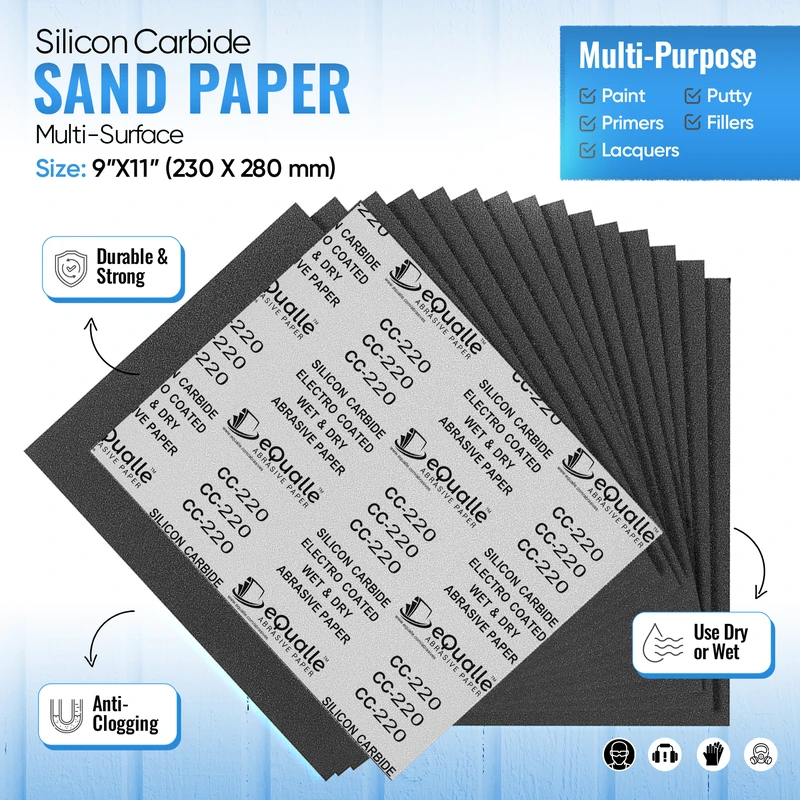
500 Grit Sandpaper Sheets (25-pack) — 9x11 in Silicon Carbide Abrasive for Wet or Dry Use — Soft-action abrasive for micro-smoothing metal, resin, or primer coatings where precision and uniformity are key. (Professional Grade).
Frequently Asked Questions (FAQ)
Q: Should I ever sand across the grain?
A: Use limited, skewed passes (10–15 degrees off-grain) for initial leveling or to remove planer ripple. Always reorient the scratch field with the grain at the end of each grit, and finish the sequence by hand with the grain.
Q: What grit should be my final pass before stain?
A: For most hardwoods, P180–P220 by hand with the grain is ideal. Stop at P180 if you want deeper dye penetration on open-pore species; go to P220 on closed-pore woods or under waterborne finishes after a water raise.
Q: How do I handle reversing or interlocked grain?
A: Reduce pressure, use sharper abrasives, and sand with a slight skew from the “downhill” side of the grain. Keep final passes strictly with the grain in the dominant direction of the surface figure; consider a scraper for localized tear-out, followed by hand sanding to blend.
Q: Why do scratches reappear after finishing even when I used P220?
A: Direction matters as much as grit. If your P220 scratches ran across the grain (common with machine sanding), pigment and film build will highlight them. Re-sand with P180–P220 by hand, strictly with the grain, under raking light to align the scratch field.
Q: How can I avoid rounding edges during final sanding?
A: Use a hard block, make minimal passes (2–3), and approach edges last with the grain. Consider pre-breaking the edge slightly early in the process to control the profile and reduce accidental roll-over later.