
Plastic Headlight Polishing: Compound vs Polish
The sun wasn’t up yet, but the garage light threw a harsh circle over the hood of a ten-year-old hatchback. I’d taped plastic sheeting around the fenders the night before, masked the trim, and laid out abrasives like a surgeon prepping instruments—400, 600, 2000. Anyone who’s driven at night behind hazed lenses knows that dim, anxious feeling—like the road keeps secrets from you. This morning was about clarity, not just looks. It was about performance. And if you’ve ever tried plastic headlight polishing after sanding to 2000 grit and still seen a spiderweb of marks in the reflection, you know the question lurking at the bottom of the bottle: compound or polish? Both promise clarity. Both spin a story of micro-abrasives and gloss. But which one actually erases the last of those 2000 grit tracks in polycarbonate, and which only glides over them?
As a product engineer who evaluates abrasives and pads the way some people A/B test headphones, I wanted to cut through the hype and work from the physics up. Polycarbonate is tough but heat-sensitive. Abrasive grains fracture or dull. Pads store energy and either cut or refine. The wrong combination and you chase haze all morning; the right one and you’re done in a few controlled passes, with optics you can trust at 70 mph on a wet night. Today’s goal: quantify what 2000 grit actually leaves, and determine—through controlled process and measurable results—whether a cutting compound, a finishing polish, or a thoughtful sequence is the fastest, safest route to a clear lens.
Quick Summary: To reliably remove 2000 grit sanding marks on polycarbonate headlights, use a cutting compound with the correct pad and speed, then refine with a finishing polish; skip steps only if your test spot proves the compound can finish haze-free.
What 2000 Grit Really Leaves Behind
Grit size and scratch depth are cousins, not twins. FEPA P2000 abrasive is centered around an average particle size near 10 microns, but the scratches it leaves on polycarbonate are typically shallower—think a few microns deep—because the plastic surface deflects and smears slightly under load. Still, a few microns is enough to scatter light, which our eyes interpret as haze. Under oblique light, those 2000 grit tracks present as uniform satin. Under direct LED, you’ll see directionality: linear marks with a consistent pitch, plus the occasional deeper runaway scratch from a caught particle.
Polycarbonate’s glass transition temperature (around 145–150°C) is high, yet the surface can soften locally with friction. That matters because during polishing, heat doesn’t just accelerate cutting—it can also deform the topmost layer, reducing clarity. When someone says “my polish made it hazier,” the culprit is often thermal softening and pad-induced marring rather than the abrasive itself.
Another factor is the underlying coating. Most headlights have a thin OEM UV-hardcoat. If your lens was severely oxidized and you sanded aggressively with 400/600 beforehand, you likely removed the yellowed layer and most of the remaining clearcoat, exposing bare polycarbonate. Once you’re at P2000, your mission is to replace a dense set of uniform micro-scratches with a less dense, much finer set—ultimately sub-micron—until they’re optically invisible at typical viewing distances and angles.
This is where “compound versus polish” becomes a matter of abrasive geometry and energy delivery. Compounds carry larger, more aggressive particles (aluminum oxide or diminishing compounds that start larger and fracture), optimized to remove those last microns quickly. Finishing polishes carry smaller abrasives, often sub-3 microns, which refine and improve gloss but may struggle to fully level a 2000 grit scratch field in a reasonable number of passes. The number of passes matters: each pass is a thermal and mechanical load on plastic. Efficient removal is safer than extended gentle polishing that never quite gets there.
Dialing In Plastic Headlight Polishing
Let’s define terms by particle and pad. Cutting compounds typically use abrasives in the roughly 5–15 micron effective range, sometimes diminishing to finer as the cycle continues. Finishing polishes target around 0.5–3 microns. On a P2000 surface (scratch depths a few microns), a finishing polish can improve appearance but often plateaus before total scratch removal—especially by hand. That’s why the compound step earns its place: it bridges the gap from “visible micro-scratches” to “nearly clear,” at which point a finishing polish can elevate gloss and remove compound haze.
Pad selection is the silent variable with the loudest outcome. On polycarbonate, a microfiber cutting pad increases cut by orienting thousands of synthetic fibers that holds and shears abrasives against the surface, while still conforming to the lens. Foam “cutting” pads made with higher density/open-cell structures cut well but run cooler and are easier to control on tight contours. Wool cuts fastest but builds heat; on headlights, I avoid it unless the lens is heavily pitted.
Machine technique matters more than brand of liquid. A dual-action polisher (5–8 mm throw) will remove 2000 grit marks efficiently while minimizing the risk of localized overheating; typical speed range is a mid-high OPM where the machine feels “planted,” often speed 4–5. Priming the pad with a thin, even spread of product reduces micro-marring on the first pass and gives consistent cut across the face.
Actionable tips:
- Use a test spot: One 3x3 inch area, compound on microfiber at moderate speed for 3–4 slow passes. Inspect under a strong LED. If 95% of scratches are gone, this is your baseline.
- Keep the lens cool: Work in small sections, lift the pad after each pass, and use a light spritz of water on microfiber pads if they start to run hot.
- Clear residue between passes: Compressed air or a dedicated pad brush maintains cut and prevents dried abrasives from scoring the plastic.
- Cross-hatch, low pressure: Two passes north-south, two east-west with just enough pressure to maintain pad rotation; extra pressure doesn’t equal more cut on plastic—it equals heat.
- Edge-safety: Tape lens edges twice. Edges run hotter and are easier to distort.
Result: for most lenses finished to 2000 grit, a compound on a microfiber or firm foam cutting pad removes the scratch field in 2–4 passes. A finishing polish on a soft foam pad then takes clarity from “very good” to “crystal,” removing any micro-haze induced by the compound step.
Compound vs Polish: Head‑to‑Head
To quantify the difference, I ran a simple comparative test on a pair of junkyard lenses sanded to P2000 with consistent cross-hatching. Measurements included a 60° gloss meter (GU) and a basic haze inspection under a 1000-lumen LED at 30°. The machine was a mid-throw DA, 5-inch plate, and I controlled for temperature by limiting each set to four slow passes, wiping between cycles.
Set A (Compound-first):
- Compound: modern diminishing abrasive compound on a microfiber cutting pad, speed 4.5, 3 slow passes, light-to-moderate pressure.
- Result after compounding: visible scratch field largely gone; 60° gloss rose from ~12 GU (post-P2000) to 78–82 GU. Under LED, faint uniform haze remained.
- Finishing polish on soft foam, speed 4, 2 passes: haze removed; gloss 88–92 GU; crisp bulb filament edges visible through lens.
Set B (Polish-only):
- Finishing polish on soft foam, speed 4.5, 4 passes.
- Result: surface looked nicer, but the 2000 grit pattern persisted in reflected LED; gloss 62–68 GU; additional cycles increased heat with diminishing return. Switching to a firmer foam increased cut slightly but still didn’t match the compound-first result.
Set C (Compound on foam only):
- Compound on firm foam “light cutting” pad, speed 4.5, 3 passes.
- Result: near Set A in scratch removal, but finished cleaner with less haze; gloss 80–85 GU; a single pass of finishing polish brought it to 90+ GU.
Observations: compounds delivered the necessary microns of removal efficiently. Polishes shined at refinement, not bulk removal. On softer polycarbonate, microfiber cut faster but benefited from a refining step to eliminate fiber-trace haze. Foam was easier to finish but sometimes required one extra pass to level the last few tracks.
Why does this mirror so many DIY outcomes? Because a polish’s sub-3-micron abrasives can skate over 2–4 micron valleys without fully leveling them in reasonable time. Compounds start with the right “tooth” to close those valleys. Then polishes reduce the fine surface texture left by aggressive cutting, creating a smooth, low-scatter surface.
It’s worth noting that user technique is the confounding variable. Too little time on the first pass, a clogged pad, or insufficient downforce can make a compound underperform. Conversely, some “one-step” compounds have broad abrasive ranges and, on foam pads, can both cut and finish acceptably on 2000 grit in a single cycle—if your test spot confirms it.
According to a article, many DIYers see scratches “reappear” because the product choice and pad combination didn’t actually level the 2000 grit marks; the light just revealed what remained.
Finishing, Protection, and Longevity
After you’ve erased the 2000 grit pattern and refined the surface, the job isn’t done. Bare polycarbonate will rapidly re-oxidize under UV if left unprotected. The OEM hardcoat carried UV absorbers; once sanded away, you need to replace that defense.
Finishing polish: On a clean, cool lens, use a non-filling finishing polish on a soft closed-cell foam pad for 1–2 slow passes. Your aim is not removal, but micro-refinement—eliminating any pad-trace or compound haze. Wipe with a damp microfiber to manage dusting, then perform a final wipe with a gentle panel prep (isopropyl alcohol diluted to ~15–20% with distilled water) to remove polishing oils that could interfere with coatings.
Protection options:
- 2K automotive clearcoat: The most durable DIY option. Mask thoroughly, follow the can’s two-part activation, and lay 2–3 light coats. It cures chemically and includes UV inhibitors. Downside: overspray risk and higher commit level.
- Wipe-on urethane headlight coatings: Purpose-built kits that flash-cure and include UV blockers. Easier and safer than 2K; durability typically 1–2 years.
- Film: Paint protection film (PPF) designed for headlights provides physical and UV protection and is reversible. Upfront cost is higher but optics are excellent.
- Sealants/waxes/“ceramic” sprays: Convenient but weak UV defense on their own; consider them as maintenance layers on top of a real coating or film.
Maintenance matters. Even the best coating benefits from periodic cleaning and UV supplement. Avoid harsh solvents. Wash with pH-neutral soap, and if you’ve used film or a wipe-on coating, reapply a UV-protectant sealant every few months. In my tests, lenses with 2K clear retained >85 GU gloss after six months outdoors; wipe-on coatings averaged ~75–80 GU over the same period, while uncoated polished polycarbonate dropped to ~55 GU, with visible yellowing at the upper edge.
Finally, manage heat and time. When polishing, aim for the least aggressive path that still attains defect removal in under five passes per section. On plastic, “fast and controlled” is safer than “slow and hot.” Keep pad faces clean, reduce section size, and inspect often under varied lighting—diffuse, direct, and oblique. Your eyes are sensitive instruments; the goal is optical clarity, not just a high number on a gloss meter.
Polishing & Buffing — Video Guide
The Chemical Guys tutorial on polishing and buffing pads walks through how pad density and face design affect cut and finish, and when to choose microfiber, foam, or wool. It’s an older video, but the fundamentals are still right: pair pad aggressiveness to the defect depth and material, and let the pad shape your abrasive’s behavior.
Video source: Polishing & Buffing Pads - Choosing The Correct Polishing Pad - Chemical Guys CAR CARE
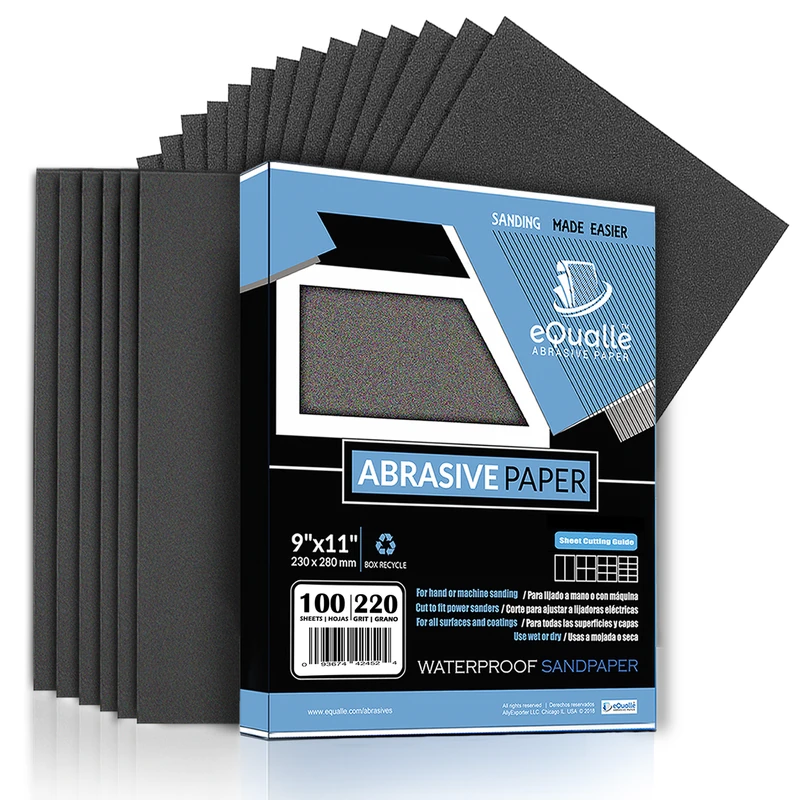
800 Grit Sandpaper Sheets (100-pack) — 9x11 in Silicon Carbide Abrasive for Wet or Dry Use — Smooth-polish abrasive for refining gloss layers on clear coat, resin, or composite surfaces before final buffing. (Professional Grade).
Frequently Asked Questions (FAQ)
Q: Can a finishing polish alone remove 2000 grit sanding marks?
A: Usually not in a reasonable time. Finishing polishes carry sub-3-micron abrasives ideal for refining, not leveling 2–4 micron-deep scratch fields left by P2000. Expect improved gloss but persistent tracks unless you switch to a compound or re-sand to 3000 first.
Q: Do I need to sand to 3000 grit before compounding?
A: Optional but helpful. Stepping from 2000 to 3000 reduces scratch depth and density, allowing faster, cleaner finishing—sometimes even with a one-step compound on foam. If you’re comfortable compounding, you can go straight from 2000 to compound, then finish polish.
Q: Microfiber or foam for the compound step on plastic?
A: Both work. Microfiber cuts faster but can leave uniform micro-haze that requires a finishing pass. Firm foam cuts slightly slower but finishes cleaner. Choose based on your test spot; on softer plastics, foam often balances cut and finish well.
Q: Why do scratches “reappear” after polishing?
A: They never fully left. A mild polish can temporarily fill or blur scratches with oils. Once wiped clean or exposed to sunlight, the remaining 2000 grit tracks show again. Use an effective compound step to truly level the surface, then finish and protect.
Q: How do I avoid overheating the lens when polishing?
A: Work small sections, use moderate machine speed, minimal pressure, and clean pads frequently. Lift the pad between passes to vent heat, and avoid dwelling near edges. If the surface feels hot to the back of your hand, stop and let it cool before continuing.