
Profile Sanding: Trim Details Without Rounding Over
A Saturday morning, coffee cooling on the bench, I’m staring at a stretch of 1920s casing that’s seen one too many paint jobs and a hard century of sun. The ogee still reads elegant from across the room, but up close the quirk line is softened and the fillet is barely a suggestion. I know the story because I’ve helped write versions of it: strip, sand, repaint — and somehow every pass with paper steals the edges that make the molding sing. The fear of rounding is why many pros dread profile sanding. It’s not the effort; it’s the risk of flattening crisp geometry that took a knife or cutter just seconds to define.
So I do what I always do as a product engineer before I touch the real piece: I pull similar stock from the offcuts and set up a test panel. I pencil witness lines on the arrises, photograph the starting geometry, and bring out a selection of media — hard film-backed abrasives, foam pads, abrasive cords, and a card scraper with a slight negative rake. The goal is precision: remove finish and fuzz, not shape. In profile sanding, the materials matter as much as the hands; abrasive grain chemistry and backing compliance will decide whether ridges stay crisp or blur into mush.
I dial down the dust extractor, set a timer for each pass, and use a scale under my palm to feel what 200–300 grams of force actually is. The shop becomes quiet and incremental. And slowly, through the rhythm of light, controlled strokes, that ogee stops feeling fragile. The edges stop eroding. Profiles don’t have to be casualties of cleanup — if you control what touches them.
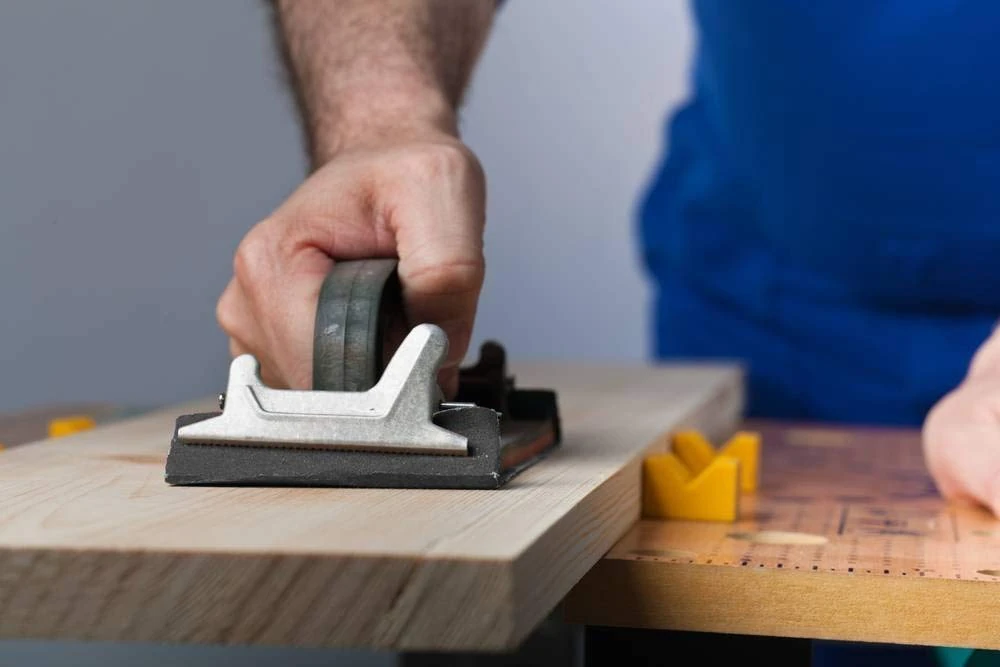
Quick Summary: Preserve trim geometry by pairing hard, profile-matched backers with controlled abrasives, minimal pressure, and frequent inspection to remove finish, not shape.
Why profiles get rounded—and how to stop it
When edges round during sanding, it’s almost never a single mistake; it’s a chain of small compliance errors. Think of every layer between your hand and the wood as a spring. Your skin, gloves, foam interface pads, flexible paper backings — each compresses and wraps around peaks. Under pressure, the abrasive preferentially cuts the high points, turning sharp edges into gentle slopes.
Three mechanisms dominate rounding:
- Backing compliance: Soft interfaces (thick foam, fingers) deflect into valleys and ride over peaks. On a small fillet, even a 2–3 mm foam pad can overcut the arris.
- Pressure concentration: Small contact areas carry high local pressure. A little extra force over an arris accelerates grain fracture and cut rate exactly where you least want it.
- Cross-grain scratch propagation: On curved transitions, abrasive motion can unintentionally track across grain directions, making scratches that you then “chase out,” removing even more material from edges.
Stopping the cascade means engineering rigidity and predictability into the contact patch. On critical profiles, I start with hard, film-backed abrasives (polyester or Mylar) and wrap them around a backer that matches the target radius or cove. If I use foam at all, it’s thin (2–3 mm) and high-density so it serves only to conform microvariations, not change macro geometry. With hand sanding, I engage more of my forearm and less of my fingers to reduce point loads. And I always use pencil witness lines on every edge — the moment a line breaks, I know I’m at risk of changing the shape.
Heat also matters. As temperature rises, binders soften and resins smear, encouraging more pressure to “make it cut,” which compounds rounding. Dust extraction and anti-loading abrasives keep the cut cool and consistent. Most importantly, move your strokes along the direction of the profile, not across it. As you follow the cutter’s path, you avoid cross-grain scratches that force extra sanding at the edges.
Finally, measurement isn’t overkill. A simple contour gauge or a 3D-printed template gives you an objective before/after. If the peak heights differ by more than a few thousandths after your test pass, your setup is too soft or your pressure too high.
Dialing in profile sanding media and grits
Abrasive selection drives how quickly you remove material and how much you load or burnish. For profile sanding, harder grains and harder backings reduce rounding. Here’s the short engineering view:
- Grain type: Aluminum oxide is the generalist — tough, blocky, and cost-effective. Silicon carbide fractures readily to maintain a sharp cutting edge and excels on finishes and between coats; it’s also less likely to tear fibers on end grain. Ceramic alumina cuts aggressively and runs cool, but on fragile profiles it can remove shape faster than you think. My go-to for cleanup without reshaping: silicon carbide films for finishing layers and premium aluminum oxide for raw wood.
- Backing: Paper backings (C or D weight) are flexible; film backings offer higher tensile strength and flatter substrates. Film-backed discs and sheets transfer pressure more uniformly and resist edge folding — this helps keep arrises crisp.
- Coatings: Stearate “no-load” coatings delay clogging on paints and primers. For raw wood, open-coat abrasives reduce heat by leaving space for dust. Mesh or net abrasives with a strong vacuum cut cool and clear, especially on resinous softwoods.
- Specialty media: Abrasive cords and laces are invaluable for tight coves and bead transitions. Look for resin-bonded silicon carbide cords in diameters that match the feature you’re cleaning. Foam-backed “contour” pads are fast on broad, convex shapes; choose high-density, thin foam to minimize rounding.
Grit progression is where many jobs go sideways. If your goal is preservation, start finer than you think. On paint removal where chemicals or heat guns did the heavy lifting, begin at 220–320 grit with film-backed silicon carbide and evaluate. If you must refine fresh milled wood or heavy fuzz, 180 is often the coarsest you should need on profiles. Jumping to 120 or 80 grit on an ogee is an invitation to re-shape it.
I test abrasives on a mocked-up offcut first. I draw a grid of pencil lines across every arris and run timed strokes with measured pressure, vacuum on, then check a contour template. If the pencil breaks before the scratch pattern clears, I harden the backer or go finer. If removal is too slow, I step one grit coarser and retest. This small calibration step pays for itself by protecting details you can’t replace.
Fixtures, blocks, and custom backers that fit
The fastest way to avoid rounding is to prevent the abrasive from deciding the geometry in the first place. That means using a rigid shape to carry the grit so the tool, not your fingers, defines the cut.
H3: Make a mirror block
- Casting a backer: Apply release tape to a clean section of your trim. Build a shallow dam with hot glue, then cast a thin shell using fast-setting epoxy or even Bondo. Once cured, reinforce the back side with a wood handle. Now wrap film-backed abrasive around this “negative” and you have a rigid, perfect-fit block that kisses only the intended surfaces.
- Thermoplastic option: Low-melt moldable plastic (PCL) softens in hot water. Press it against the protected molding to form a custom tool, then let it harden. It’s dimensionally stable enough for controlled sanding; reheat to tweak as needed.
- 3D print it: If you have the profile in CAD (trace with calipers and a profile gauge), print a PLA or PETG block with a sacrificial rubber or cork face to grip the abrasive. PLA keeps edges crisp; flexible TPU for the face can be kept very thin to avoid rounding.
H3: Off-the-shelf helpers
- Dowel and strip sets: For beads and coves, assemble a kit of dowels, hardwood strips, and short lengths of PVC pipe in common radii. Wrap abrasives around them for instant profile control.
- Profiling scrapers: Grind and burnish a card scraper to the negative of your molding. A sharp scraper removes fuzz without changing geometry and is unrivaled for crisp quirks and fillets.
- Interface control: When using power tools like a detail sander, swap to a hard interface pad or even an aluminum or phenolic platen where possible. Soft hook-and-loop adds compliance; minimize it on sensitive features.
Your process improves with one more habit: template checks. Make a thin template by pressing a contour gauge into an undamaged section and tracing it onto stiff card or 1 mm plastic. After each sanding step, quickly compare. When the peaks match and you’re only cleaning the flats, you’re safe; if peaks start to drop, stop and reassess your backer or grit.
According to a article.
Process control: strokes, pressure, and inspection
With the right media and backers, your technique closes the loop. Think like a machinist running a fragile setup: minimize forces, control direction, and measure often.
H3: Strokes that follow the profile
- Align motion with the cutter path. On an ogee, move parallel to the edge, working each segment separately rather than sweeping across transitions. Avoid rolling your wrist at arrises; let the backer lift and reset instead.
- Short strokes over features. Long strokes cross multiple radii and concentrate wear at the highest point — usually an arris. Keep strokes local and straight.
H3: Pressure tuning and timing
- Use less force than you think. On sensitive profiles, I aim for 200–300 gf (grams-force). You can calibrate this feel by pushing on a small kitchen or luggage scale until it reads the target weight; memorize the sensation.
- Counted passes. Run in small sets (e.g., 5–10 strokes), then inspect under raking light. Timed sessions prevent the “one more second” that turns cleanup into rework.
- Pencil witness lines. Shade the edges and high spots lightly. Sand until the lines just begin to fade, then stop. If lines vanish too quickly, your setup is too aggressive.
H3: Inspection and dust control
- Raking light and magnification reveal fibers, swirl, and edge loss earlier than you can feel it. A bright LED at a shallow angle will show whether you’re flattening a bead.
- Extraction on and net abrasives keep the cut cool and consistent. Dust itself is an abrasive; leaving it under the paper increases local pressure at edges and accelerates rounding.
Actionable tips to implement today:
- Tape as a sacrificial guard: Apply two layers of painter’s tape along sharp quirks before sanding adjacent flats. The tape preserves the arris by absorbing incidental contact.
- Pre-seal end grain: On profiles with exposed end grain, wipe a 1:1 shellac wash coat first. It stiffens fibers and reduces snagging that tempts heavier grits.
- Use abrasive cords for tight coves: Saw a shallow relief kerf in a scrap of hardwood to guide the cord; this keeps it centered and prevents it from riding up and easing the edge.
- Negative-rake scraping first: Before any abrasive, pull a negative-rake scraper along the profile to remove nibs and flatten dust pimples with minimal shape change.
Material-specific strategies for paint and stain
Not all trim behaves the same. Material and finish stage determine what the profile will tolerate and which abrasive chemistry works best.
H3: Painted and pre-primed MDF MDF profiles are easy to round because the core is friable and edges crush under pressure. Work almost exclusively with film-backed silicon carbide at 220–320 grit between coats. Use hard backers and avoid foam entirely on sharp details. Where you cut through primer to raw MDF, reseal immediately with primer to re-harden the fibers before returning with a finer grit. Mesh abrasives shine under vacuum, keeping dust from packing into the soft surface.
H3: Softwoods (pine, fir) with stain or clear Resinous softwoods fuzz on curves and bruise at edges. Start with a very sharp scraper to remove raised grain, then go to 180–220 grit aluminum oxide on a hard backer. Pre-raise the grain with a light water wipe, dry, then sand once — this reduces repeated passes that cause rounding. Keep extraction high; heat softens pitch, which smears and encourages more pressure. On convex beads, a thin, high-density foam interface can help avoid flats, but keep it minimal and check witness lines often.
H3: Hardwoods (oak, maple) and open pore considerations Hardwoods tolerate a touch more pressure but also highlight rounding with crisp shadow lines. Use film-backed abrasives from 180–320 grit; silicon carbide films leave a refined scratch that takes dye evenly. On oak profiles, avoid cross-grain scratches that will telegraph under dye; stroke along the feature. If you’re pore-filling, sand the filler flush with rigid blocks only — flexible foam will dish between latewood and earlywood at edges.
Between coats on any finish, step one grit finer than the previous raw-wood pass and use as few strokes as necessary to de-nib. Your target is surface refinement, not profile change. Keep a clean brush or tack cloth to remove dust before inspection; stray particles under paper act like rogue 60-grit on fragile arrises.
The Best Sanding — Video Guide
Greg Hampton’s shop test of SurfPrep’s oversized foam pads shows why pad size and density matter when working across complex trim. He runs a variety of profiles with the new large-format foam, highlighting how the extra overhang reduces pad-edge marks and helps reach into shallow coves with fewer passes. The takeaway is speed with control — provided you understand foam compliance.
Video source: The Best Sanding Pads for Profiles
120 Grit Sandpaper Sheets (100-pack) — 9x11 in Silicon Carbide Abrasive for Wet or Dry Use — Refines surfaces after coarse sanding by removing scratches from lower grits. Consistent performance on wood, drywall, and metal. Ideal for wet or dry finishing before applying primer or stain. (Professional Grade).
Frequently Asked Questions (FAQ)
Q: What’s the single best way to avoid rounding over trim profiles?
A: Use a rigid, profile-matched backer with film-backed abrasives, apply very light pressure, and sand along the profile with frequent visual checks.
Q: Which grit should I start with on delicate, painted molding?
A: Begin at 220–320 grit silicon carbide film to de-nib or scuff. Only step coarser if you confirm with a test piece that you can do so without changing the shape.
Q: Are foam pads safe for profile sanding?
A: Thin, high-density foam can help on broad curves, but thick, soft foam rounds edges quickly. Prefer hard backers on sharp details and use foam sparingly.
Q: How do I sand a tiny cove without flattening adjacent beads?
A: Use abrasive cords sized to the cove and guide them in a shallow kerf in a scrap block to keep the cord centered. Keep strokes short and pressure minimal.
Q: Can a scraper replace sandpaper on detailed profiles?
A: Often, yes. A negative-rake or profiled card scraper removes fuzz and nibs with excellent control and no scratch pattern, preserving crisp edges before any light sanding.