
Epoxy Sanding: Quick Polish at 2000–3000 Grit
You set the project down with both hands, the way you place a full coffee mug on a brand-new table—carefully, like it could bruise. Yesterday it was a cloudy slab: dust nibs, tiny ripples, a faint orange peel. Today, it’s close. Under the shop LEDs, you can already see straight lines in the reflection, but not a perfect mirror—still a little fog, still a couple of shallow witness lines that your eyes keep returning to. The moment is tempting: grab a compound and try to bully the gloss into existence. But you’ve done this long enough to know that shine doesn’t come from polish alone; it’s earned in the scratch pattern. This is where epoxy sanding decides whether you’ll be buffing for minutes or for hours, whether the finish will hold up in sunlight or betray you with haloed swirls.
You wipe the surface clean and let your fingertips skate across the resin. It’s cured, but not brittle; you can feel the micro-topography in the drag of your hand. A random-orbit pad in your right palm, a spray bottle in your left, and a stack of film-backed sheets in measured steps—800, 1500, 2000, 3000. The plan is simple: refine to 2000–3000 for a quick polish, no heroic compounding, no chasing your own tail. Crosshatch, flood, squeegee, read the panel, adjust. The finish is not a mystery so much as a system—abrasive selection, stroke rate, pad density, pressure control—each one a lever you can feel but not always see until the light hits just right.
By the time the compound comes out, it should feel almost ceremonial: a kiss of gloss on a surface already shaped by the grit beneath it. You’ll lock the foam pad in, jog the polisher to life, and watch the reflection lift—not because you pushed harder at the end, but because every step before it was clean, disciplined, and consistent.
Quick Summary: The fastest path to a high-gloss resin finish is disciplined scratch refinement to 2000–3000 grit, tight wet-sanding technique, and minimal, targeted polishing.
From Cure to Clarity: Know When to Sand
Perfecting a finish at 2000–3000 grit starts long before you touch fine abrasives. The first decision is timing: sanding too early churns gummy residue and clogs abrasives; sanding too late wastes cycles fighting a fully hardened surface. Most tabletop epoxies reach a workable window around 24–72 hours at 70–75°F, where the resin is fully tack-free, has passed the soft “green” stage, and resists edge tearing. If the manufacturer lists a recoat-without-sanding window, you’re probably still too early for aggressive leveling work. Aim for a state where a fingernail won’t dent and a fresh paper towel dragged across the surface leaves no trace.
If your system is prone to amine blush, remove it before any abrasive touches the panel. Blush is water-soluble; a warm water rinse with a non-scratch gray pad and a drop of dish soap lifts it cleanly. Avoid solvents at this stage, which can smear contaminants into pores. Dry thoroughly and inspect under raking light. Note dust pimples, sags, or fish-eyes—these defects will dictate your starting grit and whether you spot-level first.
Flatness determines efficiency. A flexible foam interface pad will track subtle ripples but can mask low spots. For true leveling, start without an interface on a hard pad until the surface reads flat, then add foam for your refinement steps. Match your tool to the task: a 5 mm stroke random-orbit (RO) sander at moderate orbits per minute (OPM) prevents deep pigtails and promotes a uniform scratch. Keep the pad trimmed and the surface clean; dragging debris into your cut is the fastest way to embed random deep scratches that you won’t find until you hit 3000.
Finally, choose a starting grit appropriate to your surface quality. Light orange peel or uniform satin can often begin at P1000–P1500. Pronounced texture, nibs, or small runs require P600–P800 to establish flatness. The goal is not to get “shiny” early—it’s to build a controlled, even scratch field that you can reliably erase with two subsequent steps.
Dialing In Epoxy Sanding at 2000–3000 Grit
Once the surface is flat and consistent, epoxy sanding becomes a study in scratch geometry. The rule is simple: never jump more than 2× in grit size, and make sure each step completely erases the last. A streamlined resin workflow often runs P800 → P1500 → P2000 → P3000. That sequence is intentionally tight. P800 establishes flatness and removes peaks. P1500 normalizes the field and collapses the depth of the 800 scratches. P2000 gets you into a range where polishing compounds work quickly without heat buildup. P3000 makes the final polish a few light passes rather than a cut session.
Run the 2000–3000 steps wet. Add a single drop of dish soap per spray bottle to reduce surface tension and keep the slurry mobile. Flood lightly—just enough to float swarf and keep the abrasive from loading. Keep the pad flat with consistent arm speed and go crosshatch: one set of overlapping passes lengthwise, one set widthwise. Every two or three passes, pause and squeegee the panel clear. Reading the scratch pattern through a thin water film is the most reliable way to confirm you’ve fully erased the prior step.
Use film-backed abrasives or resin-bonded foam-backed discs at these grits. They cut cleaner, last longer, and are far less likely to shed grit that causes rogue scratches. With 2000, aim for quiet, uniform sound and feel—if you hear chirps, you have debris under the pad. With 3000, don’t chase gloss on the sander; you’re building a pre-polish surface, not finishing. What matters is uniformity: an even, fine haze that brightens uniformly under a ragged-edge beam of light is the right landing zone for compound.
Pressure and speed discipline pay off here. Let the abrasive do the work at 2–3 lb of downforce; too much pressure collapses the pad and imprints tool marks. Keep the RO in the middle of its speed range to avoid thermal spikes. The result is a consistent microtexture—optically shallow and quickly converted to deep gloss with minimal compound.
Abrasives, Pads, and Pressure That Work
Surface chemistry and abrasive engineering define how quickly you reach that final polish. At 2000–3000 grit, the difference between lasting clarity and faint holograms is often the backing material and pad stack you choose. Film-backed abrasives maintain a flat cutting plane; they don’t buckle at the edges like paper, reducing the chance of edge-loading that grinds crescent scars into resin. Silicon carbide is a fast cutter and excels in wet-sanding; modern ceramic blends can work, but they’re often optimized for metals and can be too aggressive in the final steps. Foam-backed finishing discs (Trizact-style) at 3000 distribute pressure extremely evenly, shaping micro-scratches rather than gouging them.
Interface foam matters. A 3–5 mm medium-density pad lets the abrasive drape without over-conforming. Too soft and you mirror the surface’s subtle waviness; too hard and you print micro-facets from the sander’s orbit. On flat countertops, run without an interface through 1500, then add the interface starting at 2000 to ease transitions and protect edges. On complex shapes—river tables with chamfers, cast parts with radii—keep the interface on for all refinement steps to avoid cutting through.
A clean slurry is key. Epoxy swarf is sticky; it cakes into the abrasive and rolls under the pad as nodules that cut random deep tracks. Spritz often, wipe often, and dedicate one microfiber towel as your “read towel” to pull water and expose the pattern. Change discs the moment cutting slows or the pattern darkens unevenly; dull abrasives force pressure, which forces heat, which pushes you into polishing problems (ghosting, swirl retention, softening).
Pad maintenance on the polisher side matters, too. If you transition to a rotary or dual-action polisher after 3000, use a fresh, firm foam cutting pad with a non-filling compound. Avoid heavy fillers; they hide scratches in the shop and reappear in sunlight. With a clean 3000 surface, your compound set should be short—usually one pass at low-to-moderate speed, then a final jeweling pass if needed. If you find yourself chasing defects with compound, step back to 2000.
According to a article
Fast, Repeatable Wet-Sanding Workflow
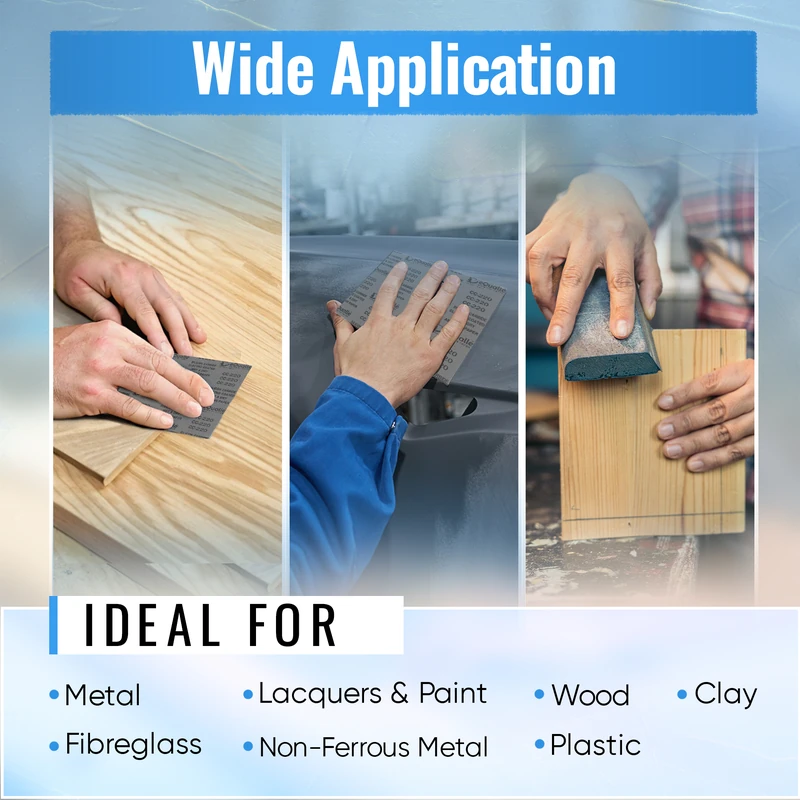
A controlled workflow saves time and ensures the 2000–3000 transition delivers a near-polish surface. Set up the bench before the tool leaves the hook: lay out grits in order, stack clean microfibers, fill your spray bottle (water + one drop of dish soap), keep a rubber squeegee and a bright raking light at arm’s reach, and mark each disc to avoid cross-use. Mask edges if your pour is thin; epoxy is easy to over-cut at corners, and edging a surface back in is slower than protecting it.
Run this sequence:
- Establish flatness. Level at P800 (dry or damp) with a hard pad and no interface. Vacuum between passes. Check with raking light and a straightedge. Do not advance until uniform.
- Normalize at P1500. Introduce light wet-sanding, add the foam interface if appropriate, and run crosshatch passes. Squeegee and read—prior scratches should vanish completely.
- Refine at P2000. Increase flood slightly. Keep the pad flat; avoid tipping into edges. Two complete crosshatches are usually sufficient.
- Finish at P3000. Use a foam-backed 3000 disc if available. One to two slow crosshatches is enough; the surface should present as an even, fine haze with crisp reflected edges.
- Polish deliberately. Wipe dry, swap to a clean polisher, and use a non-filling finishing compound. Two to three section passes should bring full gloss.
Actionable tips for speed and consistency:
- Use a squeegee after every two passes to read the scratch field; don’t trust a wet sheen.
- Keep RO speed mid-range and pressure light at 2–3 lb; more force slows cutting and adds heat.
- Replace discs the moment cutting drops off—especially at 2000; dull media creates random deep tracks.
- Edge insurance: ease into edges with one-half pad overlap from the field; never start a stroke on the edge.
- If compound struggles, step back one grit (e.g., from polish to 3000, or 3000 to 2000) rather than pushing longer at the wrong stage.
Done correctly, the 2000–3000 steps change polishing from “cut and hope” into “confirm and reveal.” The gloss arrives fast because there’s almost nothing left to remove.
Sanding 101: How — Video Guide
A clear, practical walkthrough helps translate theory into motion. In “Sanding 101: How to sand epoxy resin projects,” Alumilite demonstrates how to bring a freshly demolded resin piece from rough to refined using sequential grits, wet-sanding control, and a simple polish. The host frames common pitfalls—skipping grits, pushing too hard, and over-polishing—and shows how crosshatch patterns and slurry management make scratch removal predictable.
Video source: Sanding 101: How to sand epoxy resin projects | Alumilite
2000 Grit Sandpaper Sheets (50-pack) — 9x11 in Silicon Carbide Abrasive for Wet or Dry Use — Super-fine grit for restoring deep gloss on automotive paint, resin, or metal. Removes micro-defects and surface haze. Ideal for precision polishing prior to waxing or compounding. (Professional Grade).
Frequently Asked Questions (FAQ)
Q: Can I jump directly from 1500 to polish without 2000–3000
A: You can, but expect longer polishing time, more heat, and higher risk of visible swirls in sunlight. A quick pass at 2000 and a short 3000 step typically reduces polishing by half or more.
Q: Is dry sanding at 2000–3000 safe on epoxy
A: It’s possible with high-quality film discs and dust extraction, but wet-sanding is safer against loading and random deep scratches. The water slurry carries away swarf and stabilizes temperature, keeping the scratch pattern uniform.
Q: How do I know if I’ve fully removed the previous grit’s scratches
A: Squeegee the surface clean and inspect under raking light from multiple angles. The field should appear uniformly matte with no coarser, directional lines. If any deeper scratches persist, continue at the current grit before advancing.
Q: What if I see holograms after polishing
A: Holograms signal incomplete refinement or pad contamination. Step back to 3000, re-level the microtexture, then polish with a clean, firm foam pad and a non-filling finishing compound at low-to-moderate speed.
Q: Do I need a rotary polisher, or is a dual-action enough
A: A dual-action (DA) polisher is sufficient when you’ve refined to 3000. The DA’s oscillation reduces swirl risk and, with a quality finishing compound, quickly converts a 3000 surface to full gloss without aggressive heat.