
Cross-grain scratch removal: find flaws before finish
It’s late in the day, and the shop is quiet enough to hear your own breath. You’ve planed, scraped, and sanded a walnut tabletop into a silky plane that reflects light like calm water. The first wipe of finish goes on and your shoulders loosen—until the sheen turns and a faint zebra pattern ghosts across the surface. There they are: those fine cross-grain scratches that seemed invisible a moment ago, now stark under the finish. We talk a lot about sanding sequences, but the real craft is knowing how to find the marks you can’t yet see—and to do it before a finish locks them in forever. That’s the heart of cross-grain scratch removal: finding and fixing the tiny, off-direction lines that explode under dye, oil, or film, and keeping them from stealing focus from the piece you worked so hard to build.
Most woodworkers meet this moment at some point. You lean closer. Was that a swirl? A diagonal? You pivot a light, squint, and second-guess your grit progression. The truth is that wood, light, and finish can conspire to hide scratches until it’s too late. Different species mask or magnify them. Certain finishes amplify every flaw. And shop lighting, designed to see the whole bench, is often the worst light for seeing the micro-topography that scratches create. The good news: there are reliable, repeatable ways to surface these flaws, regardless of species or finish, and to correct them with confidence. In this guide, we’ll take you through the checks, lighting, guide coats, and sanding strategies that expose hidden scratches, plus how to read what you’re seeing so you can fix it—the first time.
Quick Summary: Use purposeful lighting, pencil guide coats, wet checks with alcohol or water, and grit-by-grit checkpoints to reveal and eliminate cross-grain scratches before finish.
Why scratches hide until it’s too late
Cross-grain scratches are sneaky because they’re not just “lines”—they’re tiny troughs that run across the wood fiber rather than with it. When you sand with the grain, you flatten and align fibers; when even a few strokes go off-track, the abrasive cuts across the fiber ends and leaves micro-facets angled to catch light. Bare, sanded wood scatters light and disguises these facets, but the moment a finish wets the surface, it fills and darkens the troughs. The result is contrast and directionality that can jump out at you, even if you never saw it raw.
Species matter. Diffuse-porous woods like maple, birch, and cherry are notorious for revealing cross-grain scratches under dye or waterborne topcoats. Ring-porous woods (oak, ash) can hide scratches within their open pores—until an oil or pigment lodges there and traces the scratch like ink. Walnut and mahogany are more forgiving under clear oils but can still betray diagonal marks under raking light or under film finishes with sheen.
Your tools can also mask or create scratches. Random-orbit sanders (ROS) reduce directional marks, but on edges and near grain transitions, the pad’s orbit can accidentally go off-grain, especially with too much pressure or a hard interface pad. Hand sanding with the grain is good practice, but a single off-hand move at a low grit can survive through higher grits if you rush the progression. And your shop light plays a role: overhead, diffuse light makes surfaces look evenly matte, which is comfortable for assembly—and terrible for inspection.
Finally, finishes amplify. Dyes wet deeply and emphasize fiber direction. Oil and shellac warm and clarify figure, but also heighten contrast within scratches. High-sheen film finishes (lacquer, varnish, waterborne polyurethane) exaggerate topography: any cross-grain trench becomes a bright or dark streak depending on your viewing angle. Knowing these dynamics explains why an obsession with “removal” is only half the story—the other half is learning to reveal the invisible, while you still have the chance to correct it calmly and cleanly.
Cross-grain scratch removal checkpoints
“Don’t move up in grit until you can prove you’ve removed the last grit’s scratches.” That’s the principle. Cross-grain scratch removal works best when you build structured checkpoints into your sanding flow, so you never chase ghosts at the very end.
Set these checkpoints every time:
- Pencil in a light, loose cross-hatch before each grit. Sand until all pencil marks are gone; what remains are low spots or scratches you missed. This takes seconds and prevents hours of regret.
- Change direction deliberately. For flattening, sand diagonally at 30–45° with a low grit to level, then switch to the opposite diagonal with the next grit, and finish with-the-grain. This pattern makes any leftover cross-grain lines obvious at each stage.
- Inspect under raking light between grits. Kill overheads if needed and use a movable light low to the surface. If you can’t see it now, you won’t see it until finish—and then it’s too late.
- “Border check” edges and transitions. Cross-grain scratches often live near end-grain-to-long-grain transitions and around knots or figure. Hand sand those areas with a fresh sheet on a soft block with-the-grain after every ROS step.
Three practical tips to lock the process:
- Use shorter sanding sessions at each grit. Set a timer for 3–5 minutes for tabletops; then inspect. Long, unfocused sessions drift and add random off-grain strokes.
- Keep a grit card at the bench. Record the last grit used and any “danger zones” you spotted. It’s easy to forget where a stubborn mark lived—your notes won’t.
- Finish each grit with 8–12 hand-sanding strokes with-the-grain using the same grit you just used on the ROS. It blends the scratch pattern and neutralizes off-grain halos caused by the machine.
By pacing your progression and checking as you go, you’ll stop cross-grain scratches from sneaking through the sequence—and keep “fixes” from turning into re-sandings.
Lighting that reveals the invisible
You can sand perfectly and still miss scratches if your lighting hides them. The right lighting turns a smooth-looking surface into a readable map of topography and direction.
Raking light is the key. Position a bright, focused light low to the surface (10–30°) and move it across your work, observing from the opposite side. A headlamp can work; a compact LED work light with a narrow beam is even better. You’re looking for bright streaks (a ridge catching light) or dark lines (a trough). Cross-grain scratches typically appear as fine, evenly spaced lines marching diagonally across the grain. Rotate the light 90° and scour again; scratches sometimes reveal themselves only from one angle.
Control glare and bounce. Overhead fixtures wash everything evenly. Turn them off or dim them while you inspect. Drape a mid-tone sheet or drop cloth behind your bench to prevent reflections. If possible, choose a high-CRI (90+) light to render wood tones and defects accurately. Color temperature matters too: cool white (5000–6500K) can sharpen the look of edges; warm light (2700–3000K) can hide them. Use both, one after the other, to cross-check.
Make a simple inspection rig:
- A small LED panel on a camera tripod gives flexible raking angles.
- A narrow-beam flashlight wrapped with a strip of tracing paper creates softer, gradient raking light that exaggerates scratches without blinding glare.
- A straightedge or card held on edge across the surface creates a controlled shadow line to scan for local troughs.
Remember to inspect at the height and angle your furniture will be seen in use. A dining table under a pendant light will reveal different flaws than a cabinet in ambient light. Move the piece if you can; bring your raking light to mimic the real setting. This habit will catch scratches that shop-only inspections might miss.
According to a article
Guide coats, wet checks, and test finishes
When your eyes and lights still leave doubt, guide coats and wet checks create contrast that scratches can’t hide in. The simplest guide coat is a soft pencil scribble—wide, loose strokes across the surface before sanding a given grit. As you sand, the pencil scuffs disappear where the abrasive contacts the high spots; any remaining pencil in tiny lines often outlines low scratches or hollows. Wipe away dust and reinspect under raking light before moving up a grit.
You can also use a dry guide coat: a whisper of chalk, artists’ pastel, or specialized dry powder on the surface. Rub it lightly, then sand. The powder clings in troughs, exposing scratch direction. This is especially useful on tight, diffuse woods like maple, where pencil lines can be hard to see.
Wet checks offer an even clearer preview of what a finish will do:
- Denatured alcohol: Wipe a lightly dampened cloth across an inconspicuous section. Alcohol flashes fast, raising contrast without swelling fibers much. It’s excellent for checking dye reactions or shellac schedules.
- Water: A light spritz will raise grain and show scratches with high clarity. Useful for waterborne finishes and when you plan to raise the grain anyway. Allow to dry fully, then de-nib with the same grit and recheck.
- Mineral spirits: Great for oil finishes. Wipe on and watch. It evaporates slower, so be patient before re-sanding.
If you need more assurance, make a micro test finish. Mask off a small rectangle with painter’s tape on your underside or a sample board from the same stock. Apply one coat of the actual finish you’ll use. Examine under raking light, then sand back when dry. This costs minutes and can save a project.
Caution: guide coats should be minimal and fully removed. Heavy pencil or pastel can embed in open pores and telegraph under clear finishes. A light touch plus thorough sanding solves this.
Tools, grit strategy, and safe repairs
Your tools and strategy determine whether you create, reveal, or erase cross-grain scratches. Start with a grit that’s honest about your surface. If you have planer or glue-line defects, begin at 80–100 grit; if your surfaces are already clean from a hand plane or scraper, 120–150 may be plenty. The mistake many make is to start too fine and spend longer burnishing in scratches instead of cutting them away.
Grit progression should be steady, not rushed: 80 → 100/120 → 150 → 180 → 220 is a safe path for most film finishes; stop at 180 for penetrating oils on ring-porous species, where over-sanding can reduce stain uptake. Avoid skipping grits, especially between 120 and 180, where cross-grain scratches often survive.
Tool choices matter:
- Random-orbit sander: Use a soft or medium interface pad on contoured or figured areas; hard pads can press off-grain. Keep pressure light; let the abrasive cut. Heavy pressure slows the orbit and scours arcs that look “cross-grain” later.
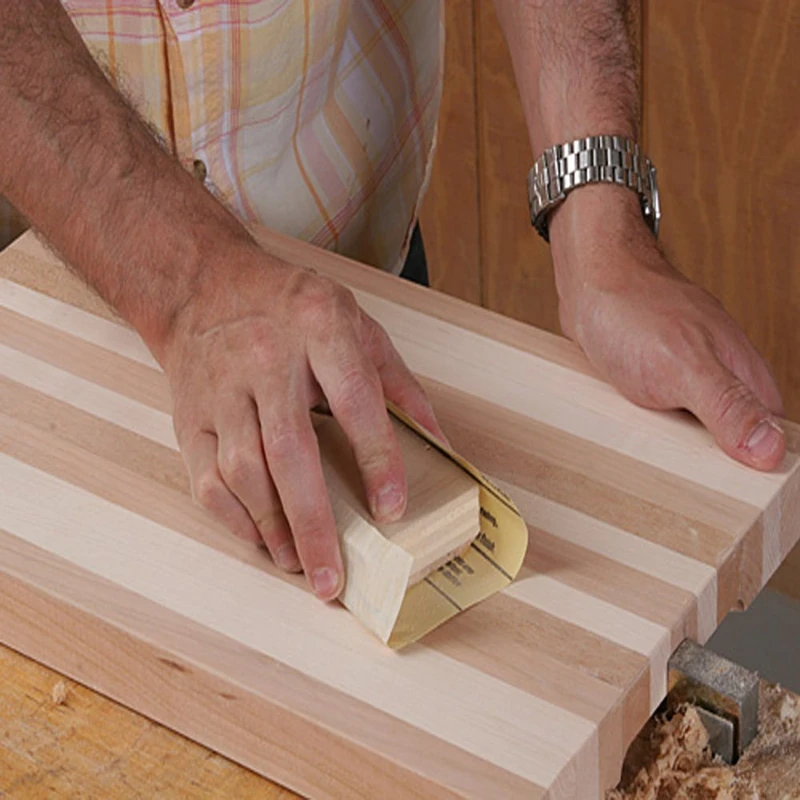
- Hand sanding: Always finish with-the-grain. Wrap paper around a cork or foam block to keep even pressure without digging into fibers.
- Scrapers: A sharp card or cabinet scraper can erase isolated cross-grain scratches quickly without re-sanding a whole field. But a dull scraper can leave its own ripples—inspect under raking light immediately after scraping.
- Drums and wide-belt sanders: Feed direction and drum condition matter. A slightly skewed feed can imprint fine crosslines. Follow machine sanding with ROS and hand passes to reestablish with-the-grain scratch patterns.
For repairs, match the method to the substrate. Solid wood gives you depth to re-sand or scrape. Veneer does not. If you discover a deep cross-grain scratch in veneer near the end, resist aggressive sanding that risks a sand-through. Target a local blend: scrape gently across the scratch to level the trough, then hand sand with-the-grain, stopping to inspect with a wet check. If the scratch telegraphs under your test finish, consider tinting a seal coat to reduce contrast rather than chasing it mechanically.
Species and finish interplay guides your final grit: maple under waterborne poly wants higher grits and meticulous scratch control; oak under oil tolerates a step earlier. When in doubt, make a test board from offcuts, run the full schedule, and inspect. Matching your strategy to wood and finish is the quiet secret of predictable results.
Alleviating Cross Grain — Video Guide
In this short demonstration, Ethan walks through how he removes cross-grain scratches using a Flatmaster drum sander, highlighting the importance of feed direction, light pressure, and a disciplined grit progression. You’ll see how a small change in setup and touch can prevent diagonal marks from printing into the surface.
Video source: Alleviating Cross Grain Scratches With a Flatmaster Drum Sander! EthAnswers
800 Grit Sandpaper Sheets (50-pack) — 9x11 in Silicon Carbide Abrasive for Wet or Dry Use — Smooth-polish abrasive for refining gloss layers on clear coat, resin, or composite surfaces before final buffing. (Professional Grade).
Frequently Asked Questions (FAQ)
Q: How can I tell if a mark is a cross-grain scratch or just figure?
A: Rotate your raking light. If the line maintains a straight path across the grain regardless of figure and changes from bright to dark as you move the light, it’s likely a scratch. Figure usually flows with grain and curves or breaks around growth.
Q: What’s the fastest way to check a large tabletop?
A: Use a bright, narrow-beam light on a tripod set low to the surface. Sweep the light slowly across the top while standing opposite the beam. Add a quick alcohol wipe to a corner if unsure, then correct with the last grit used and finish with a few hand strokes with-the-grain.
Q: Should I always sand to 220 grit to avoid cross-grain marks?
A: Not always. The right stopping grit depends on wood and finish. For waterborne finishes on maple or birch, 220 (and careful inspection) is smart. For oil on oak, stopping at 180 can yield better color. What matters more is removing the previous grit’s scratches and aligning the final scratch pattern with the grain.
Q: Are cabinet scrapers safer than sanding for removing cross-grain scratches?
A: They can be. A sharp scraper removes material precisely and can level a scratch without broad sanding. But scrapers can also leave subtle ripples if the burr is uneven. Always follow with light hand sanding with-the-grain and a raking-light check.
Q: How do I handle a cross-grain scratch in veneer close to final finish?
A: Proceed gently. Try a sharp scraper to level the trough, then hand sand with-the-grain using a fresh, fine grit. If it still shows under a test wipe, consider a tinted seal coat or glazing to reduce contrast, rather than sanding deeper and risking a sand-through.