
Stain Preparation: What Grit to Sand Furniture
On a quiet Saturday morning, you clear the dining table and pull the tarp tight. The surface is a patchwork of rings, scratches, and a few mystery stains from a previous life—nothing that an orbital sander and a little patience can’t fix. The smell of sawdust arrives quickly, and with it a deceptively simple choice: what grit to sand furniture before applying stain. There are plenty of opinions, but only one proper sequence for your species, stain type, and condition of the substrate. That decision—more than the brand of stain or even your brushing technique—will decide whether the grain pops evenly or blotches, whether the edges stay crisp or burn through, and whether your topcoat glides over a consistent scratch pattern or amplifies every swirl mark. Done right, stain preparation becomes a repeatable, almost meditative routine that pays off with reliable, beautiful finishes.
If you’ve ever had a stain turn muddy, go too dark at the ends, or highlight scratches you swore you’d removed, grit choice is the common denominator. Coarser grits open the wood and speed flattening; finer grits refine the scratch pattern and moderate stain uptake. But go too fine and you polish the fibers so much that pigment has nothing to hold onto, producing a washed-out tone. Go too coarse and stain floods the valleys and stops on the peaks—instant zebra striping. The best outcomes come from thinking in systems: substrate assessment, a grit ladder matched to the defect load, control of fiber raise, and a final pre-stain pass that equals your stain chemistry. In practice, that means dialing in the grit, feed pressure, and dust collection with the same attention you’d give to blade geometry or spray fan patterns. The reward is not theoretical—your next furniture piece will prove it.
Quick Summary: For most furniture, sand through a consistent grit ladder, finishing at 180 for oil-based wiping stains and 220 for water-based stains or dye, with end grain taken 1–2 steps finer and veneers capped at 180 to preserve thickness.
Why Grit Choice Dictates Stain Color
Sanding is controlled damage. Each abrasive grit cuts furrows that both flatten defects and create the microtexture that stain must wet and anchor. The depth and uniformity of these furrows determine how pigments or dyes distribute across earlywood, latewood, and end grain. Coarse grits (80–120) remove finish and level quickly, but leave deep troughs that trap excess pigment. If you skip straight to fine grits from there, those troughs remain underpolished and telegraph as dark streaks after staining. The solution is a consistent grit ladder—no skipped steps—so every scratch family is replaced by a finer one until the surface is uniformly conditioned.
Oil-based wiping stains rely on pigment lodging in the surface profile. A final pass at 180 typically strikes the right balance: enough profile to carry color without blotching on most hardwoods. Water-based stains and dyes behave differently. They wet more aggressively and raise grain; finishing at 220 before a “water-pop” or pre-wetting step moderates absorption and keeps color clean. Softwoods like pine complicate the picture due to variable density bands; too fine a grit can reduce contrast but may reduce blotching if paired with a conditioner.
From a process standpoint, grit isn’t acting alone. Abrasive type (aluminum oxide versus ceramic), backing rigidity (film-backed discs cut flatter), pad hardness on your sander, and your feed pressure all influence the scratch pattern. Dust extraction matters too—loaded discs cut hot and smear earlywood. The end goal remains constant: a uniform, directionally consistent profile that accepts stain evenly. Achieve that, and your stain color becomes predictable across panels, mouldings, and the end grain that normally betrays inexperience.
Building a Smart Grit Ladder for Furniture
The heart of stain-ready sanding is a predictable progression—sometimes called a “grit ladder”—that responds to the substrate’s initial condition and finish target. Start by diagnosing: Is there an existing film to remove? Are there deep scratches or flattening issues? Is the piece veneer or solid? Once you quantify the “defect load,” you can choose the coarsest necessary starting grit and plan the steps to your intended final grit.
A robust, furniture-safe grit ladder looks like this:
- Heavy removal (old finish, deep defects): 80 → 100 → 120 → 150 → 180. Stop at 180 for oil-based stains; optionally go to 220 for water-based.
- Moderate defects, no film: 100 → 120 → 150 → 180 (→ 220 for water-based).
- Light scuff, new work: 120 → 150 → 180 (→ 220 for water-based).
- Veneer: start at 120 if possible → 150 → 180 max to protect thickness.
Each step should erase the previous scratch family. Don’t skip grits; that’s the fastest way to leave hidden coarse scratches that jump out under stain and topcoat. Use a medium or hard interface pad for flattening, then switch to a softer pad for the last pass to prevent edge gouging. Sand with the grain on flats after orbital work to align the final scratch pattern, especially on open-pore woods like oak or ash.
Four actionable tips for consistency:
- Mark the surface with pencil squiggles before each pass; when they disappear uniformly, you’ve leveled that grit.
- Replace discs early; if the cut rate drops, you’ll start burnishing rather than cutting, especially at 180–220.
- Vacuum with a brush nozzle between grits and wipe with a clean microfiber; dust left on the surface works like rogue coarse grit.
- Use raking light to locate residual swirl marks; rotate the light source to catch different scratch orientations.
This grit discipline will save more stain jobs than any “miracle” conditioner or gel.
Species-Specific Stain Preparation Grits
Species governs fiber density, pore structure, and resin content; all affect how a given scratch profile absorbs stain. Match your final grit to both species and stain chemistry to avoid blotching and banding.
- Pine, fir, and other softwoods: These have dramatic earlywood/latewood density swings. For oil-based wiping stains, finish at 180 and consider a conditioner on blotch-prone boards. For water-based stain, go to 220, perform a light water-pop, then denib with a used 220 pad. Avoid over-sanding to 320; it can “polish” earlywood and mute color unnaturally.
- Oak, ash, and other ring-porous hardwoods: Large open pores accept pigment readily. 180 final for oil-based stains yields strong color. For dyes or water-based stains, 220 is appropriate. Pore-filling steps occur after staining if needed.
- Maple, birch, and cherry (diffuse-porous, blotch-prone): These species can splotch with pigment stains. Final at 180 with oil-based gel stains for better control, or 220 with dye stains for clarity. Use a light hand; too much pressure compresses fibers and increases blotch potential.
- Walnut and mahogany: Generally forgiving. 180 for oil-based or 220 for dye/water-based produces predictable results. Watch for figure that may “chatoy” differently under dye.
- Exotics (teak, ipe, padauk): Natural oils can interfere with stains. Wipe with naphtha before staining and finish 180–220 depending on the stain. Test panels are essential.
For end grain, always step 1–2 grits finer than adjoining face grain (e.g., if faces end at 180, sand end grain to 220–320) to restrain over-absorption while keeping tone aligned.
According to a article.
A few advanced controls:
- Water-pop selectively: On tight-grained hardwoods, a light wipe with water (not soaking) before your final denib pass can even out uptake for water-based systems without over-darkening.
- Condition strategically: Use a washcoat or pre-stain conditioner on blotch-prone species only when your tests show it’s needed and compatible with your stain chemistry; they can reduce contrast if overapplied.
- Sanding direction: After orbital passes, hand-sand with the grain using your final grit to align scratches. Cross-grain scratches are color magnets.
Dialing these in turns “species unpredictability” into a manageable variable.
Edges, End Grain, Veneer, and Profiles
Uniform color isn’t just about the flat fields. Furniture edges, moulded profiles, and veneered panels require dedicated workflows.
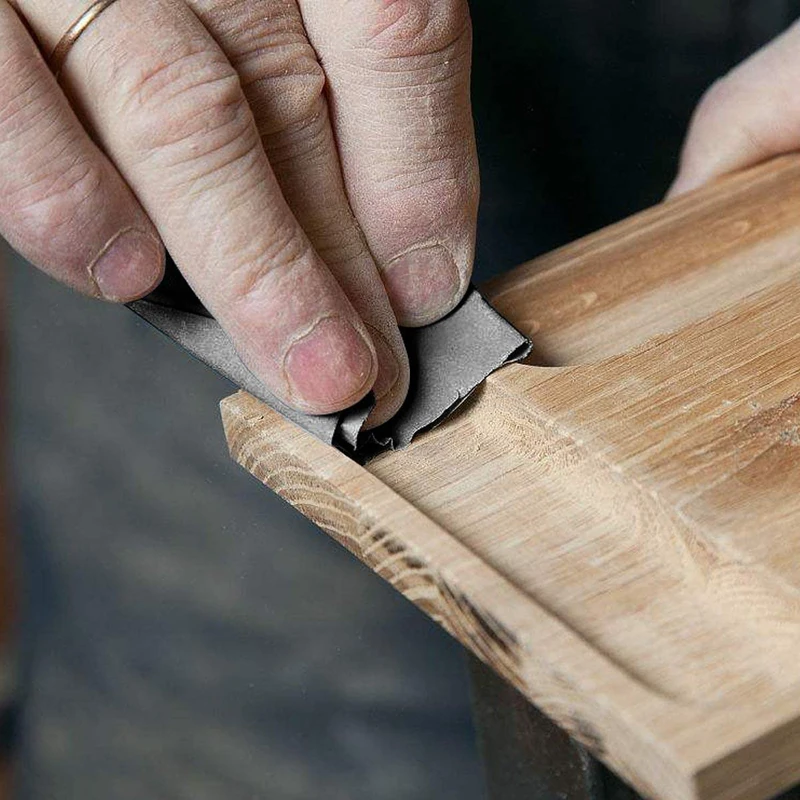
Edges and profiles: The risk is twofold—rounding over crisp lines and leaving inconsistent scratch patterns across curves. Use a soft interface pad on an orbital for profiles and lighten pressure at the arris. For sharp edges, consider a sanding block or folded abrasive sheet to maintain geometry. Keep grits synchronized: if the field is at 180, your profile should pass through the same ladder; don’t jump from 120 to 220 on a routed edge. On tight profiles, switch to foam-backed sheets at the final grit to avoid facets.
End grain: End grain wicks stain fast due to exposed vessels. To harmonize color with adjacent face grain, sand end grain 1–2 steps finer. For example, faces at 180, end grain at 220–320. After sanding, burnish lightly with a dull piece of the same grit to reduce micro-cutting edges that over-accept pigment. Test on scraps cut from your project for the closest match.
Veneer: Veneered tops and drawer fronts can be as thin as 0.5 mm. Prioritize safety over aggressive leveling. If you must flatten, use a fresh 120 on a hard pad with feather-light pressure, then 150 and 180. Stop at 180 for most stains; a brief water-pop and denib can simulate a 200–220 surface without the risk of cutting through. Avoid spot-sanding defects on veneer; mask and scrape carefully instead.
Carvings and turnings: These require hand-abrasive tools—sanding sponges, flap wheels, or woven nonwoven pads—to conform to geometry. Keep grit parity with flat surfaces to avoid tonal shifts after staining. In deep recesses, blowing out dust with compressed air before staining prevents dark “mud pits” where abrasive residue and wood flour collect.
Process controls for all details:
- Use pencil witness marks on edges to confirm even passes.
- Move the tool before touching the surface and lift off while moving to avoid “start/stop dips.”
- Clean swarf often; small surfaces load abrasives quickly and start burnishing.
These micro-areas are where a professional finish distinguishes itself—no dark ends, no halos, just continuous tone.
Quality Control: Dust, Light, and Test Panels
Even a perfect grit schedule fails if quality controls are neglected. Stain amplifies small errors, so build verification into your workflow.
Dust management: Dust acts like rogue grit and contaminates stain. Connect your sander to a high-efficiency extractor with an appropriate flow rate; use multi-hole film-backed discs to maximize capture. After each grit, vacuum the surface, brush out pores (nylon bristle on oak/ash), and wipe with a clean microfiber. Avoid tack cloths that leave residue incompatible with water-based stains. Before staining, vacuum the shop air or allow dust to settle, then wipe again.
Lighting: Use raking light at 15–30 degrees to reveal scratch orientation and low spots. LED task lights with a high CRI make defects obvious. Move both your body and the light; what’s invisible head-on often jumps out at an oblique angle. Mark defects with painter’s tape, address them, then recheck.
Moisture and raise: For water-based stains, pre-wet (water-pop) to raise grain intentionally, let dry, then make a light denib pass with a worn 220 or 320. This eliminates the dramatic first-coat fuzz that can un-level pigment. For oil-based stains, skip water-pop unless testing proves a needed color shift.
Test panels: Always build a “story stick” or set of sample blocks from the project’s offcuts. Sand them through your intended ladders—e.g., 150/180 vs. 180/220—apply the chosen stain, and topcoat a corner. Label each sample. In one look, you’ll know which final grit and sequence produce the tone you want. This is your cheapest insurance.
Four targeted tips to lock in results:
- Pressure control: Let the abrasive cut. Excess downforce closes pores and polishes fibers—especially at 180–220—leading to pale or blotchy stain.
- Time-on-surface: Count passes rather than linger; “dwelling” makes valleys.
- Disc rotation: Rotate used discs between panels to extend life but retire them early for final passes; dull final grits burnish.
- Cross-grain hand pass: On closed-grain woods, a very light final hand pass with the grain can reduce orbital swirls that telegraph under stain.
By treating sanding as a measured process rather than a chore, your stain color becomes not just better—but repeatable.
How to Stain — Video Guide
A concise video walkthrough from a professional woodworker breaks staining into four practical phases: surface prep, color application, wipe/back-brush timing, and protective finishing. It reinforces the principle that proper sanding and dust control are the foundation, with clear visuals showing how scratch patterns affect color and how timing the wipe determines depth.
Video source: How to Stain Wood Like a PRO - 4 Simple Steps!
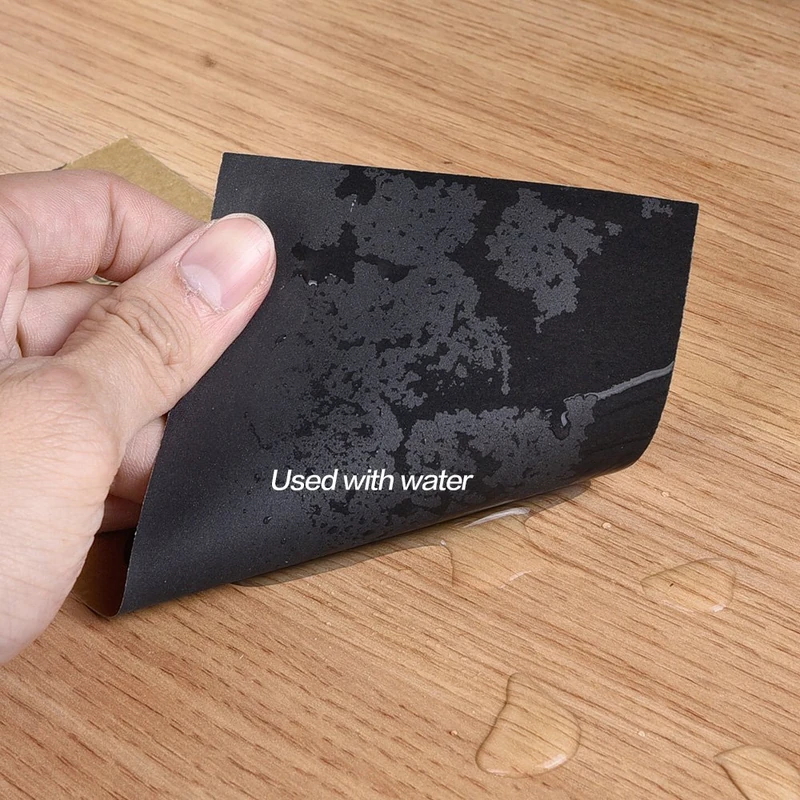
800 Grit Sandpaper Sheets (100-pack) — 9x11 in Silicon Carbide Abrasive for Wet or Dry Use — Ultra-fine grit for pre-polish refinement on paint, clear coats, or resin. Smooths imperfections without damaging the base layer. Provides optimal control when used wet or dry before 1000 or 1200 grits. (Professional Grade).
Frequently Asked Questions (FAQ)
Q: What final grit should I use before applying an oil-based wiping stain on hardwood furniture?
A: Finish at 180 grit for most hardwoods. This leaves a microtexture that carries pigment evenly without blotching. On blotch-prone woods like maple, consider a gel stain at 180, or test 220 if you prefer slightly lighter color.
Q: Should I sand to 220 before water-based stain?
A: Yes, 220 is a good final grit for water-based stains and dyes. Pre-wet (water-pop), let dry, then denib lightly with a worn 220 or 320 to control raised grain and maintain uniform absorption.
Q: How do I handle end grain so it doesn’t go too dark?
A: Sand end grain 1–2 grits finer than face grain (e.g., 220–320 if faces are 180), then lightly burnish with the same grit. This moderates capillary uptake and aligns end-grain color with the surrounding surfaces.
Q: What about veneer—can I still go to 220?
A: Use caution. On thin veneer, cap sanding at 180 to avoid sand-through. If you need the effect of a finer surface, water-pop and perform a very light denib with a worn 220 pad instead of a full 220 pass.
Q: Do I need a pre-stain conditioner?
A: Only if tests show blotching with your chosen stain on that species. Conditioners can reduce contrast. On pine, maple, and birch they can help; pair them with a final grit of 180–220 and verify on a sample block.