
Best grits for leveling primer with psa sanding discs
Saturday mornings in my garage start with coffee, a quiet radio, and a panel that still holds a map of yesterday’s imperfections. The primer is flat gray, but under a raking light you can read it like topography—little ridges around a dent repair, faint peel from a heavy pass, and that one shallow wave you only see when you step back. I’ve learned that this is where the paint job is actually won or lost, not in the clear coat. And the tools matter: the block, the sander orbit, the mineral in the abrasive, even the adhesive that bonds the disc. When I swapped to psa sanding discs on a rigid interface for the first “leveling” cut, I noticed two things right away—straighter panels and fewer surprises after sealer.
As a product engineer, I approach primer the way I approach tooling: define the target, measure the variables, and choose the grit that produces the right scratch profile without erasing too much film. Primer is a sacrificial layer designed to be shaped. Leveling it means controlling scratch depth, spacing, and direction so it acts like a true datum for paint. That’s why grit choice isn’t just “start with 400 and go.” It’s about matching abrasive size and structure to your primer type and thickness, your tool’s motion, and the goal of the next coat. The outcome is objective: flatter, faster, with minimal rework.
You can get there with a predictable workflow. In this review, I’ll break down the physics of leveling primer, test-backed grit ranges that work on urethane and epoxy systems, where psa sanding discs make measurable gains, and how abrasive minerals and tool setup change both speed and surface. The goal is simple: a surface that looks boring under light, because nothing stands out.
Quick Summary: For leveling primer, block or DA with P180–P220 to flatten, refine with P320–P400 for sealer, and use psa sanding discs on firm backing when you need the flattest, most controlled cut.
Primer physics and scratch geometry
Leveling primer is controlled material removal. High-build urethane and polyester primers typically land around 6–10 mils total dry film thickness after multiple coats; epoxy primers are usually thinner. Your abrasive’s average particle size must cut low enough to erase peel and waves, yet not so deep that it uses half your film thickness achieving flat. This is scratch geometry: depth, width, and spacing.
FEPA grit sizes provide a useful reference. P180 averages about 82 microns; P220 around 68 µm; P320 about 46 µm; P400 about 35 µm; P600 about 26 µm. If your topcoat requires a sealer at P400 or finer, you need a path that ends with a scratch depth your sealer can fill and your base can hide. P180 or P220 has the aggression to remove orange peel and level filler edges quickly, but those scratches are too deep to seal over directly. P320–P400 reduces the scratch depth into a range that sealers are designed to bury uniformly.
Tool motion matters as much as grit. A 3/32 in. orbit DA leaves a tighter, shallower pattern than a 3/16 in. orbit at the same grit. Blocking by hand with a rigid board creates long, directional scratches that reveal high/low spots much faster than a soft pad on a DA. That’s why most pros “block” the first pass and “DA” the refinement. Use a dry powder guide coat at each step. Guide coat isn’t decoration; it is the most sensitive indicator of local low spots. If guide coat persists in a valley after the highs have been hit, you’re not done leveling regardless of the grit in your hand.
The takeaway: match grit size to film thickness and tool motion so that each stage removes only the previous scratches plus a minimal amount of fresh primer. That’s how you keep film build while increasing flatness.
Choosing grits that truly level
I benchmark leveling grits using three criteria: flatness under guide coat, film build preserved, and readiness for the next coating per its tech sheet. Across urethane and epoxy primers, these sequences are consistently effective:
- Initial level: P180–P220 on a rigid block or firm interface pad. Use this only until guide coat disappears from the highs and islands are connected. The goal is shape, not finish.
- Intermediate refine: P320 to erase P180–P220 scratches. This prepares most primers for a sealer or, if specified, for basecoat on certain high-build systems.
- Pre-sealer finish: P400 (sometimes P500 depending on system). This sets a uniform, shallow scratch that sealers wet into without telegraphing.
- Wet refinement (as needed): P600–P800 silicon carbide if the manufacturer allows base over primer without sealer and you need extra assurance on visibility-sensitive colors.
If your primer stack is thin (epoxy-only, 2–3 mils), skip P180 and start with P220 lightly, or even P320, to avoid burn-through. Conversely, if you have heavy peel or a wave you can feel, don’t waste time with P320—start with P180 and block deliberately.
Actionable tips for grit selection and sequencing:
- Use guide coat at every step. If it’s not gone, don’t move up.
- Keep a known reference: P320’s average particle is ~46 µm; if you can still see coarse lines at that stage, you didn’t fully remove the P220 pattern.
- Sand dry for leveling to track the surface; reserve wet sanding for final refinement only if allowed by the product data sheet.
- Stop early and re-prime if you’re nearing through at edges; it’s cheaper than fixing feathered paint later.
Primer is not structural; it’s a shaping layer. Treat it like a machining operation with three passes: roughing (P180–P220), semi-finish (P320), and finish (P400 or P500). That mental model keeps you from overcutting at any one stage.
When psa sanding discs beat hook-and-loop
Hook-and-loop discs dominate DA sanding because they swap quickly and work with multi-hole vacuum plates. But when the objective is planar leveling—especially on flat panels, edges, or long repairs—psa sanding discs (pressure-sensitive adhesive) on a hard interface can deliver straighter results. In testing flatness with a straightedge and feeler gauges, PSA on a rigid pad consistently reduced local dish-out compared to hook-and-loop on a soft pad at the same grit.
Why? Compliance. Hook-and-loop adds a compressible layer between abrasive and backing pad. Under pressure, that cushion conforms to low areas, reducing the abrasive’s tendency to cut just the highs. PSA discs bond directly and thinly to the pad, minimizing deflection. With a hard interface, they act more like a mini-block in motion, which increases leveling efficiency at P180–P220 and even at P320.
The trade-offs are real:
- Heat and loading: PSA discs run slightly hotter and load a bit faster in dry primer, especially without vacuum holes. Blow them out often and reduce pressure.
- Dust extraction: Many PSA discs are solid. If your DA relies on through-pad vacuum, look for PSA discs with matching hole patterns or use external extraction.
- Removal: PSA adhesive quality matters. Good discs peel cleanly; cheap ones tear or leave residue. Store them flat and clean to protect the adhesive.
I reserve PSA for the roughing and semi-finish passes where control over geometry matters most, then switch to hook-and-loop multi-hole film discs for the finishing pass (P400) to maximize dust control and surface uniformity.
According to a article.
Abrasive minerals that cut primer clean
Not all abrasives of the same grit cut the same way. The mineral’s fracture behavior, coating, and backing influence scratch uniformity and disc life.
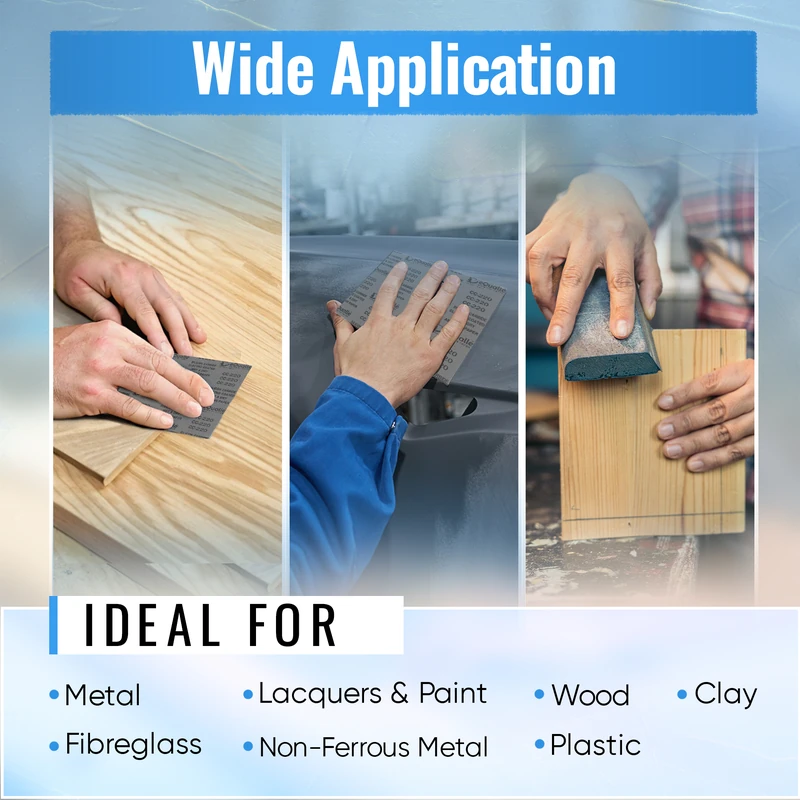
- Aluminum oxide (AO): The standard for dry sanding primer. It fractures slowly, maintains a predictable scratch, and is cost-effective. Stearated AO discs resist loading in primer by reducing resin pickup. For P180–P400, premium AO on a film backing provides consistent cut and resists edge tear-out.
- Ceramic alumina or ceramic blends: Sharper microfracture, higher initial cut rate, and longer life. In P180–P220 for aggressive leveling, ceramic blends remove high spots faster at lower pressure, which reduces heat and pilling in high-build primer. They can feel “grabby” on soft pads—pair with a firm interface.
- Silicon carbide (SiC): Brittle, fast-cutting, and ideal for wet sanding. In P600–P800, SiC makes a refined, shallow scratch that rinses clean. For dry leveling it tends to load quickly in primer; better reserved for the wet refinement stage if your system allows it.
Backing materials matter too. Paper-backed discs are economical but can curl and tear at edges. Film-backed discs maintain flatness and produce a tighter scratch distribution because the backing doesn’t deflect as much. For primer work where you’re chasing uniformity, film-backed AO or ceramic-blend discs are worth the upgrade.
Coatings and open-coat structures also change behavior. Open-coat abrasives leave air channels that reduce loading in gummy primer, while stearate coatings minimize clogging and heat. If you see “pilling” (small, rolled primer boogers) in your path, switch to a stearated disc or reduce speed and pressure. The right mineral and backing let you use a finer grit without losing cut rate, which shortens your grit ladder and preserves film build.
Tools, pads, pressure, and avoiding defects
Abrasive is only half the story; the machine-medium interface determines how that grit meets the surface. Three controllable variables matter most: orbit size, pad hardness, and contact pressure.
- Orbit: A 3/32 in. (2.5–3 mm) orbit DA sander leaves a finer, less visible scratch at a given grit than a 3/16 in. (5 mm) orbit. For leveling primer, I like 3/16 in. with P180–P220 to accelerate the roughing pass, then 3/32 in. for P320–P400 to minimize swirl.
- Pad hardness: Hard pads and hard interface layers prevent the disc from falling into lows. Use a firm pad or a 3–5 mm hard interface for the P180–P220 pass. Switch to a medium pad at P320–P400 to avoid introducing hard-edged flat spots near contours.
- Pressure: Let the abrasive cut. 1–2 kg (2–4 lb) of hand force is plenty on a DA. Overpressure increases heat and pigtail risk without improving cut rate. If the disc is spent, replace it—don’t lean harder.
Defect control is process control:
- Pigtails: Those spiral scratches come from a trapped nib or a too-soft pad with too much pressure. Blow off the panel and disc frequently; use multi-hole dust extraction; and keep the scratch shallow by stepping grits properly.
- Burn-through at edges: Tape off sharp edges during the P180–P220 pass, sand up to the tape, then peel for the P320 pass. Lower pressure and roll the DA off edges, don’t drive into them.
- Pinholes and pores: Level first, then address pinholes with a thin glazing putty after P220. Re-prime spot areas and relevel. Don’t try to “fill with primer dust”—that’s how voids telegraph through paint.
Four practical steps to lock in the finish:
- Always apply a dry guide coat before each pass; it’s your real-time map.
- Cross-hatch: Sand at 45° to panel length on the first pass, then 45° the other way on the second. On DA, overlap by one-third per track.
- Vacuum alignment: If you’re not using PSA, match hole patterns (5-, 8-, or multi-hole) to the pad to maintain airflow and reduce loading.
- Clean between grits: Wipe with a dedicated cleaner, not solvent that can swell primer. Any embedded debris becomes a pigtail generator at finer grits.
When you choose the right grit and set up the tooling to preserve geometry, the sealer stage becomes routine instead of a rescue mission.
Finish Sanding Wood — Video Guide
A solid companion to this topic is a shop video that breaks down what grit to reach before paint, stain, or clear on a guitar body. While the substrate is wood, the principles translate: you see how stopping at too coarse a grit telegraphs scratches under finishes, and how stepping correctly saves both time and coats.
Video source: Finish Sanding Wood Before Paint (GRITS and TOOLS)
150 Grit Sandpaper Sheets (100-pack) — 9x11 in Silicon Carbide Abrasive for Wet or Dry Use — Versatile medium grit that transitions from shaping to smoothing. Works well between coats of finish or for preparing even surfaces prior to paint. (Professional Grade).
Frequently Asked Questions (FAQ)
Q: What’s the best grit to start leveling high-build primer?
A: Start with P180 or P220 on a rigid block or firm interface pad. P180 removes peel and waves quickly on thicker builds; P220 is safer on thinner areas. Always use a guide coat and stop once the surface is flat—don’t chase finish at this stage.
Q: What grit should I finish at before sealer?
A: P320 to remove the coarse leveling scratches, followed by P400 (sometimes P500 per product data) to set a uniform, shallow scratch that sealer wets into without telegraphing. Confirm with your sealer’s tech sheet.
Q: Are psa sanding discs better than hook-and-loop for primer?
A: For the leveling pass, often yes. PSA on a firm pad reduces compliance, so it cuts highs instead of conforming to lows—yielding flatter panels. For the final pass, hook-and-loop multi-hole discs can improve dust control and surface uniformity.
Q: Should I wet sand primer before basecoat?
A: Only if the primer system allows it. Many urethane primers are designed for dry sanding to P400 before sealer. If wet sanding is permitted and you need extra refinement, use P600–P800 silicon carbide with light pressure. Dry the panel thoroughly and re-apply guide coat as needed.
Q: How do I avoid pigtails when DA sanding primer?
A: Use clean, quality discs; match pad hole patterns for proper extraction; keep pressure modest (1–2 kg); and blow off both disc and panel frequently. A harder pad at coarse grits plus proper grit progression (P220 to P320 to P400) keeps scratches shallow and uniform.