
Boat sanding mastery: edges, hardware, seams
The dock still smells of salt and diesel when you pull the cover back at first light. The hull prints the sunrise in dull reflections, beautiful from afar but cruel up close—pigtails, flat spots, and a halo of scuffs around the stanchion bases where an impatient hand once grazed the gelcoat. Today is about restraint as much as cutting power. Boat sanding isn’t hard in principle; it’s hard because boats are a collage of edges, radii, seams, and fasteners that punish every lapse in control. A random orbital can fair a panel in minutes, then choke at a cleat, overcut a toe rail, or trench a seam if you don’t recalibrate your technique and consumables for the geometry in front of you.
If you’ve ever carved a flat just outside a hawsehole or lifted caulk from a plank seam with a too-hard pad, you know that abrasives behave differently near discontinuities. Pressure concentrates, heat spikes, and the scratch pattern deepens at edges and at the borders of soft and hard materials. The answer isn’t avoidance—it’s better edge control. With the right backing pad durometer, an interface, a more open abrasive, and a workflow that stages tasks logically, you can move quickly without hacking away precious profile. This guide drills into the surface-prep details that matter around hardware and seams: how to choose abrasives, how to manipulate pressure and approach angles, and how to structure passes so your finish stays crisp and true to the design.
Quick Summary: Use softer interfaces, controlled pressure, sequential masking, and disciplined grit progressions to protect edges and seams while achieving fast, uniform material removal.
Edge control fundamentals
Edges are abrasion amplifiers. The same downforce that leaves a uniform scratch on a flat will cut 2–4× deeper at a convex edge because contact area collapses and grains load locally. You counter that by diffusing pressure, moderating aggressiveness, and stabilizing the tool.
Backing hardness: Match pad durometer to the task. Hard pads (90–95 Shore A) keep flats flat but are unforgiving at edges. Medium pads (75–85) are general-purpose. Soft pads (60–70), especially with a 5–10 mm foam interface, distribute load and climb over transitions rather than slicing into them. Use soft for edge work, then switch back to harder for broad fairing.
Interface control: A thin interface (3–5 mm) buffers just enough to reduce edge cut-in without rounding contours excessively. Thick interfaces (10 mm) are for complex profiles and should be used with lighter grits to avoid “dishing.”
Abrasive aggressiveness: Grain type and coating matter. Closed-coat ceramic with a fresh cut will eat edges; open-coat aluminum oxide or stearated net discs reduce bite and heat. When approaching an edge, step one grit finer than you would on a flat.
Approach angle: Keep the pad parallel to the surface and avoid tilting into edges. Feather in from the open field toward the edge, then lift off before the pad overhangs. Let the last 10–15 mm be handled with a block or finger pad to keep geometry honest.
Feed and orbit: For random orbit sanders, reduce OPM at edges. If you run 10–12k OPM on flats, drop to 7–9k for edges with the same grit. Slower orbit, slightly higher feed speed, and more passes yield cooler, safer cuts.
Finally, read edges like a machinist reads a breakpoint. Identify high-risk zones—thin gel over a sharp radius, paint over fairing compound near a hardware boss, cured epoxy fillets—and treat each as a different material stack. Tune your setup per zone, not per job.
Boat sanding around deck hardware
Hardware clusters compress geometry and materials: stainless next to epoxy, gelcoat next to bedding, sometimes teak or rubber close by. Efficient boat sanding here is a choreography of removal, protection, and incremental cuts that preserve crisp edges without undercutting.
Disassembly beats masking: Whenever feasible, remove cleats, chocks, stanchion bases, chainplates, and fairleads. Sanding with hardware in place traps abrasive dust, risks scalloping around bases, and almost guarantees stray edge rounding. If removal isn’t possible (e.g., glassed-in bases), loosen fasteners and lift components one side at a time to clear the footprint.
Masking strategy: Use high-temp painter’s tape as a hard stop around bases and fastener countersinks. Double-layer the tape at the edge line to create a physical shoulder that keeps pads from riding up. Replace tape every grit to prevent debris embedding and transfer.
Tool selection: Reserve large 125–150 mm ROS for open areas. Near hardware, switch to 75–90 mm ROS with a soft interface, delta/detail sanders with 180+ grit paper, and rigid finger blocks wrapped with paper for final approach. Use Scotch-Brite or non-woven pads only for scuffing bedding or paint; they can blur sharp borders if overused.
Heat and smear control: Metals wick heat; caulks and polysulfide bedding smear when warm. Keep strokes short, use vacuum extraction, and pause to cool. If caulk smears, stop and clean with a compatible solvent (e.g., mineral spirits for polysulfide) before it cures onto the abrasive.
Witness management: Apply a light guide coat (dry powder) on gelcoat or primer before approaching hardware bases. You’ll see when you’re touching just the high ring around the base vs. the broader field. When the ring is just broken, finish with a hand block to avoid a low halo.
For final blending at bases, switch to a hard, flat block on the last grit pass to re-sharpen the boundary. The goal is a crisp footprint with no undercut around the perimeter and no soft roll-off that telegraphs through finish coats.
Seam prep: caulk lines and fillets
Seams demand a different discipline because they combine voids, flexible filler, and sometimes dissimilar woods. On a teak deck, recaulking and sanding removes material on either side of a soft seam; any edge rounding exposes caulk above the planks or conversely buries it, leading to puddling and dirt traps. On epoxy-glass hull seams, cured fillets and tape edges introduce ridges and resin-rich borders that are easy to trench.
Teak seams: Always de-caulk and route or knife the seam to consistent depth before sanding the deck. Sanding first will lower plank edges and leave caulk proud. After recaulk cure, begin leveling with 80–100 grit on a longboard or a ROS with a hard pad and aggressive vacuum to keep rubber dust from loading discs. Keep the sander centered on planks, not the seams. Use fences or a sanding sled to span seams if needed, so pressure rides on wood, not elastomer. As Teakdecking Systems notes, sanding is required before and after recaulking; failing to remove hardware leaves teak proud beneath fittings and ruins plane references.
Epoxy fillets and glass tape: Treat cured fillets as hard ridges. Knock down highs with a hard block and 80–100 grit, keeping the block perpendicular to the seam so you don’t dish adjacent panels. For taped seams, slice the resin ridge with a scraper first, then level with 120 on a soft interface to blend the tape edge into surrounding laminate without cutting through cloth.
Seam masking: Lay tape in the seam valley when leveling adjacent wood or gelcoat to avoid loading abrasive with flexible sealant. Pull tape between grits to check progress and re-mask as needed.
Scratch directionality: On planks, orient scratches along grain to hide them under finish. Across-grain scratches next to a seam are hard to erase because you can’t cut deep without changing seam geometry.
Dust extraction: Deck seams concentrate dust; use high-flow extraction and clean seams with compressed air and a narrow nozzle often. Dust left in seams blends into finish and makes partial rework nearly impossible.
Use patience over aggression. Seams are structural and aesthetic; the slight extra time you spend with blocks and controlled passes prevents days of rework.
Abrasives, pads, and scratch management
You can’t control an edge with the wrong abrasive system. Select consumables that maintain cut rate while shedding dust and heat, and build a progression that manages scratch depth so each step erases the last without excess stock removal.
Grain selection:
- Aluminum oxide (A/O): Reliable, economical, good for wood and primer. In open-coat and stearated forms, excellent near edges to reduce loading.
- Zirconia: Higher stock removal, good for fairing compounds and fiberglass. Use cautiously near edges; pair with a soft interface.
- Ceramic: Fastest cut, sharp. Best for heavy fairing but can gouge at edges; reserve for flats and early passes.
Backing and format:
- Film-backed discs maintain flatness and leave a consistent scratch in finer grits (P240+). Great for finish sanding around hardware bases where scratch uniformity matters.
- Paper-backed discs in P80–P180 remove material quickly; pick open-coat for resinous dust.
- Net and mesh discs (Abranet-style) excel in dust extraction and edge cooling. Use them when sanding mixed materials like gelcoat adjacent to bedding or fiberglass.
Grit progression:
- Fairing: P60 → P80 → P120 for shaping. Stop at P120 before fillers or high-build primer.
- Pre-prime: P120 → P150/180 to refine. Don’t skip more than one grit step if you want predictable edge safety.
- Post-prime: P220 → P320 for topcoat. Around hardware bases and seams, many pros do an extra intermediate step (e.g., P220 → P280 → P320) to avoid chasing deep scratches near edges.
Pads and interfaces:
- Use hard pads for longboard-like behavior on flats, medium for general use, and soft with a 5–10 mm foam interface at edges and around features.
- Keep separate pads for coarse and fine grits; coarse dust embeds and continues to scratch during fine passes.
Machine parameters:
- 5 mm orbit for stock removal, 2.5–3 mm for finishing near edges.
- Lower speed with higher grit near edges to keep scratch shallow and temperature down.
For composite hatch rings, lip edges, and similar features, the joinery often leaves glue squeeze-out ridges. According to a article, pre-assembling subcomponents and cleaning squeeze-out before installation makes later edge sanding safer and more precise. Wherever you can shape off the boat, do it—it reduces on-hull edge risk dramatically.
Workflow: from fairing to finish coats
A disciplined workflow turns edge control from a fight into a habit. Sequence tasks to keep features protected until you’re ready to deal with them, and lock in checkpoints so you’re never guessing about scratch depth or flatness.
Degrease and de-wax first: Use a non-aggressive solvent appropriate to your substrate (e.g., waterborne degreasers for paint, acetone for bare epoxy, specialized de-waxers for gelcoat). Wipe in one direction with clean cloths; don’t grind contaminants into the surface with paper.
Mark risk zones: Use a pencil to outline hardware footprints, seam lines, thin gelcoat radii, and composite transitions. These marks become your slows and stops.
Bulk fairing on flats: Longboard or hard-pad ROS at P60–P80 to knock highs. Keep tools off edges; leave a margin of 10–15 mm around hardware bases and seams untouched during bulk removal.
Guide coat and refine: Light guide coat, then P120 across the field. Now close the margin to 5–8 mm with a ROS on a soft interface. Do not cross guide coat into edges until the field is uniform.
Edge approach: Switch to P150/180 and use detail tools and blocks to refine up to edges, staying shy of final dimension. Add fresh tape as a physical stop where needed.
Prime or seal: Apply high-build primer or epoxy seal coat. Re-guide coat when cured.
Finish sand: P220 → P320 (or P280 intermediate) with film-backed discs. At edges, use hand blocks for the last passes to re-sharpen borders.
Clean and inspect: Vacuum, tack, and backlight. Edges and seams reveal leftover scratches; fix now, not after topcoat.
Actionable tips for edge and seam control:
- Run a sacrificial “edge shield”: a 1–2 mm strip of rigid Mylar or thin G10 taped tight to a radius lets you sand up to it without rolling the edge.
- Pre-score cured epoxy ridges with a carbide scraper before sanding; it halves sanding time and prevents pad hop at tape lines.
- Keep a dedicated “edge kit”: soft interface, 75–90 mm ROS, detail sander, finger blocks, P150–P320 film discs, painter’s tape, guide coat. Switching fast prevents over-sanding while you hunt for tools.
- Use pencil crosshatching as a removal gauge on edge-adjacent flats; if the hatch is gone but the border remains, you’ve cut the field without touching the edge—now finish by hand.
- Heat-check frequently with a fingertip near hardware bases; if it’s too hot to touch, it’s too hot for bedding and caulk. Pause or lower speed.
When painting, remember that crisp edges need support. If you’ve softened a radius inadvertently, micro-fill and re-fair before topcoat. Paint won’t hide geometry errors; it will highlight them.
Sanding Techniques - — Video Guide
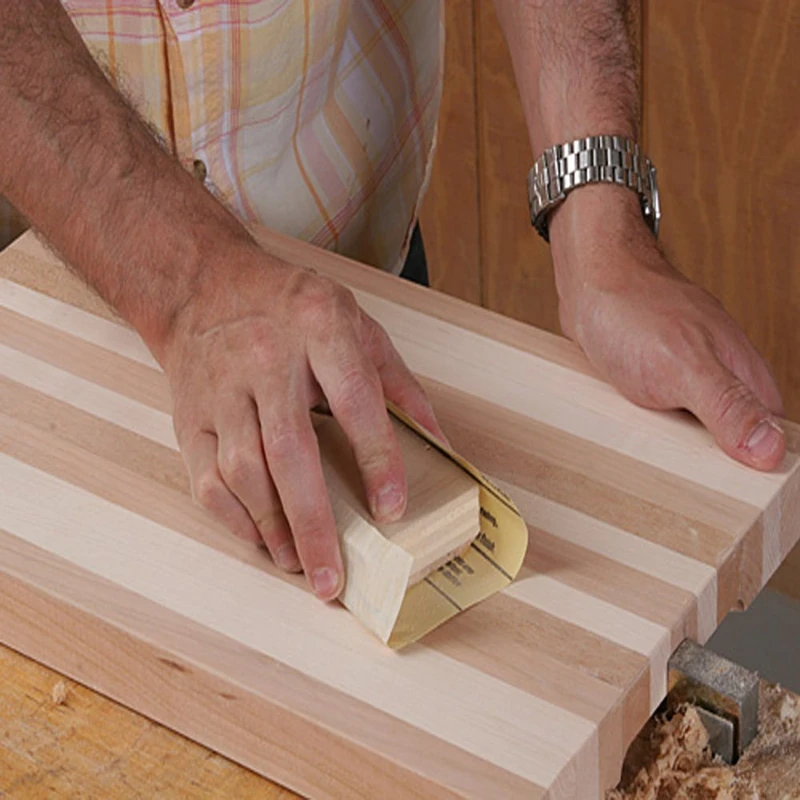
Sanding can feel tedious, but fundamentals make it faster and safer. In “Sanding Techniques - Beginners #13,” the presenter reframes sanding as a process of managing scratch depth, pressure, and progression rather than just grinding material. He demonstrates how to choose grits, apply minimal pressure, and keep the tool flat to avoid swirl marks and pigtails.
Video source: Sanding Techniques - Beginners #13 - woodworkweb
120 Grit Sandpaper Sheets (10-pack) — 9x11 in Silicon Carbide Abrasive for Wet or Dry Use — High-cut abrasive for refining rough wood grain, removing scratches, and preparing bare surfaces for priming or staining. (Professional Grade).
Frequently Asked Questions (FAQ)
Q: What grit should I start with around hardware bases?
A: After bulk fairing, approach hardware bases with P150 or P180 on a soft interface to control cut. If you need to remove significant material, start at P120, but transition quickly to finer grits to avoid halos and undercutting.
Q: How do I keep from rounding teak plank edges when leveling new caulk?
A: Use a hard pad or longboard, stay centered on planks, and span seams with a sled or wide block. Begin with P80–P100, keep strokes along the grain, and avoid dwelling over seams. Re-mask seams if caulk begins to smear or pull.
Q: Are mesh/net discs safe near gelcoat edges?
A: Yes, they’re often safer due to superior dust evacuation and cooler cutting. Pair with a soft interface and one grit finer than you’d use on flats to minimize edge risk.
Q: Should I remove all hardware before sanding?
A: Ideally, yes. Removing hardware prevents scalloping and trapped debris. If removal isn’t possible, loosen and lift components where you can, mask aggressively, and finish borders by hand to maintain sharp footprints.
Q: What orbit stroke is best for finishing close to seams?
A: A 2.5–3 mm orbit provides finer control and a shallow scratch. Combine with lower RPM and film-backed P220–P320 discs to keep the seam geometry intact while preparing for primer or topcoat.