
Floor Sanding Without Chatter: A Pro’s Workflow
A quiet house at sunrise, the kind of silence that makes you notice details. The boards gleam faintly where a rug used to sit, but everywhere else the finish is tired, dull, and scuffed. You roll the big sander off the truck, shoulders relaxed but eyes scanning for risk. This is where floor sanding gets real: the path between “good enough” and “exceptional” is only a few thousandths of an inch wide. Chatter marks—those rhythmic ripples the light will ruthlessly expose—are the difference. Once you see them, you can’t unsee them. And once they’re sealed under finish, they’ll stare back for years.
If you’ve ever run a drum across a floor and heard that faint oscillating hum, you already know what I mean. It’s resonance, minor imbalances snowballing into a repeating pattern. Chatter is a signal—from your abrasive, your machine, your technique, or the floor itself—that something is out of tune. The fix isn’t one trick; it’s a chain of disciplined choices: surface preparation so the wood cuts predictably, abrasives that track true and shed heat evenly, machine setup that kills vibration at the source, and a workflow that never overloads the cut.
This article is a pragmatic, technical guide to sanding flat without chatter. I’ll focus on how the marks form, how to break the resonance that causes them, how to choose and sequence abrasives, and how to plan a sanding workflow that stays level from the first coarse pass to your final screen. Whether you’re dialing in a 220V belt machine or a rental drum, the same physics apply—and they reward meticulous craft.
Quick Summary: Chatter-free floors come from controlled machine setup, level substrates, balanced abrasives, and a disciplined sanding sequence that avoids resonant cuts.
Why Chatter Happens Mechanically
Chatter is periodic error—an oscillation that imprints at a consistent wavelength across the floor. Mechanically, it comes from three interacting sources: machine vibration, abrasive irregularity, and substrate variation. Any one can seed a repeating pattern; together, they lock into a resonance that your eyes will immediately find under raking light.
Machine vibration. Flat-spotted wheels, out-of-round drums, worn bearings, misleveled chassis, or an unbalanced dust bag all inject harmonics. Long, light-gauge extension cords can drop voltage, producing torque ripple in the motor that compounds the pattern. Even a half‑full dust bag can swing and add a low-frequency wobble.
Abrasive irregularity. Seam bumps in cloth belts, poorly spliced joints, clogged grains that cut intermittently, or a grit leap that’s too big will leave alternating high/low cuts. Coarse grits hide the pattern; finer grits reveal and amplify it.
Substrate variation. Subfloor dips, cupped boards, proud edges from seasonal movement, and loose fasteners make the drum ride unevenly. As the drum crests and dives, the cut goes in and out, creating a repeating “wave” that the next pass can echo instead of erase.
Chatter shows up as equidistant arcs or stripes. On a 8–10" drum, you’ll often see spacing around 1/2–1" depending on feed speed and oscillation frequency. If your pattern spacing is consistent room to room, think machine/abrasive. If it changes with direction or location, think substrate.
The prevention strategy is holistic: eliminate sources of resonance, cut with abrasives that don’t introduce periodicity, maintain constant feed and pressure, and keep the floor flat at a macro scale so the drum never “bounces.” That demands setup discipline before the first cut.
Floor sanding settings that prevent chatter
Fine-tuning the machine kills most chatter before it starts. Treat this as a repeatable pre-flight.
Drum alignment and pressure. Confirm the drum is parallel to the floor and centered relative to the wheels. If your machine allows drum pressure adjustment, set just enough downforce to cut without burning—excess pressure amplifies any oscillation. Feather in and out at each run to avoid stop marks that mimic chatter.
Wheels and bearings. Inspect wheels for flat spots or hardness glazing. Spin them free to listen for bearing noise; any roughness injects high-frequency vibration. Replace suspect bearings and wheels; they’re cheaper than a resand.
Abrasive fit and balance. Use quality belts with uniform joints; avoid pronounced lap seams. Mount the belt tight, rotate by hand to feel for a “bump,” and, if present, rotate the belt 180 degrees to relocate the seam relative to the drum. On edgers and buffers, balance the pad/plate assembly and keep interface pads in good condition.
Power delivery. Run a 10-gauge extension cord and short lengths. Undervoltage causes motor pulsation that prints. Keep the dust bag no more than one-third full to minimize pendulum effect.
Feed rate consistency is equally critical. Establish a cadence: for a 12–16 ft run, aim for roughly 8–12 seconds door to wall—about 1.0–1.5 ft/sec—with no pauses mid-field. Pauses or tiny speed surges translate to wavelength changes in the cut. When turning, keep the drum off the floor or feathered to prevent a stationary cut that becomes a chatter hot spot.
Finally, temperature and dust matter. Warm abrasives cut smoother; loaded abrasives chatter as they skate. Vacuum between grits, and, on resin-bond belts, avoid overheating that can stiffen the bond and introduce more bounce.
Surface Prep and Leveling Strategy
A flat substrate is non-negotiable. You can’t “technique” your way around humps, dips, and loose boards; you must stabilize and level first.
Fasten and stabilize. Re-nail or screw down squeaking or loose boards, locating joists with a stud finder. A board that moves underfoot will move under the drum, changing cut depth.
Map the floor. Use a 6–8 ft straightedge or a long level to identify crowns and hollows. Mark these zones. Where cupping or crowning exceeds ~0.5 mm across a board, plan diagonal passes to average the high/low instead of chasing it along the grain.
Level with intent. Start your coarse pass on the high side of the room, angling 7–15 degrees to the grain if the floor is notably uneven. A shallow diagonal lets the drum bridge isolated highs without digging trenches, then you’ll come back with a with‑grain pass to clear the pattern. Avoid steep diagonals that create deep cross-grain that later grits must waste effort removing.
Edge integration. Perimeters are common chatter traps. Keep edger cuts flat by using a hard backer pad when leveling, then switch to an interface pad for blending. Overblending with a soft pad can “dish” the edge, making the big machine chatter as it rides up and down.
According to a article, sanding at a slight angle on problematic, uneven floors can reduce the tendency to create repetitive marks, especially when straight with-grain passes only echo the substrate’s defects.
Finally, clean aggressively. Grit fragments and debris trapped under the belt act like fixed “pebbles,” injecting periodic high spots into the cut. Vacuum after every pass, and blow out the drum cavity. Keep the floor and machine spotless during the coarse phase; small contaminants matter most when the cut is deepest.
Abrasive Selection and Sequencing
The abrasive path you choose determines whether micro-waves are erased or engraved. Use ceramic/zirconia open-coat belts for coarse leveling; they cut cooler and resist loading. Aluminum oxide is fine for mid and finish grits, but avoid bargain belts with inconsistent joints.
Grit progression. Don’t skip more than one grit step from the coarse base: 36 → 50 → 80 → 100/120 is a stable path. If the floor is very uneven, start at 24 or 30, then 40/50. Skipping from 36 to 80 leaves deep furrows that later grits “bridge,” recording chatter as they alternately cut and skip.
Hard-plating and multi-disc. Introduce a hard-plate (metal driver with a thin felt) under a buffer at 80 or 100 grit to flatten micro-waves before the final screens. Multi-disc sanders (e.g., 4–6 head planetary) are excellent at erasing drum patterning without dishing; use 80 → 100 → 120 on interface pads for blending.
Belt care. Replace belts as soon as the cut dulls or the sound changes pitch. A loaded belt rides higher, starts to skate, and then chatters. If a belt seam is audible, retire it from the big machine and repurpose for a short diagonal cleanup pass where the pattern will be eliminated by the next grit.
Heat management. Heat increases resin stiffness and scratch depth variability. Keep an eye on dust color (burnt scent is a warning) and feel the belt housing; if it’s getting hot, take a pause. Hot belts chatter more.
For perimeters, sequence the edger in lockstep with the field grits—if the field is at 80, don’t jump the edge to 120 yet. You’ll end up overblending to remove edger scratches, which risks a perimeter dish the big sander can’t flatten without extra passes (and more chatter risk).
Sanding Workflows That Stay Flat
Good workflow is about predictable cuts and zero surprises. Design passes that avoid stopping in open field and ensure each successive pass actually levels the previous scratch pattern.
Establish the first leveling pass. If the floor is reasonably flat, start with a with‑grain 36 or 40. If not, take a shallow 7–15 degree diagonal at the same grit. Always follow any diagonal with a with‑grain pass at the same grit to convert cross-grain scratches to longitudinal ones before stepping up.
Maintain cadence and overlap. Overlap pass edges by 1–2 inches. Keep the same walking pace every run. At room ends, lift the drum slightly before stopping, then feather down after the turn. Never pivot the drum on the floor; that stationary cut becomes a repeating echo.
Integrate edges and field. After each field grit, edge to the same grit. Then use a multi-disc or hard-plate to blend the edger’s orbitals into the field. This prevents a ridge that the next field pass would have to ride over, which introduces bounce.
Trowel-fill at the right time. After 80 grit, apply a trowel filler to stabilize microvoids and checks. Once cured, the surface cuts more uniformly at 100/120, which suppresses chatter by removing “catch and skip” behavior of the drum across open pores.
Final blend. After the last belt grit, run a multi-disc or buffer with 100 then 120 screens (or 120 then 150 where required by finish). Keep the buffer flat, use a hard-plate for the first screen, then an interface near the end for gentle blending.
Three high-impact techniques to plug into your workflow:
- Pace metronome: Count steps to time your traverse so every run takes the same seconds wall-to-wall.
- Seam indexing: Mark belt seams and rotate their position every install so any minor seam effect doesn’t stack in the same track.
- Light discipline: Use a raking LED at 12–18 inches height to inspect after each grit; fix chatter at the grit that created it—never “hope” a finer grit will erase it.
Diagnostics and On-the-Fly Corrections
Even with perfect preparation, you can encounter chatter. Diagnose by pattern and act immediately at the current grit.
Identify the wavelength. Measure the spacing between marks. If the spacing changes with feed speed, it’s resonance related to your pace. Stabilize your speed. If it’s constant, suspect mechanical: belt seam, wheel, or drum balance.
Isolate the source. Mark the floor where a mark is visible, then run a short test pass with a different belt. If the pattern changes or vanishes, it was the belt. If it remains, swap to a different machine if available or change the pass direction.
Correct at once. Do not advance grits until the pattern is gone at the current grit. Take a light diagonal pass (same grit) to average out the peaks, then a with‑grain pass to remove the diagonal. If needed, introduce a multi-disc 1–2 grits finer to flatten micro-waves before continuing.
Perimeter echo. If chatter appears within 12–18 inches of walls, you may have dished the edge. Hard-plate blend the perimeter at the same grit until the dish is gone, then repeat the field pass to integrate.
Actionable tips for field fixes:
- Drop drum pressure one increment and slow your feed by 10% to evaluate whether amplitude or wavelength changes; if amplitude drops, keep the lighter pressure.
- Swap to a fresh belt with a different seam construction; mark belts that hum and reserve them only for diagonal correction passes.
- Empty the dust bag and shorten your cord run by one segment; torque ripple often disappears with stable voltage and less bag swing.
- Add an interim grit instead of grinding harder; 36 → 50 → 80 is safer than muscling 36 to erase everything.
Quick Tip: Floor — Video Guide
This brief clip demonstrates how a compact orbital sander can help refine the field after the belt passes. It shows body positioning, pad control, and how to blend with-grain without creating swirl that telegraphs under finish. The emphasis on light pressure and consistent overlap aligns with the principles in this guide.
Video source: Quick Tip: Floor Sanding using an Orbital Sander.
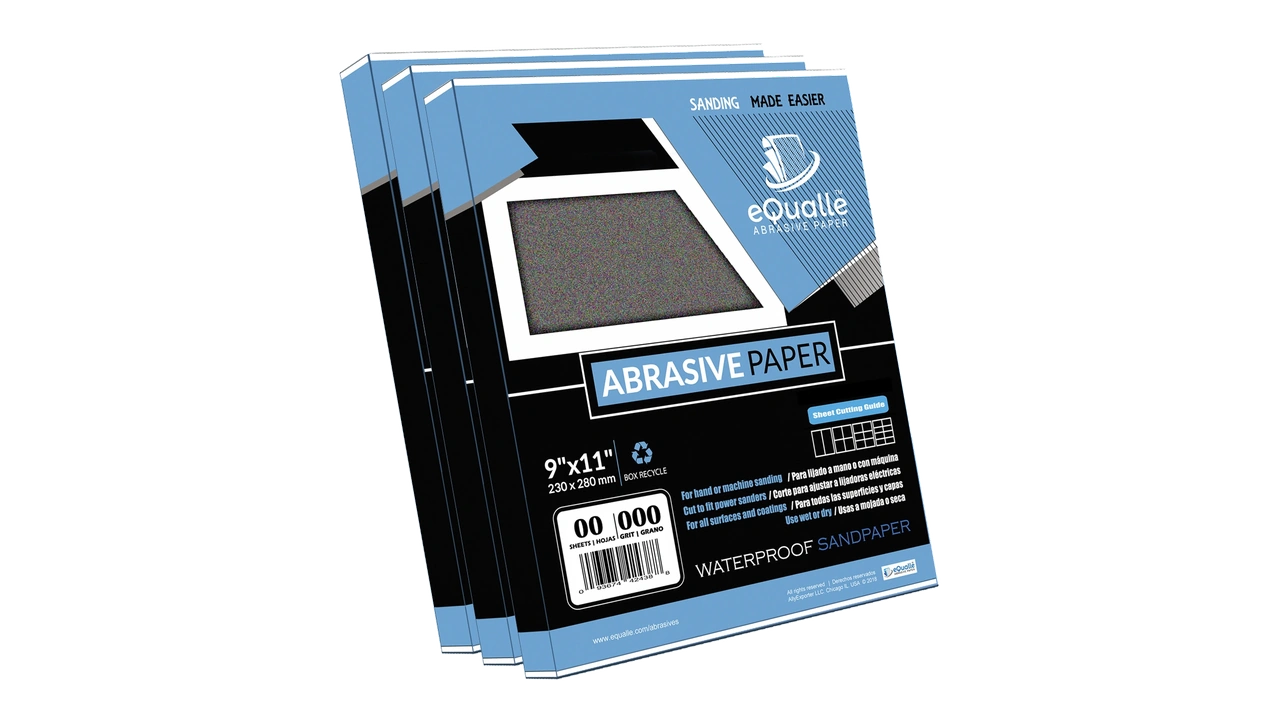
360 Grit Sandpaper Sheets (100-pack) — 9x11 in Silicon Carbide Abrasive for Wet or Dry Use — Ultra-controlled abrasive for gentle refinement and removing faint imperfections before clear coating or buffing. (Professional Grade).
Frequently Asked Questions (FAQ)
Q: What causes chatter marks to appear after finishing even if I didn’t see them while sanding?
A: Finish, especially waterborne, increases surface reflectivity and highlights periodic defects. Micro-waves invisible at 100 grit under ambient light become obvious under raking light after sealer. Always inspect with low, raking LED light between grits to catch chatter before coating.
Q: Can I remove chatter without restarting from a coarse grit?
A: Sometimes. If the marks are shallow and you’re still at 80–100, a hard-plate or multi-disc 1–2 grits finer can flatten them, followed by a with‑grain belt pass at the same grit. Deep chatter often requires stepping back one grit to erase the pattern efficiently.
Q: Does sanding diagonally always prevent chatter?
A: No. Diagonals help average uneven substrates and break resonance, but they also introduce cross-grain scratches. Always follow a diagonal with a with‑grain pass of the same grit. Use diagonals as a leveling tool, not a default.
Q: How do I keep the edger from creating a perimeter dish that leads to chatter?
A: Use a hard backer during leveling grits, keep the edger flat, and don’t overblend with a soft interface. Maintain the same grit sequence as the field and blend with a hard-plate or multi-disc before the next belt pass.
Q: What’s the safest grit progression for old, uneven floors?
A: Start 24/30 (diagonal if needed) → 40/50 (with‑grain) → 80 → 100/120, integrating edges at each step and introducing hard-plating or a multi-disc after 80. Avoid skipping grits and prioritize flattening before refining.