
Detail sander sheets: sequencing grits for profiles
On a Saturday morning in the shop, you pull the tape off a freshly routed maple picture frame and hit it with raking light. The ogee looks clean at first glance—but your fingertips catch tiny ridges where the cutter eased in and out, and the inside corners still show faint milling lines. You grab a delta sander, slide on a fresh pack of detail sander sheets, and take a breath. This is the moment that separates a merely “good enough” piece from one that reads crisp at arm’s length and holds up under a client’s inspection light.
Profiles and corners are the truth serum of your sanding workflow. They highlight any mistake in pressure, grit choice, or sequence. In flat fields you can hide with higher grits; on moldings and inside corners, the wrong move rounds a sharp fillet, dulls beading, or polishes defects you didn’t remove. Over the last decade I’ve evaluated abrasives for how they cut, load, and last—tracking real removal rates, edge retention, and scratch uniformity. The fastest path to a clean profile isn’t about “more grits,” it’s about using the right abrasive construction, the correct backing support, and a deliberate, step-efficient sequence that respects geometry.
This guide distills lab and shop testing into repeatable grit sequences for common profiles, explains the materials science behind why certain sheets behave the way they do, and shows how to protect corners and edges from over-sanding. Whether you prefer film-backed ceramics or open-coat aluminum oxide on foam, the principles are the same: remove defects with the coarsest practical grit, refine without changing shape, and stop before you burnish. And yes, we’ll get specific about where detail sander sheets shine and how to select them for your machine and task.
Quick Summary: Use a short, targeted grit ladder matched to your abrasive type and profile geometry, keep edges supported, and verify progress under raking light before advancing.
The goal: crisp edges, not burnished blobs
When sanding profiles and corners, you’re balancing two competing outcomes: defect removal and geometry preservation. The hard metric I use is edge radius growth. For a sharp 90-degree corner, I want end-of-sanding edge radius growth below 0.1 mm on stain-grade hardwood and below 0.2 mm on paint-grade MDF. For routed profiles—say a 6 mm roundover—I aim to keep the tangent section visually continuous while removing any scallops from the cutter.
Three variables dominate: abrasive aggressiveness (grit and mineral), contact pressure per unit area (especially at tips and small radii), and backing compliance. Coarse grits remove material quickly, but any compliance in the pad will exaggerate rounding at edges because pressure concentrates on high points. Conversely, very fine grits with too much pressure can glaze, smearing resin in softwoods and decreasing cut rate while polishing remaining scratches.
Practically, that means choosing the lowest grit that erases your worst defect in 3–5 strokes, not 20. If a tool mark remains after ten seconds at 180 grit, you’re wasting time and compounding rounding; drop to 120 or 100 to cut cleanly, then step efficiently. On corners and tight arcs, a firm interface (hard rubber or a thin foam pad) keeps the profile honest. For beaded and ogee shapes, I’ll often switch to a shaped profile block for the first step, then return to the detail sander to refine and align the scratch pattern.
Sequence matters with routing as well. On frames and tabletops, sanding flats to around P150 before routing produces a cleaner transition once the profile is cut, because you’re not trying to remove plane marks right at a delicate edge. After routing, I sand the profile only, working up the ladder and blending the last step onto the adjacent flat to avoid dish-outs. The goal is a uniform scratch field that disappears under finish, without losing crispness at beads and fillets.
Abrasive physics for tricky shapes
Understanding abrasive construction helps you predict performance in corners and on profiles. The mineral is your cutting tooth; the backing and resin system determine how those teeth stay oriented and whether they fracture to expose fresh edges or simply dull.
- Aluminum oxide (AO) is the default for wood. It’s tough, fracture-resistant, and available in open-coat structures that shed dust rather than clog—an advantage on resinous softwoods and painted surfaces. AO in P100–P220 is a dependable middle for profile refinement.
- Ceramic alumina cuts faster at coarse grits (P60–P120), especially on hardwoods. It micro-fractures under load, exposing new cutting edges, which maintains cut without heavy pressure. That’s useful for removing router scallops or mill marks on hard maple or oak without leaning into corners.
- Silicon carbide (SiC) has sharp, brittle grains and excels at finishing between coats or on composites; it produces very fine, consistent scratches at P240–P400+, ideal when you need stain-grade clarity on tight moldings.
Backing materials matter as much as mineral. Paper backings (C-weight or D-weight) on hook-and-loop detail sander sheets are the common standard—flexible enough to conform, but firm enough to avoid excessive rounding. Film backings spread pressure evenly and produce extremely uniform scratch patterns; I reserve these for the top steps (P240–P320) when clarity under a clear finish is the priority. Cloth backings are durable but can wrap too easily into recesses, so I prefer them for hand strips or shaped blocks rather than on a delta pad.
Resin systems with stearate coatings reduce loading. In corners, loading is both a cut-rate problem and a heat problem; once wood dust smears into the grain, heat spikes and you risk burnishing or even raised grain on the next coat. Open-coat and supersize stearate sheets keep temperatures down. Dust extraction through matched hole patterns also matters—if your sheet isn’t aligned to the pad’s ports, you’ll see faster loading at the tip and along the leading edge. In testing, matched extraction improved time-to-load by about 30% on pine moldings at P180.
Finally, pad compliance: a thin foam interface can help the sheet “flow” over gentle profiles, but it increases rounding on sharp details. On a delta sander, I run without an interface for corners and tight beads; I’ll add a 2–3 mm interface on larger coves or for final blending to avoid flat spots. Oscillation amplitude and speed should be kept moderate in delicate areas; higher speed escalates heat and edge rounding without proportional gains in cut.
Choosing detail sander sheets and pads
Not all detail sander sheets are created equal, and small design differences show up fast at the tip of a delta pad. When I evaluate sheets for profiles and corners, I look at fit, cut, clog resistance, and tip durability.
Fit starts with the cut pattern. Your pad’s hook-and-loop footprint and extraction holes need a precise match—misaligned holes starve the tip of airflow, and any overhang catches on edges, tearing the sheet prematurely. If you switch brands, lay one on your pad and press-lightly around the edges; if you feel slack or see the hooks telegraph through after a few strokes, retention may be weak. I’ve measured removal force on used sheets; anything below ~2 N at the tip after five minutes of use tends to drift, generating chatter marks on delicate profiles.
Cut and clog resistance hinge on mineral and coat weight. For heavy cleanup or paint removal on moldings, a ceramic-blend P80–P120 with a generous stearate load is my baseline. For refinement, a premium AO open-coat P150–P220 cuts smoothly and resists loading, especially on pine and poplar. For final steps in stain-grade hardwoods, film-backed SiC in P240–P320 yields a uniform finish that reveals figure without haze.
Tip durability is the stealth failure mode in corners. The triangular tip sees the highest pressure per area; inferior resin bonds fracture, dumping grains and glazing the nose. In comparative runs on 3/8" bead-and-cove profiles, premium sheets retained tip integrity 2–3x longer than economy sheets—enough to finish a frame without swapping. For exceptionally tight inside corners or carved recesses, don’t overlook specialized corner sponges; their compressible foam distributes load and can greatly extend life. According to a article.
Pad choices matter too. A fresh, flat pad maintains contact uniformity; a rounded or heat-warped pad exaggerates rounding and hot spots. If your pad is more than a season old and you work profiles often, replace it. Keep a hard pad for edge fidelity and a thin foam interface pad for blending and larger radii. In my tests on ogee casings, swapping to a hard pad in the first two grit steps reduced edge radius growth by roughly 30% while still clearing router lines in the same number of passes.
Proven grit sequences for profiles
There is no single “right” sequence, but there are efficient ladders that balance speed and geometry preservation. Below are working sets I reach for, with notes on wood species and finish plans.
- Roundovers (R3–R6 mm), hardwoods (maple, oak), clear finish:
- P120 ceramic: one quick pass to erase tool chatter; keep the pad tangent, not wrapping over the flat.
- P180 AO open-coat: refine scratches; light pressure, count strokes to match all sides.
- P240 film-backed SiC: final refine for stain clarity; minimal pressure, cross the profile at 30–45 degrees to unify the scratch field.
- Ogee/cove moldings, softwoods (pine, poplar), paint grade:
- P100 AO open-coat: remove mill marks and flatten glaze; avoid tip dwell in fillets.
- P150 AO: refine and blend; stop here for most primer systems.
- Optional P220 AO: only if your primer is thin or you see raised grain after the first coat.
- Beaded edges and small fillets, hardwoods, dye/stain:
- P150 AO: minimal shaping; use a hard pad or shaped block on the bead first.
- P220 film-backed AO: refine; make 2–3 balanced passes per edge.
- P320 SiC: final skim for stain; use raking light to confirm scratch uniformity before moving on.
MDF is a special case: its surface is dense, but edges are friable. I avoid grits coarser than P120 on edges unless I’m cleaning defects, and I stop at P180 or P220 to keep primer adhesion strong; finer grits can polish the binder and reduce tooth. On painted trim in softwoods, stopping at P150 or P180 often yields the best balance between hiding and adhesion.
Five actionable tips for keeping profiles crisp while you move through these sequences:
- Start one grit coarser than you think, but limit to one short pass: if marks remain, repeat that same grit rather than advancing prematurely.
- Always make your last two passes with the pad slightly skewed (15–30 degrees) to the profile to avoid “corduroy” tracks along the grain.
- Rotate or replace sheets when the tip dulls; don’t power through—an exhausted tip creates heat and rounds details.
- Keep edges supported by the pad’s flat, not its corner; let the triangle’s side, not the point, do the majority of the work on beads.
- Use a pencil witness line on high points; sand until the line just disappears, then stop—that’s your cue to advance grits without altering geometry.
Corners and finish-readiness checks
Inside corners and tight recesses are the hardest places to maintain shape because contact pressure spikes and airflow drops. The work plan is to minimize dwell, maintain fresh cutting edges at the tip, and verify surface quality before moving up the grit ladder.
Start with a realistic cut step. If a corner has router swirl or paint residue, going straight to P180 wastes time and heats the fibers. A controlled P120 pass with a fresh tip will clear defects in seconds; the key is to approach from both faces with the pad flat, then touch the apex with a single, quick dab. For extremely tight corners, a rigid chisel-point sanding stick or a folded strip backed by a thin hardwood shim gives better control than the powered sander. I keep 1" x 6" strips in P150, P220, and P320 for this job.
Heat is your enemy here. Back off speed and pressure; let the abrasive cut. If the sheet starts to load, tap it clean or switch to a new corner of the triangle. Consider switching mineral: SiC at P220–P320 cuts cleanly with less pressure in end grain corners and produces a finer scratch without burnishing. Between steps, blow out dust and inspect under raking light; it’s the cheapest QA you can perform.
Before declaring finish-readiness, use these targeted checks:
- Raking light at 30–45 degrees: Any surviving coarse scratches will flash; if you see a few, return to the previous grit and spot-correct only the offender.
- Pencil or chalk witness on beads and fillets: Make a single pass; if color remains in valleys, your pad is too stiff or you’re not conforming—switch to a thin foam interface for that one pass.
- Water wipe on hardwood profiles: Lightly dampen a cloth and wipe a test piece; it raises grain selectively where micro-tearout or burnishing occurred. If the surface fuzzes, plan a final P240 skim after it dries.
- Edge radius gauge (or caliper + feel): Compare opposite corners. If one feels softer, you likely dwelled too long. Even out with one or two gentle passes at the previous grit.
And remember: sharpening isn’t only for chisels. Keep your sanding set “sharp” by retiring sheets early in corners. A fresh, coarse sheet with low pressure preserves geometry far better than a tired fine sheet pushed hard.
KraftFix by Einhell — Video Guide
A QVC segment showcases the KraftFix by Einhell electric detail sander bundled with ten sanding sheets, aimed squarely at DIY users working on trim, furniture, and small surfaces. The host walks through practical use on edges and corners, emphasizing how the delta pad reaches into tight spots that round sanders can’t, and how sheet changes are fast when you move between grits.
Video source: KraftFix by Einhell Electric Detail Sander with 10 Sanding Sheets on QVC
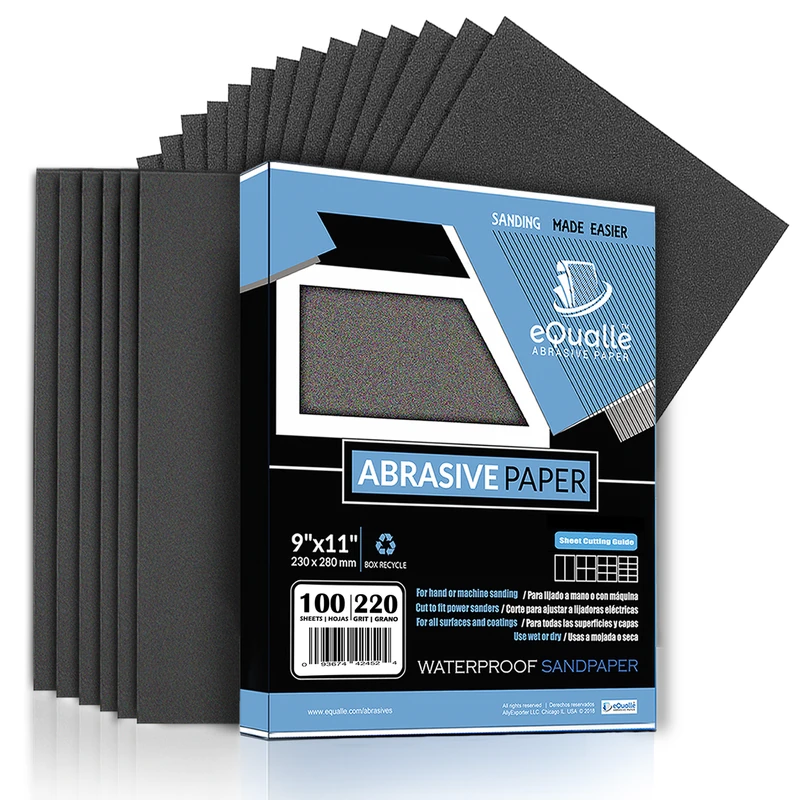
220 Grit Sandpaper Sheets (10-pack) — 9x11 in Silicon Carbide Abrasive for Wet or Dry Use — Fine finishing grit for final surface preparation before painting or coating. Offers uniform cutting on wood, metal, and plastic. Leaves a smooth, paint-ready finish suitable for wet or dry sanding. (Professional Grade).
Frequently Asked Questions (FAQ)
Q: Should I sand the flat surfaces before routing profiles, or after?
A: Sand flats to about P150 before routing to remove mill marks without risking edge rounding. Then route the profile and sand only the profile area up the ladder, blending the final step onto the adjacent flat.
Q: How many grit steps do I really need on profiles?
A: Two to three steps are sufficient if you start coarse enough to erase defects quickly. Typical ladders are P120 → P180 → P240 for clear-finished hardwood, or P100 → P150 for paint-grade softwood.
Q: Are film-backed sheets worth it for detail work?
A: Yes at the top end. Film backings distribute pressure evenly and yield consistent fine scratches (P240–P400). Use paper-backed AO for the earlier steps and switch to film for the final pass on stain-grade pieces.
Q: How do I avoid rounding sharp beads and fillets?
A: Use a firm pad (no foam interface) for the first steps, keep pressure low, let the pad’s flat—not the tip—do the work, and stop as soon as pencil witness marks disappear. Rotate or replace sheets when the tip dulls.
Q: When should I choose a corner sanding sponge instead of a sheet?
A: Use sponges in very tight recesses or delicate carved corners where a rigid pad can’t conform. They distribute pressure and resist clogging, extending life, especially in finishing grits or when scuffing between coats.