
Edge Sanding Mastery: Sandpaper Grit Guide
It starts with the first swipe on a sharp, splintery edge—maybe the oak tabletop you rescued, the cabinet door frame you’re painting for a bathroom refresh, or the picture frame for a gift that’s due tonight. In the quiet of the workshop, dust hangs in the light and you feel the edge transform under your fingers. The urge is to “just sand it” and keep going. But edges and profiles aren’t flat panels; they magnify every mistake. Round over too far and the joint line disappears. Skip a grit and scratch ghosts show up in the finish. Choose the wrong sandpaper grit and you’ll waste time or, worse, bruise a delicate profile you spent hours cutting.
I’ve been there—standing over a set of ogee drawer fronts, second-guessing if P120 is too bold for a blue-painted finish, or whether to jump straight to P320. The truth is simple: edge work is where craftsmanship shows. The right sandpaper grit, the right backer, and a clean sequence turn nervous passes into confident, controlled strokes. Whether you’re shaping a new chamfer, cleaning up a routed profile, or knocking back a razor-sharp metal edge, there’s a predictable way to get crisp, repeatable results without “melting” your geometry.
Today, I’ll walk you through a field-tested approach to edge and profile grit selection. We’ll break down where to start, when to stop, and how to support the shape so you don’t flatten a cove or round a corner that should stay sharp. Along the way, you’ll pick up tricks for sanding inside curves, handling veneer, and finishing between coats without telegraphing scratches. Set your vacuum to low, grab a pencil, and let’s make those edges tell the right story.
Quick Summary: For clean, crisp edges and profiles, match sandpaper grit to the task (shape, refine, prefinish, finish), support the geometry with the right backer, and sand in controlled, short passes with frequent checks.
Edges that Tell the Story
Edges are the handshake of your build: they broadcast how carefully you worked, what you prioritized, and how the piece will feel in a hand or against a forearm. A tabletop with a soft, even round-over invites touch; a frame with dead-square edges telegraphs precision. The first step is understanding the edge you have and the edge you want.
Start by reading the geometry:
- Square edges: cabinet doors, shelves, picture frames. These want crisp lines and minimal rounding.
- Chamfers: consistent facet width is the hero. Even a 0.5 mm wobble looks sloppy.
- Profiles (ogee, cove, bead): each curve has high and low points that can flatten out fast.
- Inside curves: easy to dish. They demand flexible backers that conform without cutting corners.
- Veneer and laminates: minimal aggression; it’s more about smoothing than shaping.
Next, assess the material and condition:
- Softwoods (pine): bruise and compress; use lighter pressure and finer starting grits.
- Hardwoods (oak, maple): tolerate slightly coarser starts but reveal scratches under stain.
- Painted or varnished edges: you’re working a film; think finesse and clog-resistant paper.
- Metal and plastic: heat and burrs are your enemy—use light passes and open abrasives.
Finally, define the goal:
- Shaping: establishing a chamfer or blending a proud joint needs a coarser starting point.
- Refining: removing tool marks or router tracks benefits from medium grits with better control.
- Prefinish smoothing: readying for stain or primer values smoothness over stock removal.
- Between-coat scuffing: adhesion, not material removal, is the target.
Edges reward a stepwise approach. Decide what you’re removing (stock, swirl, dust nibs), then choose a grit and backer that accomplishes exactly that—no more, no less.
Choose sandpaper grit for edges and profiles
Here’s the rule: start as fine as you can while still getting the job done. The more fragile the geometry (veneer, tight beads, delicate coves), the finer your starting point should be.
Typical sequences by task:
- Shaping a new chamfer or knocking down a proud joint:
- Hardwoods: P80–P100 to establish, then P120–P150 to refine.
- Softwoods: P100–P120 to start; jump to P150–P180 early to prevent crushing.
- Cleaning router tracks or mill marks on profiles:
- P120 or P150 to remove ridges, then P180–P220 to erase scratch pattern.
- Prefinish smoothing for stain or oil:
- Stop at P180–P220 on edges; going too fine can reduce stain uptake and look blotchy.
- Prefinish for film finishes (paint, lacquer, poly):
- P220–P320 on edges; profiles respond well to P320 before primer or first coat.
- Between coats:
- P320–P400 for clears; P320–P600 for paint depending on finish hardness and dust nibs.
- Final rub-out on cured finishes (optional):
- Micro-mesh 1500–2400 (P800–P1200 equivalent and up) or gray/white non-woven pads.
Material modifiers:
- Veneer and edge-banded plywood: avoid shaping grits unless you’re trimming glue squeeze-out. Start P150–P180; stop P220 on bare wood; P320 before paint.
- MDF edges: seal with thinned shellac or sanding sealer, then sand P220–P320. Raw MDF fuzzes under coarse grits.
- Metals (aluminum, steel): deburr with P120–P180; refine P220–P320; finish or blend with non-woven pads. Keep pressure light to avoid heat.
- Plastics/acrylic: start P220 wet; step P320–P600; finish polish with compounds to avoid haze.
A note on grit standards:
- FEPA “P” grits (P120, P220) are common in woodworking; CAMI numbers (120, 220) are close but not identical. Stay within one standard during a workflow for predictable jumps.
Practical jump sizes:
- When shaping: 40–60% jumps (P80 → P120 → P180).
- When refining/prefinishing: 30–40% jumps (P150 → P220 → P320).
- Between coats: smaller jumps or same grit for a consistent scratch that disappears under the next film.
If you’re unsure, do a pencil test: lightly scribble on the edge, sand five passes with a given grit, and check removal time. If it takes more than 15–20 seconds to clear marks, you’re too fine for the task. If it clears instantly but leaves deep scratches, you’re too coarse.
Tools, backers, and control
Selecting grit is half the equation. The other half is the backer—what’s behind the paper—because it dictates how pressure lands on the edge and whether you preserve or flatten detail.
Backers I rely on:
- Hard blocks (wood/MDF): preserve flatness and crisp corners. Ideal for square edges and chamfers.
- Radiused blocks/dowels: match inside curves; wrap with PSA or hook-and-loop paper for control.
- Flexible foam pads (EVA): conform to gentle profiles without scalloping. Great for beads and coves.
- File boards and stiff sanding sticks: narrow, targeted pressure for tight features.
- Interface pads on detail or random orbit sanders: soften the pad so it rides profiles without digging.
Hand vs. powered:
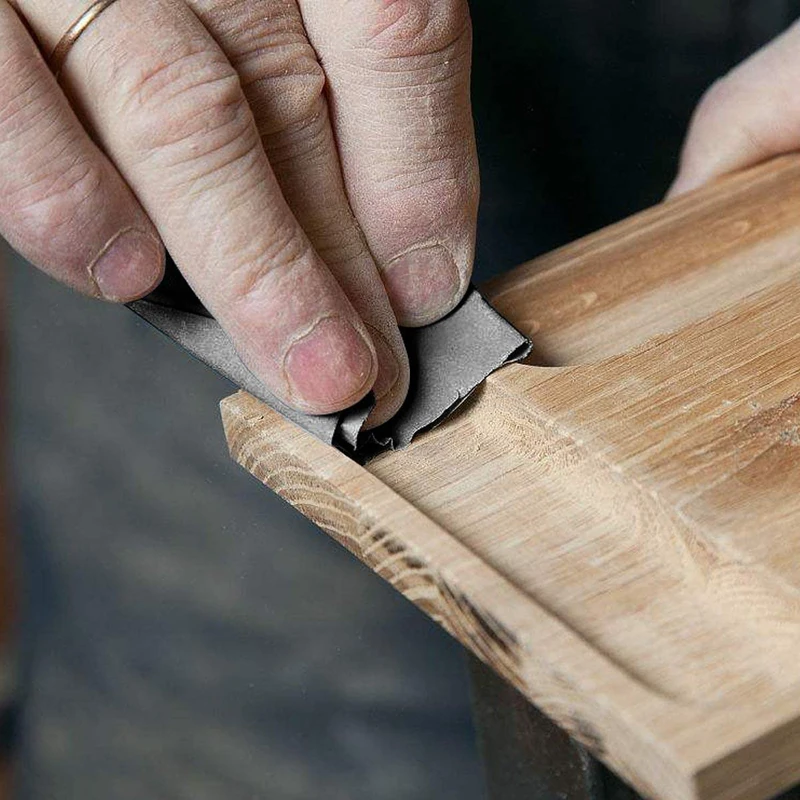
- Hand sanding gives feedback; you feel when a ridge disappears or a corner gets warm. Use it for final refinement and delicate shapes.
- Power sanding (3" RO sander with interface pad) speeds up uniform edges and broad curves. Keep the sander flat to the angle; avoid tipping which rounds the arris.
Control habits:
- Tape off adjacent faces with painter’s tape to protect finished surfaces and keep facets consistent.
- Sand with the grain whenever possible; for profiles that defy grain direction, use light, cross-body strokes to minimize visible scratches.
- Use “hit-and-run” passes: short, controlled strokes rather than long swipes that roll corners.
- Mark edges with pencil and remove marks evenly. Re-mark between grits so you confirm uniform scratch patterns.
- Clean the surface and your paper between grits. Dust loads paper and smears scratches.
Special materials:
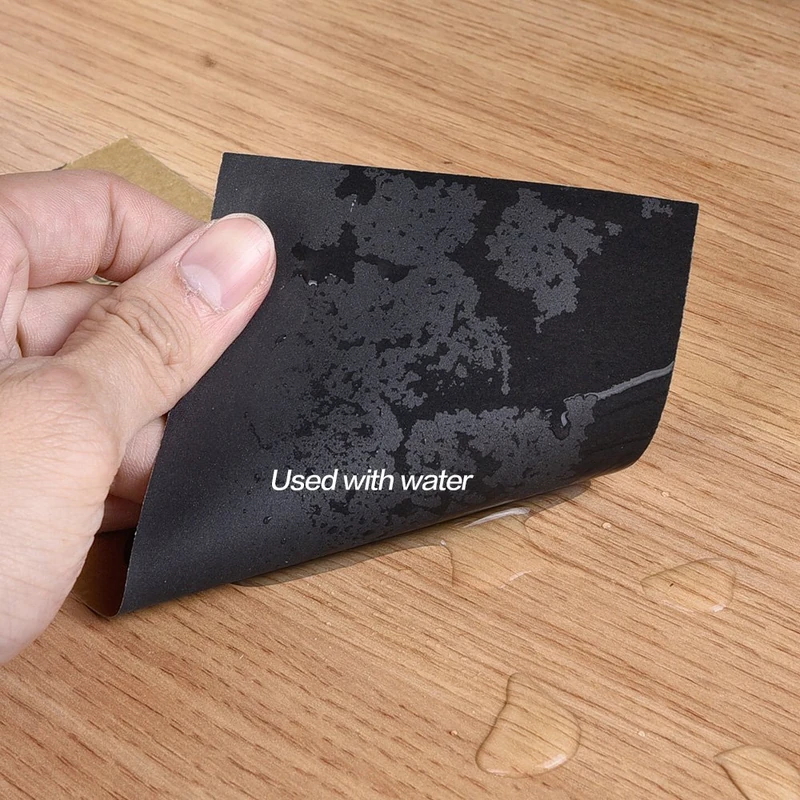
- For brittle edges (like hard plastics or even glass), wet-sanding with silicon carbide paper keeps heat down and reduces chipping. According to a article, working up through very fine wet/dry grits is recommended for safer, smoother results.
- For painted edges, stearate-coated papers resist clogging; non-woven pads scuff evenly without cutting through.
Remember: a perfect grit choice with a sloppy backer still yields rounded corners. Let the backer be your guide rail and the grit be your blade.
Step-by-step edge sanding workflow
Here’s a repeatable sequence I use on real jobs, whether it’s a dining tabletop edge, a cabinet door profile, or a freshly-painted rail.
H3: Bare wood profiles (cove, bead, chamfer)
- Assess and mark: Circle any router tracks, tear-out, or uneven chamfer widths with pencil. Note the grain direction around curves.
- Establish shape:
- Chamfer: P100 on a hard block. Three to five strokes, then check facet width end-to-end.
- Cove/bead: P120 on a medium foam pad or dowel that matches the radius. Light pressure.
- Refine: Move to P150–P180. Erase the previous scratch pattern completely—no dark lines should remain in the valleys of profiles.
- Prefinish: For stain/oil, stop at P180 or P220 on edges. For film finishes, go to P320 on profiles to reduce raised grain and router fuzz.
- Dust and seal: Vacuum, tack rag, and apply your first coat. If grain raises on edges, knock back with P320 after the first coat.
H3: Painted or metal edges
- Level and deburr:
- Paint: P220 stearate paper by hand with a soft pad, just until the edge feels uniform.
- Metal: P150 to remove burr, then P220. Use light pressure to avoid heat.
- Build smoothness: P320 to prep for primer or between coats. On cured paint, consider P400–P600 for ultra-smooth topcoats.
- Scuff between coats: One to two passes, no more. You’re promoting adhesion, not reshaping.
- Final touch: Non-woven gray pad for paint, Scotch-Brite fine for metal to unify sheen.
Edge protection moves:
- Tape guard rails: Apply two layers of painter’s tape on faces adjacent to the edge. Remove the top layer after coarse grits so you avoid cut-through.
- Stop blocks: Clamp small stop blocks to keep chamfers consistent near corners or transitions.
- Finger saver: When hand-sanding small parts, use a cork block or a scrap of leather to support your grip and keep pressure even.
Three to five actionable tips to lock it in:
- Tip 1: Don’t skip the “erase test.” If you still see the previous grit’s scratches after ten strokes, you’re under-sanding or need to step back and remove more with the prior grit.
- Tip 2: Keep a radius kit. A handful of dowels (1/4", 3/8", 1/2") and radiused blocks wrapped with PSA paper let you match profiles precisely.
- Tip 3: Use pencil witness lines along chamfers. Your goal is to remove them evenly from end to end; stop as soon as they’re gone to avoid over-rounding.
- Tip 4: Slow the sander down. On edges, a lower speed (RO setting 2–3) with an interface pad reduces swirl and preserves geometry.
- Tip 5: Switch abrasive types smartly. Silicon carbide for wet work and brittle materials; aluminum oxide for general wood; zirconia/ceramic when shaping harder woods or metals.
How Do I — Video Guide
If you’re new to flipping furniture or just want a fast confidence boost, this quick video walks through which grit to use at each stage of sanding a piece. You’ll see why starting too coarse chews profiles and how stepping through P120–P220–P320 creates a paint-ready edge with fewer passes.
Video source: How Do I Sand Furniture? | Sandpaper Grit 101 - Know Which Grit to Use for Each Step of Your Flip!
280 Grit Sandpaper Sheets (25-pack) — 9x11 in Silicon Carbide Abrasive for Wet or Dry Use — Fine finishing grit for delicate work—ideal for flattening varnish layers and creating a pre-polish smoothness on wood or resin. (Professional Grade).
Frequently Asked Questions (FAQ)
Q: What sandpaper grit should I start with on a chipped oak tabletop edge?
A: Start with P100 on a hard block to re-establish the line, then P150 to remove scratch, and P220 to prefinish. If the chip is deep, make a few controlled passes with P80 first, then step up.
Q: How do I keep square edges from rounding over while sanding?
A: Use a hard, flat block and tape off adjacent faces. Sand in short, straight passes parallel to the edge, and stop as soon as pencil lines disappear. Avoid soft pads and high sander speeds.
Q: Can I sand MDF edges smooth without sealing first?
A: You can, but it will fuzz. Better: apply a thinned shellac or sanding sealer, let it dry, then sand P220–P320. You’ll get a crisp, paint-ready edge in fewer passes.
Q: What’s the safest way to sand inside curves on a delicate profile?
A: Wrap paper around a dowel matching the radius or use a medium foam pad with P150–P220. Keep pressure light and move the support, not the edge, to avoid faceting the curve.
Q: Do I really need to sand between coats of paint or clear finish on edges?
A: Yes—lightly. One to two passes with P320–P400 promotes adhesion and knocks down nibs. Wipe clean and recoat. Don’t reshape; you’re only scuffing the film.