
Wet Dry Sandpaper and Soft Interface Pads for Curves
The first time you chase a flawless finish across a curving fender, a hand-turned wooden bowl, or the bell of an aluminum bike frame, you learn quickly that flat-surface habits don’t translate. On a crown or complex radius, the surface fights back—edges burn through, pressure spikes leave troughs, and scratches creep in from directions you didn’t intend. The instinct is to push harder or switch to a coarser abrasive; the better move is to refine the contact mechanics. This is where a soft interface pad and properly chosen wet dry sandpaper change the game. Together, they transform an unpredictable contour into a controllable contact patch, preserving geometry while delivering consistent cut and uniform scratch.
Picture a gloss-black motorcycle tank on a stand. Under raking light you can see orange peel ridges like ripples on a lake. Dry paper skates and clogs; direct-to-backing pad sanding is too aggressive at the shoulders of each curve. When you introduce a compliant interface and lubricate with a water/soap mix, the feel changes immediately. The foam adapts to the contour, distributing load, keeping the abrasive engaged but not biting at a single high point. The wet dry sandpaper builds a fine slurry that carries removed material away from the scratch tips, lowering heat and stabilizing the bite. Your strokes lengthen, your pressure lightens, and instead of fighting the shape, you’re following it.
There’s a quiet satisfaction when the surface transitions from noisy to smooth, from chalky friction to a controlled, even hiss. Your inspection light stops revealing fresh defects and starts confirming a uniform scratch pattern. This is the difference between sanding and surface engineering: knowing how the backing stiffness, abrasive mineral, lubrication regime, and stroke path combine on a curved geometry. Once you feel it, you don’t unlearn it. And once you pair the right soft interface pad with the right grit and format of wet dry sandpaper, curves stop being liabilities and become predictable workflows.
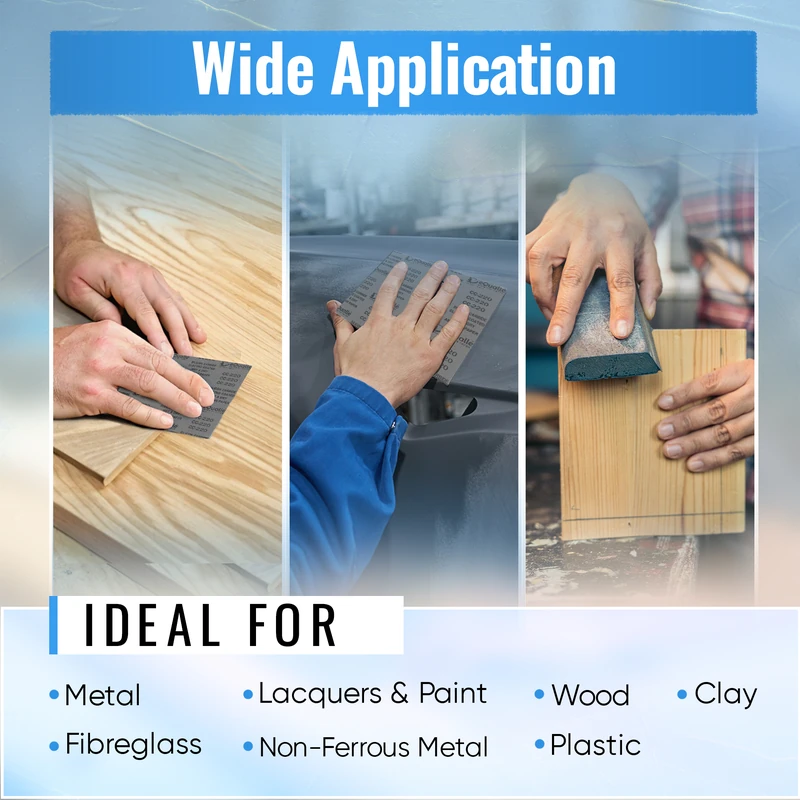
Quick Summary: Use a soft interface pad to equalize pressure on curves, pair it with appropriately graded wet dry sandpaper, control lubrication and stroke, and validate with disciplined inspection.
Why interface pads matter on curves
Curved areas concentrate force. When a rigid backing pad meets a radius, the contact area shrinks and the local pressure spikes, which makes edges dig, clears resin faster than intended, and introduces faceted flats that distort the profile. A soft interface pad adds a compliant layer—typically 3–10 mm of foam with a low to medium density—that spreads the load, increases the contact patch, and lets the abrasive conform to the curvature without telegraphing the hard backing pad’s geometry. This change is not subtle: it directly moderates cut rate, lowers peak temperatures, and reduces scratch depth variance around high points.
On thin coatings and soft substrates, compliance is insurance. A 10–15 Shore 00 foam will deflect across a contour and keep the abrasive grain working at a more consistent attack angle. Instead of each grain plowing at a steep micro-angle into a high point (burn-through risk), the foam lets it shear more uniformly across the path. The result is a narrower scratch depth distribution and fewer rogue lines that survive to polishing.
Interface thickness and density should match the curvature and the defect removal target. Too soft or thick, and you de-couple the abrasive so much that it refuses to level peaks (you’ll “follow the waves” rather than knock them down). Too stiff or thin, and you’re back to point-loading. On a 5-inch orbital sander, a 5–10 mm soft interface is a good starting point for moderate radii; for tighter contours or hand work, a thin, very soft interface backed by a flexible block gives tactile feedback without collapsing edges.
Edge control is another benefit. The foam’s compliance lets you roll into and out of features without gouging. Combined with moderate lubricant (water with a drop of surfactant), the pad reduces stick-slip events at the start and end of strokes, where many accidental scratches originate.
Selecting wet dry sandpaper for contour work
With compliance handled, abrasive selection determines how the cut presents. For curved surfaces, wet dry sandpaper with silicon carbide (SiC) is often preferred for its sharper grain and consistent breakdown under water lubrication. Film-backed sheets or discs further stabilize the scratch by preventing paper swelling and maintaining a flat abrasive plane when wet. Cloth-backed products can flex well, but on small radii they may telegraph weave; paper backings can soften when wet. Film avoids both issues and holds up under continuous wetting.
Grit placement should align with your defect depth and finishing plan. On automotive clear, stepping 100–150 P-grit increments (e.g., P1000→P1500→P2000→P3000) keeps scratches shallow and predictable. On bare aluminum or hardwood, begin at the lowest grit that removes the defect efficiently without imprinting deeper-than-necessary scratches; SiC at P400–P600 under water is a good entry point for leveling, then refine to P800–P1200. For pre-polish refinement, structured abrasives (e.g., microreplicated patterns) can yield even narrower scratch ranges, but quality wet dry sandpaper at P2000–P3000 will still produce a polish-ready finish.
Lubrication is a system variable. Water reduces friction and carries swarf, keeping grains cutting instead of rubbing. A drop of dish soap per liter reduces surface tension so water wets the sheet and the substrate, minimizing stiction on convex curves. Keep a spray bottle to recharge the film and a squeegee or microfiber to clear slurry; reloading the abrasive with swarf is a primary cause of rogue scratches and glazing.
Actionable tips:
- Pre-soak film-backed wet dry sandpaper for 2–3 minutes; avoid long soaks for paper backings to prevent swelling.
- Add 1–2 mL of mild dish soap per liter of water to improve wetting and reduce stick-slip on curves.
- Use a pencil guide coat; sand until it’s uniformly removed—stop early if edges disappear faster than flats.
- Wipe and inspect every 6–8 passes under raking light; trapped slurry creates random deep scratches.
- For hand work, wrap sheets around a flexible foam block, not bare fingers, to keep scratch tracks straight.
Dialing in pressure, stroke, and grit sequencing
Even with the right pad and abrasive, technique governs consistency. On curves, pressure management is crucial: target roughly 1–2 kgf (2–4 lbf) distributed across the pad when machine-sanding, and “just enough to keep it cutting” by hand. Overloading the interface collapses the foam and recreates point-loading; too light and the abrasive hydroplanes on the lubricant film, smearing instead of cutting.
Stroke patterns should follow the geometry. On convex curves, work in short, overlapping arcs that keep the pad’s centerline tangent to the radius. Avoid long straight strokes that bridge the curve’s apex; this concentrates cut at the tangency points and flattens the profile. Cross-hatch your passes by 30–45 degrees per grit to randomize scratch direction and ensure even coverage. With a dual-action (DA) sander, slow your travel speed to about 6–10 cm/s (2–4 in/s) so the orbital pattern has time to erase its previous track.
Sequencing affects both finish quality and efficiency. Each subsequent grit should fully remove the previous scratch pattern before advancing. On painted surfaces, a typical workflow might be: P1000 to knock down texture; P1500 to erase P1000 scratches; P2000 to refine; P3000 or a structured abrasive to pre-polish. On wood, especially end grain along a curve, step more conservatively (e.g., P400→P600→P800→P1000→P1200) to avoid raising fibers that then require backtracking. Wet dry sandpaper shines here because it keeps fibers subdued and reduces abrasive loading.
Edges and transitions require special care. Feather your pressure as you approach an edge to avoid thinning at break lines. Use the interface’s compliance: let the foam roll over the edge with minimal load, or mask neighboring surfaces if tolerances are tight. When defects are localized, spot-sand with a smaller block and interface to avoid creating shallow dishes around the repair.
Orbital setups, pad density, and Trizact options
Machine parameters translate directly into cut stability on curves. For 5-inch orbitals with a 3/16-inch (5 mm) orbit, an 8-hole soft interface pad matched to your backing pad keeps dust extraction functional when dry and equalizes suction forces when wet (even if you’re not actively extracting). Align holes to prevent local vacuum spots that can cause the pad to “stick” on convex radii.
Pad density and thickness set your compliance. A 5–10 mm, soft-density interface (roughly 8–12 pcf foam) balances contour-following with sufficient cut to level peaks. For delicate films or very tight radii, go softer and thinner to maintain tactile control. For aggressive leveling on gentle contours, consider a medium-density interface or even direct-to-backing pad for the initial grit—then switch to soft for refinement. This staged compliance approach preserves shape while staying efficient.
When you need ultra-uniform scratch for high-gloss finishes, structured abrasives like 3M Trizact in the A3000–A6000 range provide extremely narrow scratch bands and predictable behavior under water. They pair well with soft interfaces on curves because the microreplicated pattern maintains cut even at reduced pressure. That said, film-backed wet dry sandpaper in P2000–P3000, properly lubricated, can achieve similar pre-polish readiness if your technique is disciplined. The difference is consistency: structured abrasives widen your process window, especially on complex radii. According to a article, some technicians reserve interfaces for curves and switch to firmer setups for flat correction—a practical way to avoid “waving” while still protecting edges.
Dial in speed thoughtfully. DA sanders run effectively between 4,000–8,000 OPM for wet work on curves; slower speeds reduce heat and improve tactile feedback through the foam. If your machine offers variable speed, start low to “read” the surface, then increase only as needed. Always verify the abrasive stays clean—if you see slurry bands forming on the pad face, pause, rinse, and blot dry before resuming.
Defect inspection and finish validation
Curved surfaces can hide lingering scratches and incipient burn-through. Inspection is not optional—it’s integral. Use raking light at a shallow angle to the surface; move the light source, not just your head, and rotate the work so the light travels across the curve. A polarized flashlight can reduce glare and reveal sub-surface patterns in clear coats. Mark suspected lows and highs with a wax pencil before another pass to avoid redundant sanding.
Quantify when possible. A simple gloss meter (GU at 60°) won’t tell you everything, but tracking gloss before and after each grit confirms you’re moving in the right direction. For coated systems, a dry-film thickness (DFT) gauge helps you decide how aggressive to be on edges and crowns; if you start with 40–50 microns of clear, you can’t afford to erase half of it on a contour. Record your measurements; curves consume more film per unit area during leveling because peaks are disproportionately abraded.
Validate scratch removal between grits. Under bright raking light, P1500 scratches will appear wide and diffuse compared to P2000’s finer, closer-set pattern. If any coarser scratch remains, it will telegraph through polish. Use a quick “mist-and-wipe” with your lubricant to simulate post-polish clarity and reveal ghosts. On wood, raise the grain by lightly misting water before your final grit; if fibers stand on the curve, deal with them at the abrasive stage, not with finish.
Finally, lock in your result with a controlled hand-off: after your last wet dry sandpaper step, flush the surface with clean water, squeegee, and wipe with a lint-free towel. Avoid cross-contamination from earlier grits. If polishing follows, choose a pad that won’t collapse excessively on curves—microfiber or a light foam with small cells—and keep pressure low to preserve geometry you carefully maintained in sanding.
Maintenance, safety, and consumable economics
Interfaces and abrasives are consumables, but handled right, they last longer and perform predictably. Rinse soft interface pads after each session to purge slurry from cells; compress and release under running water until clear, then air-dry flat. Avoid solvents that can swell foam. Inspect hook-and-loop surfaces for fiber fatigue—poor adhesion leads to flutter and inconsistent contact, which is amplified on curves.
Wet dry sandpaper benefits from periodic “refreshing.” During long sessions, stop to rinse the sheet, drag a squeegee lightly across the face to remove loaded slurry, and re-lubricate. If the sheet glazed from excess heat, retire it; glazed grains smear rather than cut and will leave erratic tracks. Store unused sheets flat in a dry, temperate spot; for film-backed products, keep them in sleeves to prevent edge damage that can print scratches at the start of a stroke.
Safety considerations are heightened on curves because your hands naturally track closer to the work. Use finger cots or thin nitrile gloves for wet sanding grip without bulk. Manage cords and hose routing so they don’t tug the sander off-line. Water and electricity don’t mix—if you’re wet-sanding with a corded DA, use a GFCI-protected outlet and keep the machine above the wet zone; better yet, use a pneumatic sander where feasible.
Economically, plan your grit usage: most of the work should happen at the first effective grit; later grits refine. If you burn through multiple P2000 sheets trying to remove P1500 scratches, you’re wasting consumables and thinning material unnecessarily. Track your process: number of passes, pressure feel, travel speed, and sheet count. Over time, you’ll know exactly how many sheets you need per panel or part and can stock accordingly. Small interface variations (5 vs 10 mm, soft vs medium) can also shift your sheet usage—test and document what balances speed and safety for your typical curves.
Sharpening, Japanese whetstone — Video Guide
A practical demonstration of abrasive behavior comes from a side-by-side knife sharpening test that contrasts a Japanese water stone with wet and dry sandpaper. The presenter restores two blunt kitchen knives, keeping variables tight so you can see how slurry formation, pressure, and substrate compliance change edge development and surface finish.
Video source: Sharpening, Japanese whetstone vs wet & dry sandpaper
280 Grit Sandpaper Sheets (100-pack) — 9x11 in Silicon Carbide Abrasive for Wet or Dry Use — Fine finishing grit for delicate work—ideal for flattening varnish layers and creating a pre-polish smoothness on wood or resin. (Professional Grade).
Frequently Asked Questions (FAQ)
Q: Do I always need a soft interface pad on curved surfaces?
A: Not always, but it’s the safest default. Use an interface for refinement and defect removal on radii. For initial leveling on gentle curves, you can start without an interface to gain cut, then switch to soft for uniform finishing and edge protection.
Q: What thickness and density of interface should I choose?
A: For most contours, 5–10 mm thick, soft-density foam balances control and cut. Tight radii or delicate films benefit from thinner, very soft pads; broad, mild curves may accept medium density for faster leveling. Test on a non-critical area first.
Q: Which wet dry sandpaper backing is best on curves—paper, film, or cloth?
A: Film-backed sheets offer the most stable cutting face when wet and conform well without swelling. Paper can soften and tear; cloth is flexible but may telegraph texture. For consistent scratch on curves, film-backed SiC is a strong choice.
Q: How should I sequence grits to avoid lingering scratches?
A: Step in 100–150 P-grit increments, ensuring each stage fully removes the prior pattern: e.g., P1000→P1500→P2000→P3000. Use water with a drop of soap, clean the sheet frequently, and verify removal under raking light before moving on.