
Best Sandpaper Brand for Swirl Mark Reduction
The first time I noticed swirl marks, I wasn’t looking for them. A Saturday sunbreak hit my hood just right, and the paint—washed, waxed, and baby’d—looked like a galaxy of faint holograms. If you’ve had the same moment, you know how stubborn those arcs can be. As a product engineer who tests abrasives for a living, I’ve learned swirls aren’t just cosmetic annoyances; they’re microscopic signatures of process, pressure, and particle geometry. And when you’re chasing a mirror finish—whether on automotive clear coat, a guitar body, or a lacquered tabletop—the choice of abrasive is not an afterthought. Selecting the best sandpaper brand for your workflow often determines whether you finish the job in one polishing cycle or chase haze all afternoon.
In my lab we set up controlled trials with paint panels, varying grit, backing, minerals, and lubrication. Materials science isn’t just about naming the minerals—aluminum oxide, silicon carbide, ceramic alumina—but understanding how each grain fractures, how the resin bond releases dull particles, and how stearate coatings prevent loading. We also look downstream: the polish you’ll need, the pad you’ll grab, and the passes required to clear the micro-marring. It’s a system, and sanding is the foundation.
If you’re a weekend detailer with a DA polisher, a woodworker tuning a finish, or a hobbyist restoring a motorcycle tank, this guide summarizes our user tests for swirl mark reduction. I’ll walk you through controlled methods, how we measured swirl visibility, and where different brands excel. The goal isn’t brand hype; it’s teaching you to predict outcomes before your hand touches the surface. Because once you understand how grains cut and dull, you’ll reduce the risk of halos and improve consistency—saving time, compound, and clear coat.
Quick Summary: We tested leading abrasives, measured micro-marring and haze, and share which systems and techniques reliably cut defects while minimizing swirls.
How Swirls Form and Why They Persist
Swirl marks are not “mystery holograms.” They’re oriented micro-scratches that scatter light—especially visible on dark colors and under point-source lighting. The underlying causes are straightforward: scratch path geometry, scratch depth relative to the clear coat’s refractive index, and the uniformity of the scratch field. If your abrasive cuts erratically, loads up, or sheds dull grains, the scratch field gets uneven. Uneven fields produce visible swirl patterns that require additional polishing to remove.
Three material factors drive swirl formation during sanding:
- Grain type and fracture behavior: Silicon carbide (SiC) grains are sharper to start and tend to fracture into fresh, pointed edges (good for wet sanding and refining). Aluminum oxide (AlOx) is tougher with a more blocky fracture—great for stock removal but more prone to leaving a denser, sometimes deeper scratch field at the same grit. Ceramic alumina is even tougher; paired with good resin systems, it cuts aggressively and, when film-backed, can leave a uniform finish.
- Backing and conformability: Film backings maintain flatness and distribute pressure evenly, so scratch depth stays within a narrow band—especially important beyond P1000. Paper backings flex and can create localized pressure points if finger-sanding or wrapping over contours.
- Coatings and bonding: Stearate layers help reduce loading in paints and resins; closed-coat vs. open-coat affects how aggressive the cut feels for a given grit. Resin bond quality determines grain retention, which affects how quickly the sheet “goes dull” and starts burnishing rather than cutting.
Swirls persist when your final abrasive stage leaves scratches that are near—but not below—the threshold that your polish can remove efficiently. Push the sanding step one refinement further (e.g., P1500 → P2000 → P3000), and you’ll shift polish time from minutes to seconds—often the cheapest route to swirl-free results. The catch: every extra sanding step removes material. The art is choosing the minimum path to a uniform scratch field your finishing polish can clear consistently.
Test Bench and Measurement Methods
To evaluate swirl mark reduction, we structured tests around consistency and measurable outcomes. We used black and navy basecoat-clearcoat panels and black acrylic plates (to exaggerate haze) mounted on a rigid fixture. Each abrasive set was run in both dry and wet modes where applicable, and with both hand blocks and a 3/32" orbit finishing sander to see how motion patterns influence scratch orientation.
Key controls and instruments:
- Grit progression: P1000 → P1500 → P2000 → P3000 (FEPA P-scale). We avoided mixing CAMI and FEPA in a single progression for consistency.
- Pressure and passes: 1.5–2.0 lb (measured with an inline gauge on the sander arm), 4–6 crosshatch passes per stage, 50% overlap.
- Lubrication: Distilled water with a drop of pH-neutral surfactant for wet stages; panels wiped and re-wet every pass to manage debris.
- Measurement: Gloss at 60° and 85° to quantify haze; a portable haze meter for post-sanding/post-polish readings; a USB digital microscope to visually characterize scratch depth and spacing; and a stylus profilometer on flat test coupons for Ra/Rz trends (used sparingly to avoid additional marring).
- Lighting: Single-point LED and halogen “swirl finder” lighting at oblique angles for real-world visibility checks.
We standardized polish to a medium cut compound followed by a dedicated swirl remover on a dual-action polisher, using new pads for each run. The primary outcome metric was polish time-to-clear (time to remove the sanding haze), alongside residual holograms under point-source lighting after the finishing pass.
We ran each brand’s film-backed finishing abrasives against their paper-backed equivalents when available. For hand sanding over edges and complex curves, we included foam-backed finishing discs (where brands offered them) to see how conformability influenced final haze. Across trials, the combinations that reduced swirl visibility most consistently shared two traits: uniform scratch depth from a film backing and a lubricated SiC grain in the final two stages.
Brand Showdown: Finding the best sandpaper brand
When you’re shopping for the best sandpaper brand for minimizing swirls, focus on material system rather than logo alone: film backing, mineral choice, resin stability, and anti-loading coatings. That said, brands package these elements differently, and the differences show up in polish time and residual haze.
What we saw across leading lines:
- 3M Trizact and 3M wet/dry SiC sheets: Trizact’s structured abrasives at P3000 and above delivered the most predictable, uniform scratch field and reduced finishing time. Traditional 3M SiC wet sheets (P1500–P2000) performed reliably wet, with minimal loading and good edge control. Film-backed 3M finishing discs kept scratch depth tight—useful on hard clears.
- Mirka Abralon and Mirka Gold/Iridium: Abralon’s foam interface shines on curves and edges; it’s forgiving and reduces random pressure spikes that lead to localized holograms. As a finishing step (e.g., 2000–3000), it consistently produced a uniform haze easy to clear. For earlier stages, Mirka’s film-backed lines cut fast while staying consistent, especially dry.
- Sia Abrasives (siaair, siaspeed): Sia’s foam-backed finishing system is competitive with Abralon; good slurry management wet and low pigtailing risk. On flat panels, their film-backed discs left an even scratch, and in our tests they required slightly fewer polish passes versus comparable paper-backed sheets.
- Norton (Saint-Gobain) and Indasa Rhynogrip: Norton’s film-backed finishing discs and Indasa’s Rhynogrip papers are workhorse options. Norton’s SiC wet sheets refined predictably, while Rhynogrip paper excelled in earlier grits. For final refinement, stepping into a film-backed SiC or foam-backed system improved swirl reduction.
- Kovax/Finishing Films: Kovax offers precise film products; they performed near the top in uniformity, with slightly firmer feel—great on flat clears where you want a tight scratch field.
Patterns we trust: if your goal is minimal swirls post-polish, use a film-backed SiC at P2000 and a structured or foam-backed finish at P3000, wet. In our time-to-clear measurements, these combinations consistently outpaced paper-backed AlOx at the same grit because the latter left a broader scratch-depth distribution. There isn’t a single “winner” across all use cases, but if forced to recommend a short list for swirl reduction: 3M Trizact (P3000) for final uniformity; Mirka Abralon (2000–3000) for curved panels; and Sia’s foam-backed or film-backed finishing discs for balanced control. Availability and price will drive the rest.
Wet vs Dry, Discs vs Sheets
Wet sanding dramatically improves debris evacuation and keeps grain tips cutting cleanly, which tightens the scratch field. For swirl prevention, that matters more than most realize. Water with a small surfactant drop lowers surface tension, flushing abraded clear rather than smearing it. Dry sanding with excellent dust extraction can be comparable on flat panels, but wet remains the safer bet for final refinement on dark colors.
Discs versus sheets comes down to control and contact patch. Hook-and-loop discs on a DA or finishing sander provide consistent motion and pressure, reducing the chance of arc-shaped micro-marring caused by finger pressure. Film-backed discs further tighten scratch depth uniformity. Sheets still have their place—especially for spot work and edge awareness—but require a soft interface pad or block to avoid pressure ridges that telegraph into swirls.
Mineral and backing selection:
- SiC wet sheets or film discs (P1500–P3000): Fast, sharp, and predictable refinement. Excellent for paints that respond poorly to heat and for clear coats prone to loading.
- AlOx paper for earlier cuts (P800–P1200): Efficient leveling but transition to film-backed SiC for finishing steps to tame swirls.
- Structured abrasives (e.g., Trizact): Micro-replicated pyramids distribute cutting edges uniformly; as the pyramids wear, fresh points reveal, keeping scratch depth narrow.
Polishing strategy after sanding matters, too. Cutting compounds remove the sanding haze; swirl removers refine the polishing haze. Some polishes claim to remove 1500 grit marks outright, but your success depends on the uniformity you achieved in sanding, pad choice, and coating hardness. An extra P2000 or P3000 step often saves more time than muscle at the polishing stage. According to a article, test-spotting a small area to dial in your combo is smarter than committing the whole panel—advice that aligns with our findings.
Actionable Tips to Reduce Swirls Fast
The fastest route to fewer swirls is disciplined process control. These practical steps consistently lower polish time and improve clarity in our tests:
- Use a soft interface for hand work
- Slip a 3–5 mm foam interface between your sheet and block. It evens out micro-pressure spikes, especially over edges and curves, preventing deeper localized scratches that show as swirls.
- If you must finger-sand, use only the pad of two fingers and keep them moving with light, even pressure.
- Standardize your final two sanding stages
- Move from P1500 to P2000 to P3000, not just 1500 → 3000. The intermediate step reduces outlier scratch depths that a finishing polish struggles to clear.
- Run wet at the last stage with SiC or structured film; refresh water every pass to remove debris.
- Control pressure and overlap
- Keep pressure low—enough to keep the abrasive planted without flexing the backing plate. Over-pressure widens scratch depth distribution.
- Use a consistent crosshatch pattern with 50% overlap, 4–6 passes per stage. Mark your panel edge with a grease pencil and erase it evenly to visualize coverage.
- Choose abrasives by backing and mineral, not color
- For swirl-sensitive finishes, prefer film-backed SiC at P2000+ and foam-backed finishing discs for irregular shapes.
- Save paper-backed AlOx for earlier leveling; transition to film or structured abrasives for refinement.
- Verify with the right light and a test spot
- Use a single-point LED or halogen at a shallow angle to assess swirls after each stage. If you can’t clear P2000 in a timely polish test spot, you likely need a uniform P3000 step.
- Keep pads and towels surgically clean; contaminated microfiber can reintroduce arcs you thought you removed.
These steps sound simple, but the compounding effect is huge: tighter scratch fields mean faster, cleaner polishing and fewer holograms under harsh lighting.
Cost, Availability, and Sustainability
Consumables add up. The trick is optimizing your sanding sequence so you spend less on compound and pads later. Film-backed discs generally cost more per piece than paper, but the yield—fewer passes, less rework—often flips the cost equation. Foam-backed finishing discs (e.g., Abralon, siaair) are pricier still, yet they save time on complex shapes where paper tends to create hot spots and extra polish work.
Considerations when choosing the most economical path:
- Yield per disc/sheet: Track how many panels or square feet you complete before performance drops. Film and structured abrasives often retain cutting consistency longer, especially wet.
- System compatibility: Stick to one brand’s system for a given workflow when possible—backing plate, interface pad, and abrasive—so compliance and wear patterns are predictable.
- Mixed progression: It’s fine to mix brands if you stay consistent in grit rating systems (FEPA P-scale at finishing stages) and match backing types. Don’t jump between JIS, CAMI, and FEPA without translating grits.
- Waste and sustainability: Wet sanding enables longer life for SiC sheets because debris evacuates instead of clogging. Rinse and re-use until the sheet truly dulls. Some manufacturers offer recyclable backings—check local guidelines.
On availability, 3M and Norton are widely stocked; Mirka, Sia, Kovax, and Indasa are easy to source online but may be limited in local stores. If you’re buying in bulk, consider assortments that cover P1500–P3000 so you can tailor sequences without over-buying any one grit. The bottom line: investing in a high-uniformity finish abrasive (film-backed SiC or structured) trims polish time and product use—an economy that pays back quickly if you sand more than a panel or two a month.
Wet Sanding a — Video Guide
There’s no substitute for seeing the process. In this short demo, a shallow scratch is refined using 1500, 2000, and 3000 grit abrasives with clean water as lubricant, followed by a compound and a finishing polish on a buffer. The sequence mirrors the test logic in this article: control scratch depth, then remove it efficiently.
Video source: Wet Sanding a Scratch
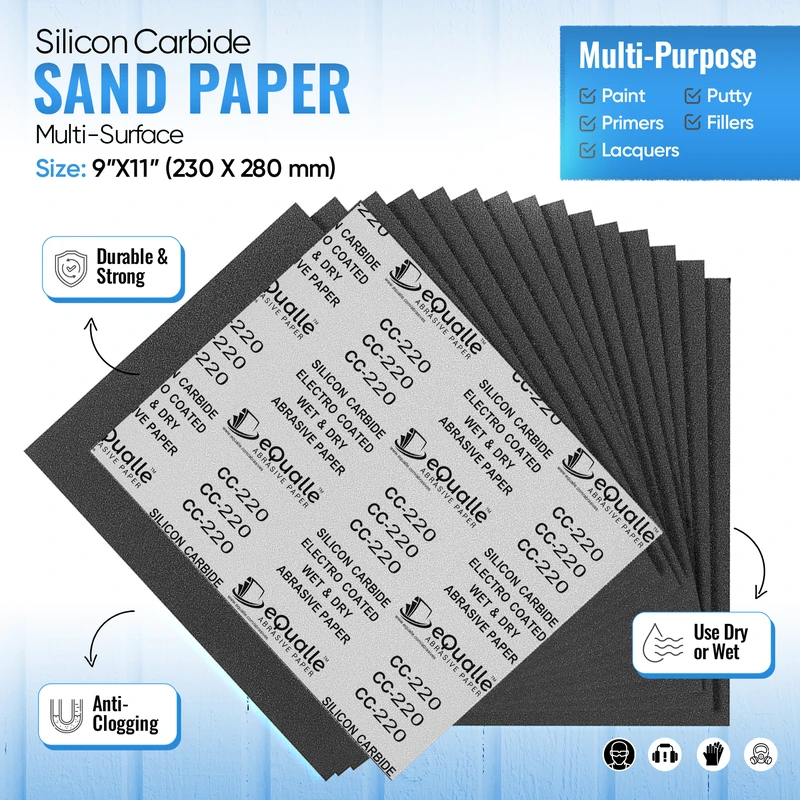
1000 Grit Sandpaper Sheets (100-pack) — 9x11 in Silicon Carbide Abrasive for Wet or Dry Use — Light polishing grit for removing swirl marks and fine scratches. Commonly used in automotive finishing, plastic restoration, and resin art. Delivers a consistent semi-gloss surface ready for final polish. (Professional Grade).
Frequently Asked Questions (FAQ)
Q: What grit should I finish sanding at to minimize swirls?
A: For dark automotive finishes, end at P3000 with a film-backed SiC or structured abrasive, wet. On lighter colors or harder clears, P2000 may suffice if your polish and pad combo can clear it quickly.
Q: Is there a single best sandpaper brand for all swirl problems?
A: No single brand wins every scenario. Look for film-backed SiC at P2000–P3000 or structured abrasives for uniformity. 3M Trizact, Mirka Abralon, and Sia foam/film systems are consistently strong finishers.
Q: Can a polish remove 1500 grit sanding marks without a P2000 step?
A: Sometimes, but it depends on coating hardness, pad choice, and abrasive uniformity. An intermediate P2000 step often shortens total polish time and reduces the risk of residual holograms.
Q: Should I sand wet or dry before polishing?
A: Wet is safer for final refinement because water flushes debris and reduces clogging, tightening the scratch field. Dry with good extraction can work on flat panels but is less forgiving.
Q: How do I avoid creating new swirls after sanding?
A: Keep pads, towels, and the panel pristine. Use dedicated towels per step, blow out pads frequently, and re-wet the surface during sanding to avoid dragging debris. Cleanliness matters as much as grit choice.