
Grain Preparation: How to Read Wood Before Sanding
A few Saturdays ago, I stood in the morning light with a walnut tabletop that had the right dimensions and the wrong look. Sun traced across the surface at a shallow angle, revealing every swirl left by a rushed sanding job the night before. I’d worked through my grits, vacuumed diligently, and still the surface read like a topographical map of mistakes. What changed the next pass wasn’t a fancier sander or a new finish—it was slowing down to read the wood first. Grain preparation sounds mundane, but it’s the difference between fighting a board and letting it finish itself. When you know which way the fibers lie, where they reverse, and how earlywood and latewood will respond, you save hours and achieve a surface that looks polished even before the first coat.
As a product engineer who’s spent years testing abrasives—mapping scratch patterns, measuring loading rates, and photographing surfaces under raking light—I’ve learned that sanding is engineering by touch. The wood’s anatomy dictates how aluminum oxide or ceramic grains fracture, how a foam-backed pad conforms, and how a scratch either hides with the fibers or shouts across them. Identifying grain direction before sanding transforms your workflow. It reduces rework, extends abrasive life, and sets a finish that will look deeper and more even.
So, before you even plug in a sander, pause. Pick up the board, angle it to the light, and ask a simple question: what story is the grain telling? The answer will determine your motion, your grit progression, and ultimately the quality of everything that follows.

Quick Summary: Read grain direction using light, touch, and simple tests, then align your abrasives and grit progression to minimize scratches and maximize finish quality.
Seeing the grain, not just the board
Most sanding problems start as anatomy problems. Wood is a composite: long cellulose fibers bound by lignin, arranged in annual growth layers. Earlywood is spring growth—softer, more porous—while latewood is dense and resists abrasion. When you sand along the fiber direction, scratches nest in the fiber channels and become visually subtle; when you sand across, scratches span across fibers and stand out. That’s why “with the grain” is so often good advice—but only if you actually know which way the fibers run.
Reading grain starts with light. Use raking light at a shallow angle (10–20 degrees to the surface). Rotate the board and watch how the highlights move: when light catches raised fibers, the “uphill” direction is usually against the grain; flip the board 180 degrees and the sheen will even out when you’re looking “with” the grain. Cathedrals (arched patterns on flatsawn faces) generally point toward the direction the fibers rise; on quartersawn faces, straight lines are your friend, but ray fleck can mask reversals. If you see alternating light/dark bands that flip as you change direction, you’re likely on a board with interlocked grain—common in sapele or utile—where the fiber direction changes every few inches.
Touch is equally telling. Drag a card scraper or even a shop rag lightly across the surface. One direction will feel smoother and quieter; the opposite direction feels fuzzier, sometimes with a faint scratching sound. On planed surfaces, you may see “washboarding” where the plane caught reversing grain; those micro-tears mark zones to sand with extra care. Edge and end profiles help too: end grain shows the arc of growth rings—use that arc to infer fiber flow on the face. If the rings arc up toward the face edge, fibers typically angle that way as well.
Finally, look at defects. Knots compress and swirl nearby fibers; treat them as micro-fields with their own directions. Mineral streaks and resin pockets can harden sections that cut differently, making a uniform motion risky. Identifying these features up front is as important as picking the right grit.
Grain preparation and reading the surface
Grain preparation is the act of making the grain legible and stable before you commit to abrasion. Think of it as surface diagnostics. If the grain is hard to read, you’ll push too hard, traverse the wrong way, or load a disc prematurely. A few low-tech tests clarify the picture:
- Moisture wipe: Lightly wipe with water or mineral spirits. This “raises the grain” just enough to outline fiber direction. Watch the fuzz stand up; it stands more aggressively against the fiber direction.
- Pencil grid: Shade a light pencil grid across the board. As you make a handful of passes in one direction with a sanding block, the grid erases faster when sanding with the grain due to lower micro-tearing.
- Tape peel: Lay painter’s tape and pull it off in opposite directions. Slight fuzz transfer and edge lift are more pronounced pulling against the grain on coarser or open-pore woods.
- Micro-scratch test: With a dull cabinet scraper edge or plastic card, make two micro-scratches at 90 degrees. The one that looks “hairier” is typically against the grain.
Preparation also includes conditioning the surface so abrasives cut predictably. If the board was planed by machine, you’ll often see ridges. Skewing your first sanding passes 10–15 degrees to those ridges can level them faster, but finish that grit along the grain to align the scratch field. On resinous woods like pine, use an open-coat, stearate-treated abrasive to mitigate loading. For dense hardwoods, a film-backed ceramic disc maintains a more uniform scratch at lower pressure—key for avoiding cross-grain scars you won’t see until stain hits.
I like to photograph tricky panels under raking LED light after each grit. The camera sees uniformity better than my eyes do, and it forces discipline in grit progression. If you still see the previous grit’s crosshatch, you either switched grits too soon, sanded across the fiber in a visible zone, or skipped the along-grain “erase pass.” Grain preparation is about making those decisions deliberate, not habitual.
Field tests for reading grain
- Use a bright flashlight at a 10–20° rake. Rotate the board and mark arrows where the surface looks smoothest—that’s your with-grain direction.
- Run a clean cotton glove across the surface both ways. Increased snagging or “nap” in one direction signals against-grain.
- Lightly dampen a corner. The raised fibers point back toward the source of stiffness—their rooted direction. Sand the opposite way.
- On edges, study the ring arc. Sand from the “root” side of the arc toward its tip, not the other way around.
Abrasive science: why direction matters
Not all scratches are created equal. Abrasive grains differ in shape, fracture mechanics, and how they plow or shear wood fibers. Aluminum oxide (Al2O3) is the workhorse for woodworking—tough, blocky grains that micro-fracture slowly, producing consistent cuts. Silicon carbide (SiC) is sharper and more friable; it cuts faster initially and can leave a cleaner surface on rigid substrates but tends to dull faster on softwoods. Ceramic alumina and zirconia alumina are engineered for high-pressure, high-heat metalwork but excel on dense hardwoods when you keep pressure low and motion controlled—they self-sharpen under load.
Grain direction dictates how those cutting edges interact. With the grain, abrasive edges tend to slide into fiber valleys, making scratches linear and visually recessive. Against the grain, the same edge cuts across fiber ends, lifting and tearing, creating scratch shoulders that scatter light. Under finish, those shoulders telegraph as gray lines.
Grit size matters too. Under the FEPA “P” scale common to woodworking abrasives, median particle sizes are roughly: P120 ~125 µm, P150 ~100 µm, P180 ~82 µm, P220 ~68 µm. Each step removes the scratch field of the previous grit by about 30–40% reduction in depth. If you cut across the grain at P120, it can take twice as many passes at P150 and P180 to erase those scratches compared to if your initial field was with-grain. The math is unforgiving: scratch depth is proportional to particle size and pressure, while visibility is amplified by directionality.
Tool dynamics amplify this. Random orbit sanders combine rotation with oscillation; they minimize directional bias but don’t eliminate it. If you hold a ROS in place, the micro-orbits still impose a weak crosshatch. When that crosshatch intersects fiber ends, you see “pigtails.” Backing pad stiffness influences scratch conformity: a soft pad wraps around earlywood/latewood ridges, reducing cross-cut severity. Hard pads level faster but risk visible cross-grain marks unless you finish with dedicated along-grain passes.
For end grain, the rules invert. You’re cutting across millions of straw-like fiber ends. Here, light cross-grain sanding with a firm backing can shear ends cleanly, while with-grain motion may just polish the surface and leave low spots. Maintain higher grits and minimal pressure to avoid washboarding.
According to a article, sanding direction on end grain is less relevant than maintaining flatness and an even scratch field; that aligns with shop experience—work through finer grits and prioritize uniformity over direction.
Finally, coatings respond differently based on scratch orientation. Penetrating stains absorb more into torn fiber ends, exaggerating cross-grain scratches as darker streaks. Film finishes level better over aligned scratch fields. Reading the grain first lets you choose abrasives and motions that keep the scratch field uniform and oriented to hide under finish.
Step-by-step: align your sanding strategy
A clear sequence keeps you from improvising under pressure. Use this method on tabletops, doors, and panels where surface quality is paramount.
- Map grain direction
- Under raking light, mark arrows indicating with-grain directions in each zone. Circle areas of reversing grain, knots, and figure.
- Select abrasives by substrate
- For softwoods: open-coat aluminum oxide, soft pad, begin at P120.
- For dense hardwoods: film-backed ceramic or high-grade aluminum oxide, medium pad, begin at P120 or P150 unless mill marks demand P80/P100.
- Level first, then align scratches
- If flattening is needed, skew the sander 10–15 degrees to the longest ridge lines at the starting grit. Once flat, make two light passes with the grain to align the field before stepping up.
- Control pressure and dwell
- Use just enough pressure to keep the pad fully engaged; excess pressure deepens scratches and increases cross-grain tear-out. Keep the sander moving 25–35 cm/s with 30–50% overlap.
- Progress grits without skipping
- Typical sequence: P120 → P150 → P180 → P220. Verify under raking light after each change: if you still see the previous grit’s crosshatch, don’t move on. On open-pore woods, stopping at P180 can improve stain acceptance.
- Treat edges, end grain, and details as separate zones
- Edge grain: short, along-grain strokes with a block to avoid rounding. End grain: progress further (P180–P320), sanding lightly, and finish with a platen-backed ROS to prevent dish. If dye or stain is planned, pre-wet and re-sand end grain at the final grit to reduce blotching.
- Clean between grits
- Vacuum, then use a clean brush. Avoid shop rags that leave lint. Any stray grit is a cross-grain scratch generator.
Special cases to watch
- Reversing grain (e.g., sapele, ribbon stripe): keep grits finer and pressure lighter across reversals; finish each grit with long, with-grain passes using a soft pad.
- Plywood veneers: extremely light pressure and higher starting grit (P150). Sand strictly with the face-grain; a single cross-grain scratch risks burning through the veneer.
- Curly and figured maple: exerts a “cat’s tongue” feel. Use fresh, sharp abrasives; consider a hand-sanding block with cork and long with-grain strokes at final grits to tame chatoyance without cross-hatching.
DIY Shou-sugi-ban Wood — Video Guide
DIY Shou-sugi-ban Wood Burning Torching Technique on Pine shows a simple torching approach that accentuates the boundary between earlywood and latewood, making grain direction visible even to a casual eye. While it’s a finishing effect, it doubles as a teaching tool: heat reveals where fibers are softer and more open, which are the same zones that load sandpaper and telegraph scratches.
Video source: DIY Shou-sugi-ban Wood Burning Torching Technique on Pine
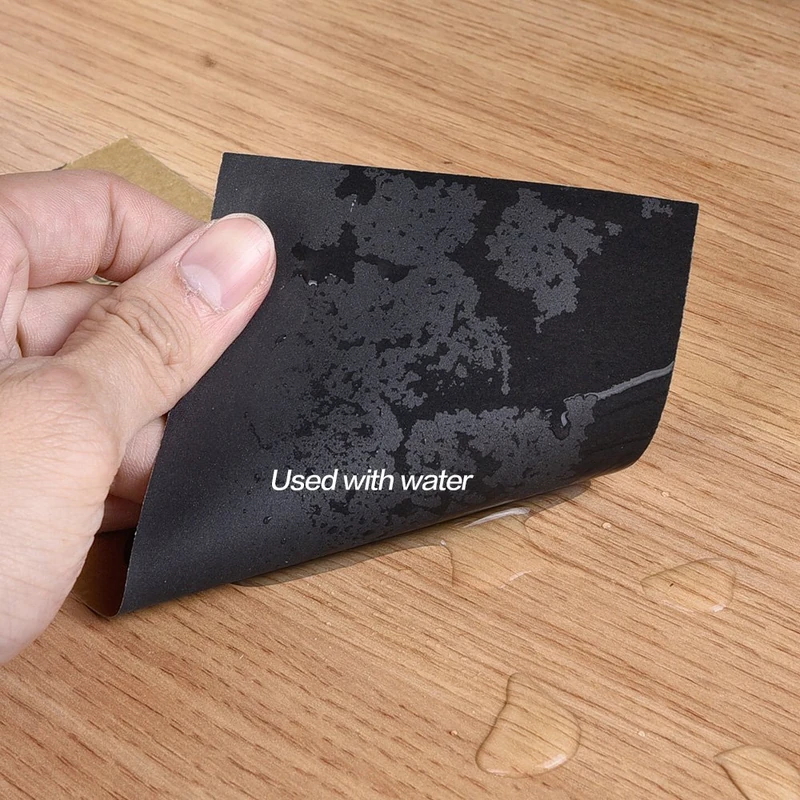
120 Grit Sandpaper Sheets (25-pack) — 9x11 in Silicon Carbide Abrasive for Wet or Dry Use — Refines surfaces after coarse sanding by removing scratches from lower grits. Consistent performance on wood, drywall, and metal. Ideal for wet or dry finishing before applying primer or stain. (Professional Grade).
Frequently Asked Questions (FAQ)
Q: How can I tell grain direction on a uniformly colored board?
A: Use raking light and touch. Rotate the board under a flashlight at a shallow angle and mark where the sheen looks smoothest—that’s with-grain. Drag a cotton glove both ways: more snagging equals against-grain. A light moisture wipe will also raise fibers against the grain.
Q: Do I always sand with the grain?
A: Mostly on face grain, yes—finish each grit with along-grain passes to align the scratch field. For leveling, short skewed passes are fine if you follow with with-grain cleanup. On end grain, direction matters less than flatness and a fine, uniform progression.
Q: What grit should I start with on a new tabletop?
A: If mill marks are shallow, start at P120. If you see planer ridges or tear-out, begin at P100 or P80, then work to P120, P150, P180, and stop at P220 for clear coats. For staining, consider stopping at P180 on open-pore woods to preserve even absorption.
Q: Why do swirl marks appear even with a random orbit sander?
A: ROS patterns still produce a weak crosshatch that becomes visible if you pause, apply excess pressure, or sand against-grain in visible zones. Use light, continuous motion, clean between grits, and end each grit with long, with-grain passes.
Q: How do different abrasives change my results?
A: Aluminum oxide offers consistent cutting and durability. Silicon carbide cuts fast but dulls quicker on softwoods. Ceramic excels on dense hardwoods when used with low pressure. Match abrasive type to wood density, and always align your final passes with the grain to hide scratches under finish.