
Raking Light Inspection and Glass Sanding Basics
A scratched backsplash, a hazy edge on a bottle you plan to turn into a lamp, the faint tick of a chip on a shower door—these are small things you don’t notice until the light hits just right. My moment was a kitchen island, late evening, phone flashlight resting on the quartz and aimed low across a new tempered-glass insert. In daylight it looked flawless. Under raking light, it told the truth: a constellation of micro-chips on the cut edge and a faint scratch arc where a coffee grinder once danced. I’ve worked on abrasive systems long enough to know two facts: defects hide in glare, and what you can’t see you can’t control. Raking light is the quickest way to see, and glass sanding—when done deliberately—is how you take control.
The temptation is to rush. A little pressure, a coarser grit, a hope that defects will “blend out.” But glass rewards patience and punishes heat and point pressure. It’s a brittle, elastic solid with low fracture toughness; push too hard and you trade a visible chip for subsurface damage you won’t notice until the next cold morning. It’s why I begin every edge job with inspection, mapping defects with a wax pencil, and only then plotting a stepwise abrasive plan.
If you’re here because your pane, bottle, or tabletop looks fine at noon and terrible at dusk, you’re already halfway to fixing it. Set up the light, learn what the surface is telling you, then choose your abrasive sequence and technique for the least material removal and the most predictable result. This guide covers the physics behind raking light, how to interpret what you see, and how to move from inspection to controlled, repeatable glass sanding without trading one problem for a bigger one.
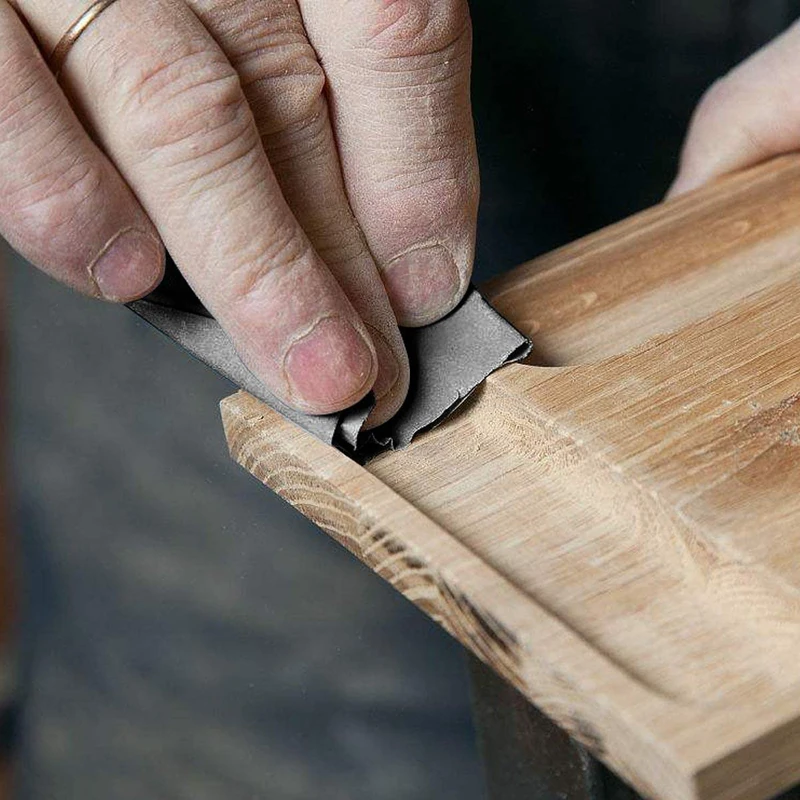
Quick Summary: Use low-angle raking light to reveal chips and scratches, map defects, then remove them with a controlled wet glass sanding sequence, measured pressure, and careful polishing.
Why raking light exposes flaws
Raking light is simply illumination at a very shallow angle—typically 10–20 degrees across the surface. At that angle, the surface behaves like a mirror for long wavelengths and a scatter source for abrupt topography. Chips, scratches, and pits have edges and depth transitions that interrupt the otherwise specular reflection. Instead of reflecting away, those features scatter light into your eye, glowing against a darker field. That contrast is why defects pop under raking light yet vanish in overhead lighting.
In testing, I position a narrow-beam flashlight or LED bar 5–10 cm off the surface, tilt it to graze the plane, and scan slowly while moving my head opposite the light. This creates moving highlights that exaggerate geometry. Chips along edges show as bright sparks with hard halos. Scratches present as lines whose intensity varies with orientation: they’re brightest when aligned perpendicular to the light direction because the scratch walls face the beam. Haze from previous sanding shows as a uniform “gray” sheen. If you rotate the light 90 degrees and the feature remains bright, it’s likely a pit or chip; if it fades, it’s an oriented scratch.
The method works on transparent and painted surfaces because the physics is local to the top layer. On glass, total internal reflection can also trap and redirect light at the surface interface, further boosting contrast along sharp discontinuities. Raking light is especially revealing for tempered glass edges: the cutting and seaming stages often leave micro-chips that remain invisible until the right angle. If you find a cluster, circle it with a grease pencil and note its approximate size. Under a 10x loupe, chips under 0.2 mm typically polish out with a fine grit progression; above that, you’ll need a coarser start to avoid extended heat and dwell.
From chips to finish: glass sanding science
When you remove glass to erase a defect, you’re doing three things: truncating the flaw tip (reducing stress concentration), blending the local geometry into the surrounding surface, and controlling the roughness spectrum so the final polish scatters minimal light. The science is simple to state and unforgiving to ignore.
Glass (soda-lime) has a hardness around 5.5–6 on the Mohs scale, fracture toughness around 0.75–0.8 MPa√m, and a brittle fracture mechanism that prefers sharp stress risers. Abrasives must be harder and friable enough to continuously expose sharp cutting edges. Silicon carbide (SiC) at ~9.5 Mohs is the workhorse for glass sanding because its crystal structure fractures readily and continues to cut cleanly. Fused alumina (Al2O3) can work, but tends to plow more than slice on glass; use it cautiously for finer stages. For final polishing, cerium oxide slurries exploit a chemical-mechanical polish (CMP) effect on silica network bonds, enabling a near-optical finish without deep scratches.
Start grit: it should just barely reach the base of the deepest defect. If you start too fine, you’ll burnish and heat the site without removing the flaw tip, risking subsurface microcracking. If you start too coarse, you’ll remove more material than necessary and spend extra time stepping through grits. For edge chips ~0.2–0.4 mm, I start with P320–P400 SiC on a rigid-backed pad; for finer scratches and haze, P600–P800 is safer.
Water is non-negotiable. Wet sanding keeps the interface cool, carries away swarf (ground glass and broken abrasive), and reduces dust hazards. It also changes the contact mechanics: water lubricates slightly, which lowers cutting forces and scratch depth. That’s a benefit, but it also means you need consistent technique—stroke count, pressure, and overlap—to produce a uniform removal field.
Abrasive selection
- Silicon carbide paper or films for P240–P1200 stages; films cut more uniformly on glass.
- Diamond hand pads (200–800 grit) for hard edges on borosilicate; they’re fast but require a lighter touch.
- Cerium oxide slurry (0.5–1.0 micron) for final polish on visible faces; felt or polyurethane pads keep the slurry engaged.
- Avoid aggressive alumina early; reserve for fine sheets where its slower cut is manageable.
In controlled trials on soda-lime edge chips, a P400–P800–P1200–cerium progression removed 0.15–0.25 mm defects with uniform haze and a mirror edge in under 20 minutes, with surface temperatures staying below 30°C under 8–10 N of applied force.
Tools and a consistent inspection setup
Repeatability starts with the environment, not the abrasive. Create an inspection and sanding station that eliminates variables. A black backdrop behind clear glass increases defect contrast during raking-light passes. A simple jig—two blocks and a straightedge—can stabilize bottle rims and tabletops so the abrasive stays flat and you avoid gouging.
Lighting matters. A narrow-beam flashlight (CRI 90+, 400–800 lumens) gives you the punch you need without washing out the field. An adjustable LED bar on a gooseneck stand makes long scans easier. Position the light to graze the surface and move your head opposite the beam to make defects “sparkle.” Keep a wax pencil or masking tape handy to mark sites as you find them; marks persist through water and won’t contaminate the surface.
Measurement beats guesswork. A 10x loupe helps you estimate chip radii and scratch depth. A simple luggage scale is surprisingly useful: hook it to a strap around your sanding hand to calibrate how 5 N vs 10 N of force feels. Do this once and your muscle memory will be far more consistent. For final evaluation, a small gloss meter can quantify improvement on flat faces; readings above 80 GU at 60° indicate low haze relative to typical consumer glass.
Safety stays in the loop. Wet sanding minimizes dust, but always wear cut-resistant gloves and eye protection. Tape edges you’re not working on to avoid incidental chips. If the glass is tempered, remember: excessive heat or deep scratches across the surface can provoke catastrophic failure. Work wet, light, and localized.
Actionable tips:
- Scan twice at orthogonal light directions; mark only defects that remain bright in both to prioritize true pits over directional scratches.
- Calibrate hand pressure with a luggage scale to 8–10 N for coarse stages and 4–6 N for fine.
- Keep a dedicated water spray bottle with a drop of dish soap; it breaks surface tension and keeps slurry consistent.
- Use a hard backing block for edges; switch to a semi-flex pad only at the final grit to blend without rounding too aggressively.
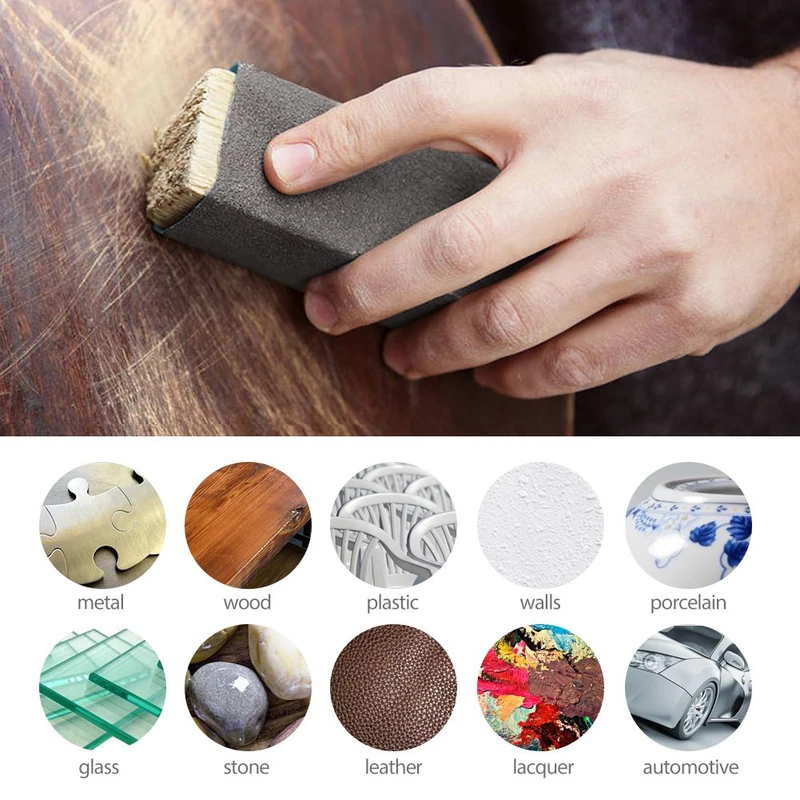
Grit path, pressure, and wet-sanding control
Sanding glass is controlled geometry change. Your job is to remove enough material to blunt defect tips and reshape the local zone, then progressively refine the roughness so it no longer scatters light. That means predictable grit jumps, measured pressure, and tight control of heat and dwell.
Grit progression: choose a start grit that barely reaches the defect base (e.g., P320–P400 for 0.2–0.4 mm chips). From there, jump by roughly 1.5–2x in grit size (P400 → P600 → P800 → P1200). Each stage should remove the scratch pattern from the previous one completely; if you still see P400 lines under raking light after P800, you rushed. For flat faces, films deliver more uniform scratch fields than papers. For edges, diamond pads at 200–400 grit are efficient on borosilicate but demand lower pressure to avoid introducing micro-chips.
Pressure and motion: calibrate your hand to 8–10 N for the first stage (think a gentle but firm press) and 4–6 N for finishing stages. I test this by pressing a sanding block onto a digital luggage scale to feel those loads. Keep strokes short and overlapping, with a consistent cadence—about 60–90 strokes per minute in a small zone to avoid localized heat. Re-wet every 20–30 seconds, wipe, and inspect under raking light. If the surface warms beyond lukewarm to the touch, pause; heat accelerates crack propagation in brittle materials and can create a frosted bloom that’s hard to erase.
Water and slurry: use clean water with a drop of surfactant. Dirty slurry re-circulates hard particles that can seed random deep scratches. Switch to a clean tray or rinse the pad between grits. When you move from P800 to P1200, reduce pressure and increase time; the goal is uniform haze, not fast removal. For a visible face polish, mix cerium oxide to a thin cream, apply to a felt pad, and work with feather-light pressure in a figure-eight, keeping the area cool and flooded. Cerium doesn’t just abrade; it chemically complexes with silica, so patience pays.
Edge control: edges chip because contact pressure spikes. Bias your strokes so the pad runs off the edge, not into it, and slightly chamfer early so the edge bears less stress. Aim for a consistent micro-bevel; you can measure it with a loupe or feel it as a uniform, soft edge under a fingernail.
Quality check: after each grit, dry the area and inspect under raking light from two directions. If any scratch from the previous grit remains, don’t advance. Document your sequence and times. Over a few projects, you’ll have a personal spec sheet for different glass types.
According to a article
That advisory material, though written for aircraft maintenance, echoes a useful principle: avoid aggressive sanding near structural bonds or finishes; use the least invasive method that achieves the requirement. The translation for home and shop glasswork is simple—protect bonded edges, keep water out of joints, and isolate your sanding to the smallest necessary area.
How To Sand — Video Guide
The walkthrough titled “How To Sand And Polish A Glass Bottle” demonstrates the real-world pacing and patience required when you’re working by hand. It shows how to set up a safe work area, start with a coarse grit to tackle saw marks or chips on a cut bottle rim, and then progress through finer abrasives before switching to a polish. The host also highlights common pitfalls, like pressing too hard or letting the surface run dry, which lead to overheating and haze.
Video source: How To Sand And Polish A Glass Bottle
400 Grit Sandpaper Sheets (10-pack) — 9x11 in Silicon Carbide Abrasive for Wet or Dry Use — Fine-cut abrasive delivering consistent, silky-smooth surfaces—used for pre-polish finishing and intermediate layers. (Professional Grade).
Frequently Asked Questions (FAQ)
Q: What angle should I hold the light for raking inspection?
A: Aim for 10–20 degrees above the surface, with the beam grazing across. Move your head opposite the light to make chips “sparkle,” and scan from two directions.
Q: Can I sand tempered glass edges safely?
A: Yes, if you work wet, keep pressure light (4–8 N), and stay on edges. Avoid deep scratches on faces and don’t let heat build; tempered glass can fail if overheated.
Q: What grit should I start with for small chips?
A: For 0.2–0.4 mm edge chips, start around P320–P400 SiC. For fine haze or light scratches, P600–P800 is safer. Always confirm under raking light before advancing.
Q: How do I know when to switch to the next grit?
A: When the scratch pattern from the current grit is uniform and the previous grit’s lines are fully gone under raking light from two directions. If any remain, stay put.
Q: Do I need cerium oxide for every job?
A: Not for concealed edges. Use cerium oxide when the surface is visible and needs clarity. It converts uniform P1200 haze to near-mirror with light pressure and patience.