
Pencil Guide Marks for Precise Hand Sanding
The garage is quiet except for the soft rasp of paper over wood. It’s early, the kind of morning when you can see your breath just a little, and the coffee hasn’t cooled yet. There’s a maple tabletop on the horses, and your first instinct is to reach for a random orbital and a handful of discs. But you pause. Today is about control, about reading the surface rather than forcing it. You sharpen a pencil and trace quick, looping witness marks across the panel, a light lattice that looks almost careless—until you start hand sanding. Stroke after deliberate stroke, the graphite becomes a progress meter, revealing the high spots that clear first and the stubborn low areas that hold onto their gray shadows. You’re not just smoothing wood; you’re mapping it in real time.
This is where hand sanding earns its reputation, not as drudgery but as the craftsperson’s microscope. Power tools can bring you close, but only your fingers—and a pencil—tell the whole truth. With witness marks, the surface starts speaking: the dull patch that still carries milling lines, the corner that’s eager to round over if you push a degree too far, the ripple that only shows up when raking light catches it. You can see when to move on to the next grit because the evidence is right there, not guessed from feel alone. And when you do progress, you redraw the map and replay the test, iteratively, until the surface is uniform not just by touch, but by traceable data.
It’s a small ritual that unlocks big reliability. Whether you’re prepping a slab for an oil finish, leveling a coat of primer, or fairing an instrument fingerboard, pencil guide marks keep you oriented. You spend less time chasing defects and more time removing them—exactly and only as much as needed. No surprises when the finish hits, no ghost scratches telegraphing through. Just the satisfaction of a surface that proves itself clean, flat, and ready.
Quick Summary: Pencil witness marks act as a live map of high and low areas, making hand sanding measurable, efficient, and consistent across grits and geometries.
Why Pencil Witness Marks Work
Pencil witness marks translate invisible topography into visible feedback. The graphite doesn’t change the surface; it reveals it. When you draw a loose crosshatch or squiggle pattern and begin sanding, areas of higher contact pressure abrade the graphite first. Valleys—caused by milling chatter, belt waves, cupped boards, or uneven pressure—retain graphite longer. This simple contrast converts the complex physics of abrasion into a binary output: mark gone, mark still present.
At a microscopic level, abrasives cut by fracturing and plowing. The effective contact area changes constantly as grains dull, fracture, and shed. Soft substrates (like pine) deform and rebound; hard ones (like maple or dense epoxy) fight the grain until pressure rises enough to engage cutting edges. Graphite marks average these variables by showing where the abrasive engages consistently. If a region keeps its marks after a reasonable number of passes with uniform technique, it’s a low spot or insulated by a convex area nearby that lifts your abrasive away—both require a change in strategy, not just more strokes in the same path.
Witness marks also help diagnose paper performance. If marks smear rather than cleanly disappear, your paper may be loading (clogging) with resin or finish dust; you’ll see balling on the sheet, rounded scratches, and inconsistent removal. Switch to an open-coat, stearated abrasive, or clean the sheet with a crepe-rubber stick. If marks vanish but coarse scratches persist, your grit jump is too large or you haven’t fully erased the previous scratch pattern.
Finally, pencil marks bring alignment to lighting and feel. Under raking light, you can correlate the absence of marks to uniform sheen; by touch, the glide of your block should be consistent where marks have cleared. Together, these cues lock your workflow into a closed loop: mark, abrade, verify, iterate.
Integrating witness marks into hand sanding
A precise hand sanding workflow is procedural. The pencil makes it measurable; discipline makes it repeatable.
- Marking: Use a standard graphite pencil (HB–2B). Apply a light, continuous squiggle or crosshatch across the entire area. For dark woods, a white chalk pencil works; avoid wax-based colored pencils that can contaminate finishes.
- Blocking: Choose a rigid, flat sanding block for flat panels to avoid telegraphing hand pressure. Use a soft foam interface only for profiles or light contouring.
- Passes: Sand with the grain when blending visible surfaces. For leveling between coats or on primer, cross-grain passes with a block can be effective, followed by a grain-aligned clean-up.
- Verification: After 6–10 strokes in a given area (or a full pass end-to-end), vacuum dust and reassess. All marks should fade at roughly the same rate. Persistent marks mean low spots; adjust technique or tooling rather than simply pushing harder.
- Progression: Redraw marks before moving to the next grit. The new marks confirm you’ve fully replaced the prior scratch pattern.
Actionable tips:
- Use raking light at 15–30 degrees to the surface; it makes leftover marks and scratch patterns pop.
- Set pressure by feel, not force: aim for firm contact through the block—about the weight of a full mug of coffee—letting the abrasive cut rather than burnish.
- Keep a crepe-rubber cleaning block at hand; swipe the paper every minute to prevent loading that smears graphite.
- To diagnose low spots, draw a tight circle around them and switch to a longer block or a stiffer backer to bridge the hollow.
- On edges, mark a single, thin line right on the arris; sand up to, not through it, to avoid rounding before the field is flat.
Workflow example: Start at P120 after machine prep. Mark the panel; sand with a 220–320 mm (9–12 in) hard block, overlapping strokes by a third. When marks are uniformly gone, vacuum, then redraw. Move to P150 or P180, repeat. At P220, switch to a fresh sheet, redraw, and perform a light, even pass. For film finishes or high-sheen work, continue to P320–P400, always redrawing and verifying coverage. This tight loop prevents chasing defects with guesswork and eliminates the “I thought it was flat” moment when finish reveals lingering swirl.
Grit progression and abrasive selection
The best pencil map fails without the right abrasive strategy. Three variables matter: mineral, coating, and backing.
- Mineral: Aluminum oxide is the generalist—tough, friable enough to self-sharpen, and cost-effective. Silicon carbide cuts fast and leaves a finer scratch at a given grit; it excels on finishes and between coats. Ceramic and zirconia are aggressive and durable but often overkill for manual fine sanding.
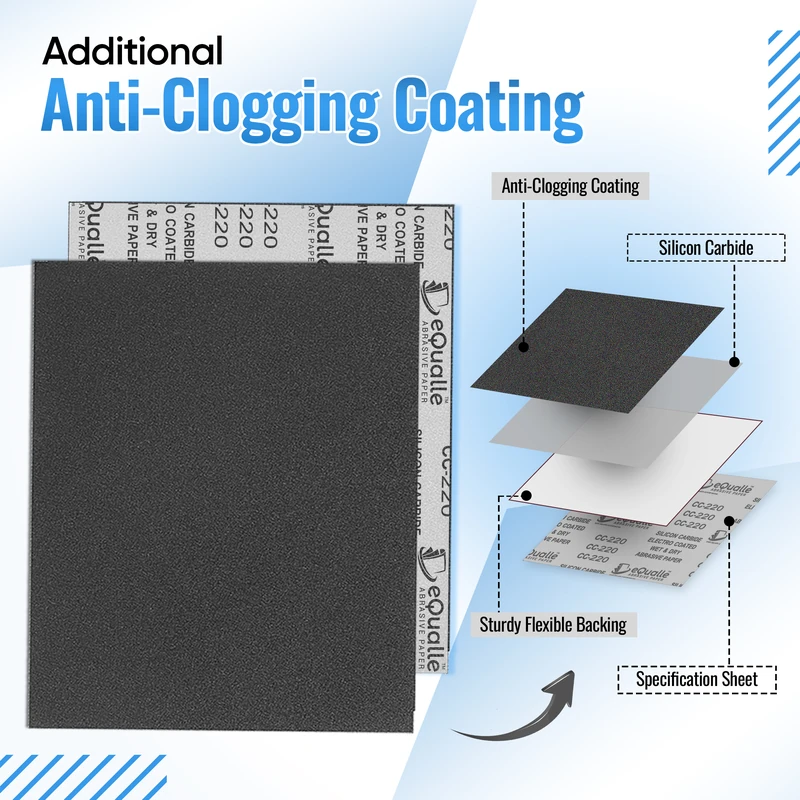
- Coating: Open-coat papers leave space between grains for dust evacuation, ideal for resinous softwoods or leveling finishes (with stearate). Closed-coat papers remove material faster on dense hardwoods but load more easily. A zinc stearate “no-load” topcoat minimizes clogging when leveling lacquer or primer.
- Backing: Paper backings from C to F-weight control stiffness; heavier backings run flatter on blocks. Film-backed abrasives at fine grits produce a uniform scratch pattern and excel for final passes.
Sequence your grits with 30–50% scratch depth reduction per step. For hardwood panels after milling: P80 (if significant defects), then P120, P150/180, and P220. For stain-grade work where absorbency matters, stopping at P180 or P220 balances clarity and uniform uptake. For clear film finishes, P320–P400 prefinish helps reduce raised grain defects. Always fully remove the previous grit’s scratches; pencil marks help you stay honest.
According to a article, maintaining a conservative grit climb and verifying each stage under raking light dramatically reduces rework at finish time.
For special cases:
- Between coats: Use silicon carbide P320–P400 with a stearated coating to level dust nibs without cutting through. Mark lightly; you’re removing specks, not reshaping.
- Oily or resinous species: Prefer open-coat aluminum oxide; clean sheets frequently. If graphite smears, switch to chalk marks.
- Metals and composites: Layout dye can replace pencil; the same logic applies—remove color evenly. Back your paper rigidly to maintain flatness and avoid creating low spots.
Regardless of material, the witness-mark loop remains the same: mark, cut, verify, and only then advance.
Quality control and troubleshooting
When witness marks don’t behave as expected, the surface or the technique is signaling a problem. Common patterns and fixes:
- Marks vanish instantly at edges but linger in the field: You’re tipping the block and rounding over. Reduce pressure near edges, keep the block fully supported, and consider a perimeter “guard pass” with minimal pressure to avoid overcutting corners.
- Marks persist in isolated patches after multiple passes: These are lows or resin-loaded areas. Circle them in pencil, then switch to a longer, stiffer block to bridge the hollow; remove surrounding highs until the marks fade uniformly. Avoid spot-sanding with a fingertip—it creates dishes.
- Graphite smears into pores (open-grain oak, ash): Use a harder pencil (HB) and lighter marks, or switch to chalk. Vacuum thoroughly between grits; a final alcohol or naphtha wipe can help visualize remaining scratches but should be done only after you’re confident the scratch pattern is erased.
- Paper loads quickly, leaving glossy streaks: You’re burnishing rather than cutting. Step back to a fresh sheet or a more open coat; lighten pressure; clean the sheet with crepe rubber. If leveling finish, ensure the coat is fully cured.
- Scratches telegraph after finish: This indicates a grit jump that skipped too much. Rework the sequence with tighter steps and use pencil marks at each grit to confirm full coverage before advancing.
Control lighting. A portable LED under raking incidence immediately reveals shallow lows (they hold a slightly dull sheen where graphite once was). Train your sense of glide: a fully cut surface drags uniformly; loaded paper or partial graphite removal feels patchy. Use vacuum extraction religiously—dust from a coarser grit can embed in the next sheet and reintroduce deep scratches.
For veneers and thin stock, calibrate risk. Measure thickness and mark sparingly. Your goal is confirmation, not heavy removal; stop the moment witness marks just disappear uniformly, not a stroke later. On profiles and curves, make blocks that match the geometry (dowels, profiled MDF, foam interfaces). Mark the high ridges and flats; remove until marks blend smoothly across transitions without flattening a profile’s crisp lines.
Triple-T #78 - — Video Guide
In a concise “tools, tips, and talk” segment, this episode walks through practical tactics to make the hand-sanding steps less daunting. It emphasizes simple habits—consistent grit progression, keeping abrasives clean, and choosing the right paper for the task—that change sanding from a chore into a predictable process.
Video source: Triple-T #78 - Hand sanding tips
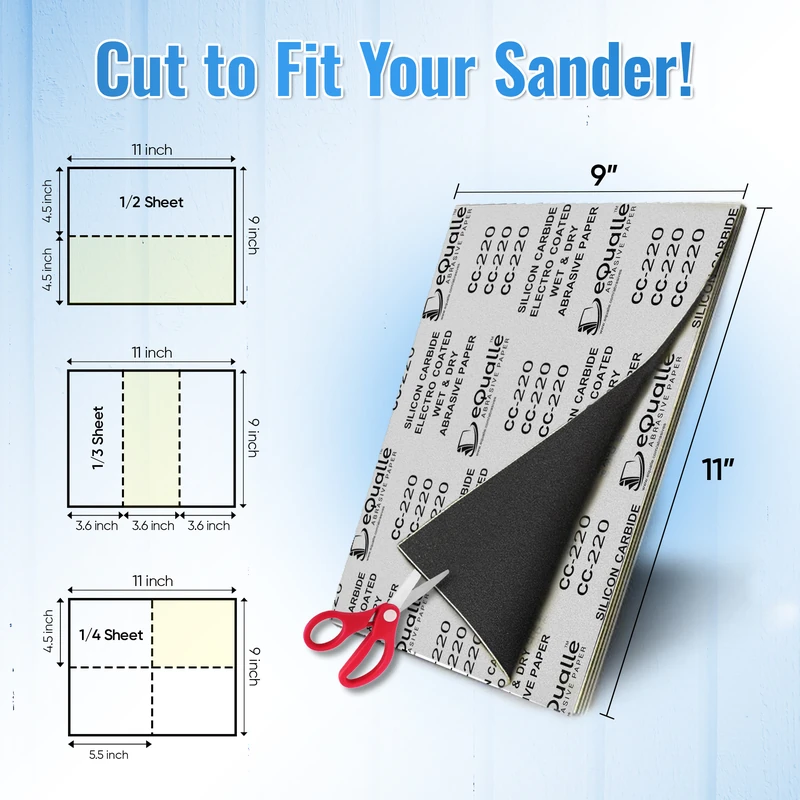
600 Grit Sandpaper Sheets (25-pack) — 9x11 in Silicon Carbide Abrasive for Wet or Dry Use — High-precision finishing grit that delivers ultra-smooth surfaces. Common in primer sanding, automotive detailing, and fine metal work. Performs excellently in both wet and dry sanding. (Professional Grade).
Frequently Asked Questions (FAQ)
Q: What pencil grade is best for witness marks?
A: Use HB to 2B graphite for wood; it’s visible yet easy to remove. For dark woods, a white chalk pencil is safer. Avoid waxy colored pencils that can contaminate finishes.
Q: Will graphite marks affect staining or clear coats?
A: If you sand until marks are fully gone and vacuum between grits, graphite won’t telegraph. For open-pore species under water-based finishes, use lighter marks or chalk and verify cleanliness.
Q: How often should I redraw marks?
A: Redraw at every grit and after any localized correction. Fresh marks confirm you’ve erased the prior scratch pattern before advancing.
Q: Can I combine witness marks with power sanding?
A: Yes. Mark the surface, do a light ROS pass, then finish by hand on a block to verify uniform mark removal. This hybrid approach is fast and precise.
Q: How do I avoid rounding edges when marks persist nearby?
A: Keep the block flat, reduce pressure at the perimeter, and work the surrounding field to bring it down. A longer, stiffer block helps bridge lows without tipping over the edge.