
Sanding Block Hardness for Every Surface Shape
The memory is small but vivid: a late evening in the garage, raking light across a cherry drawer front that looked perfect from a distance. Under the lamp, the truth appeared—uneven sheen, slight hollows near the pull recess, and a treacherously rounded lower edge. Hours of sanding, and I had softened the geometry I meant to preserve. The culprit wasn’t the grit or the wood species; it was the mismatch between the workpiece shape and the hardness of the sanding block in my hand. I was using a foam block on flats that demanded something rigid, and a rigid block on contours that needed controlled compliance. That night I learned that selecting the correct backing hardness is as fundamental as choosing the right abrasive.
If you build guitars, fair boat hulls, restore furniture, or prep auto panels, the same physics governs your surface quality. A sanding block is not just a handle for paper; it is a pressure-distribution device. Its hardness determines how grit contacts high and low features, how edges are supported or eroded, and how reliably you can remove a known scratch pattern without altering geometry. Hardness affects how much the abrasive “digs” versus “floats,” modulating both stock removal rates and the risk of unintentional rounding. Matching block hardness to the surface shape is therefore a deliberate engineering choice: the right durometer maintains form while efficiently converting elbow grease into a controlled, uniform finish. Get this wrong, and you chase swirls and dips; get it right, and your surfaces level quickly, edges stay true, and the last coat looks like you meant it.
Quick Summary: Pair block hardness to geometry—rigid for flats and edges, semi-rigid for gentle curves, flexible or profiled for tight radii—to control pressure, preserve form, and speed finishing.
Why Hardness Controls Your Finish
Block hardness is a proxy for compliance—the degree to which the backing deforms under hand pressure. This deformation determines the abrasive contact patch, which in turn sets the local pressure (force/area) and scratch behavior. On a flat surface, a rigid block maintains a plane: abrasive grains engage simultaneously, share load evenly, and cut high spots rather than follow low ones. On a curve, that same rigid block bridges, loading edges of the paper and creating non-uniform pressure that can facet the surface or generate deep scratches at the shoulders of the contact patch.
Conversely, a soft block (foam or sponge) conforms to curvature and shallow surface defects. This compliance increases contact area, lowering point pressure and “averaging” micro-topography. The visual result is smoother sheen and reduced scratch depth, but at the cost of geometry control: on flats and sharp edges, soft backers will round over and telegraph finger pressure through the block if it’s too thin or too soft.
Think of hardness selection as a stability–conformity trade. For planar work, stability dominates: a rigid or very stiff semi-rigid block maintains edge fidelity and accelerates flattening by cutting high zones preferentially. For gentle convex or concave forms, some conformity is required; a semi-rigid block with a thin interface pad follows the shape while preserving directional control of the scratch. For tight radii and complex profiles, flexible or purpose-shaped blocks are essential to avoid bridging.
Three practical implications:
- Pressure linearity: Stiffer blocks provide predictable removal per stroke; soft blocks vary with finger pressure and foam compression.
- Apparent grit: On soft backers, the same grit leaves a shallower, more diffuse scratch; on hard backers, the grit cuts deeper and tracks truer.
- Edge integrity: Only rigid blocks reliably preserve sharp arrises. Use soft backers on edges only when you intend a eased profile.
Choosing a sanding block for flats and edges
For flats, geometry is king. Use a sanding block with minimal deflection—hardwood, acrylic, aluminum, or a thick, high-durometer rubber block (Shore A 80–95) with a flat, true face. The goal is a block that behaves like a lapping plate: it references the plane and refuses to dip into lows. Pair it with pressure-sensitive adhesive (PSA) paper or hook-and-loop sheets on a thin interface (1–2 mm) only if you need slight forgiveness; otherwise, mount the paper directly to preserve crisp tracking. On longer surfaces like tabletops or doors, increase block length to bridge waviness; on narrow rails and stiles, use narrower blocks to concentrate effort where needed without tipping.
Edges and arrises deserve special caution. The physics is unforgiving: any compliance allows the abrasive to wrap the edge, concentrating forces and eroding the line. For crisp edges, chamfer very lightly with a rigid block at a controlled angle (e.g., 45 degrees) using fine grit, then return to face sanding with a fully flat orientation, keeping the block a few millimeters off the edge during early grits to avoid roll-over. When leveling joint lines, a dead-flat, rigid backer transmits force precisely across the seam rather than “smiling” over glue lines.
Actionable tips for flats and edges:
- Use a pencil crosshatch map on the surface; stop only when all marks are uniformly removed—no islands.
- Limit interface padding; 0 mm for flattening, 1–2 mm max if you need minor forgiveness without rounding.
- Keep pressure in the 1–2 psi range; excessive force collapses even stiff pads and deepens scratches unnecessarily.
- For edges, tape a “no-go” margin during coarse grits to protect arrises; remove tape at 180–220 grit for final blending.
Semi-rigid blocks for gentle contours
Gently curved panels—think guitar backs, chair seats, or automotive compound sweeps—need a backer that can bend slightly without collapsing. Semi-rigid blocks (Shore A 50–70 in rubber terms, or cork/rubber laminates, or thin MDF with a 2–3 mm foam interface) distribute pressure across the curve while preserving directional control. The block should be just compliant enough to maintain full contact across the local radius without facetting. As a rule of thumb, if the radius is greater than 10x the block thickness, a semi-rigid block with a thin interface pad can track it cleanly.
Material choices matter. Cork-faced blocks dampen chatter and can “average” minor chatter marks, especially in brittle veneers. Rubber blocks with replaceable interface pads allow you to tune stiffness on the fly by swapping pad thickness and density. For abrasive selection, open-coat papers (especially in stearated variants) reduce loading on resins and paints; cloth backing adds tear resistance as the paper flexes repeatedly over curves. Keep the abrasive fresh: dull grains on compliant backers burnish rather than cut, leading to heat buildup and swirl.
Technique makes or breaks contour sanding. Work with the grain or body line to avoid cross-grain scratches that telegraph under finish. Use short, overlapping strokes that follow the curvature, and maintain even pressure from palm to fingers—avoid “point loading” with fingertips that will print through a semi-rigid pad. Periodically rotate the block or change hand positions to average out any bias.
Practical tips for gentle contours:
- Tune durometer: start at Shore A ~60 and adjust via pad thickness until the block matches the radius without bridging.
- Use hook-and-loop abrasives with a firm interface pad; they swap fast and resist edge catch on curves.
- Inspect with raking light from multiple angles; gloss reveals low zones that a semi-rigid block should still correct.
Flexible and profiled blocks for tight curves
Tight radii, coves, beads, and sculpted transitions demand true flexibility or a shaped negative that matches the profile. Foam blocks (Shore 00 scale) and sanding sponges conform aggressively, making uniform contact in areas where rigid or semi-rigid blocks would bridge and score shoulders. For concaves, a contoured sanding block shaped to the workpiece radius delivers repeatable contact without crowding edges. You can create these profiles using dense foam cut to shape, 3D-printed holders with interchangeable radiused inserts, or even poured urethane cast around a sealed master.
Here, the prime risk flips: geometry loss from over-conformity. Overly soft blocks can “follow” defects rather than level them, translating to prolonged sanding and potential wash-out of crisp details. Mitigate this by stepping through grits deliberately and locking in geometry first with the least compliance that still maintains full contact. Employ narrow strips of abrasive around profiled forms to avoid sanding beyond the intended footprint. On complex bead-and-cove moldings, a set of matched-radius blocks prevents flattening the quirk line.
According to a article, crafting purpose-shaped blocks can be straightforward and highly effective, especially when you need repeatability across symmetrical parts. Whether you laminate cork to shape, route matching radii into hardwood, or cast flexible backers, the principle is the same: maximize contact where you want material removal and minimize it where you don’t.
Implementation notes:
- Use softer blocks only after establishing the form; they refine, not define, geometry.
- Wrap abrasive smoothly without wrinkles; any fold becomes a cutting ridge on soft backers.
- Replace abrasives more frequently; flexible setups load faster and cut cooler with fresh grains.
Workflow: grits, passes, and inspection
Whatever the geometry, a disciplined workflow converts good block selection into a predictable finish. Begin by defining the target: flattening, fairing, or finishing. Flattening (establishing plane or profile) uses the hardest practical block and coarser grits (80–120) with long, straight strokes aligned to the dominant line. Fairing (smoothing high/low undulations without changing form) uses semi-rigid blocks and mid grits (150–220) with overlapping arcs that follow curvature. Finishing (scratch refinement) uses flexible or lightly padded blocks at 220–400+ grits, with reduced pressure and crosshatch passes to erase the previous scratch pattern fully.
Mark the surface with a light pencil grid before each grit change; it’s the fastest truth-teller for whether you’ve uniformly removed prior scratches. Use raking light and a squeegee of mineral spirits or water (on compatible substrates) to simulate a finish and expose remaining marks. Maintain cleanliness: vacuum between grits and wipe down to avoid rogue coarse particles causing deep scratches at later stages. Track your grit progression and block choice in a quick bench note; repeatability is your friend, especially across matching parts.
Pressure and stroke management matter as much as grit. Aim for consistent, low pressure—just enough to keep full contact without collapsing interfaces. Let the abrasive cut; if you need to push, the grit is dull or the block is too soft for the task. Finish each grit with several light, full-length passes to normalize the surface. On edges and transitions, use dedicated micro-blocks (small, rigid forms) to control contact area precisely rather than trying to “feather” with a larger flexible block.
Actionable workflow tips:
- Never skip more than one grit step; scratch depth scales nonlinearly and becomes costly to remove later.
- Keep separate blocks for coarse and fine grits to avoid contamination.
- Orient scratch direction ±10–15 degrees between grits to make inspection unambiguous.
Are you using — Video Guide
If you’ve ever wondered whether your block is too hard, too soft, or just wrong for the job, a concise video breakdown helps connect theory to practice. One clear, practical walkthrough compares rigid, semi-rigid, flexible, and contoured sanding blocks, showing where each shines and where it causes trouble. It also discusses materials such as cork, rubber, and foam, and how hook-and-loop or PSA interfaces change behavior.
Video source: Are you using the wrong kind of sanding block? What you need to know...
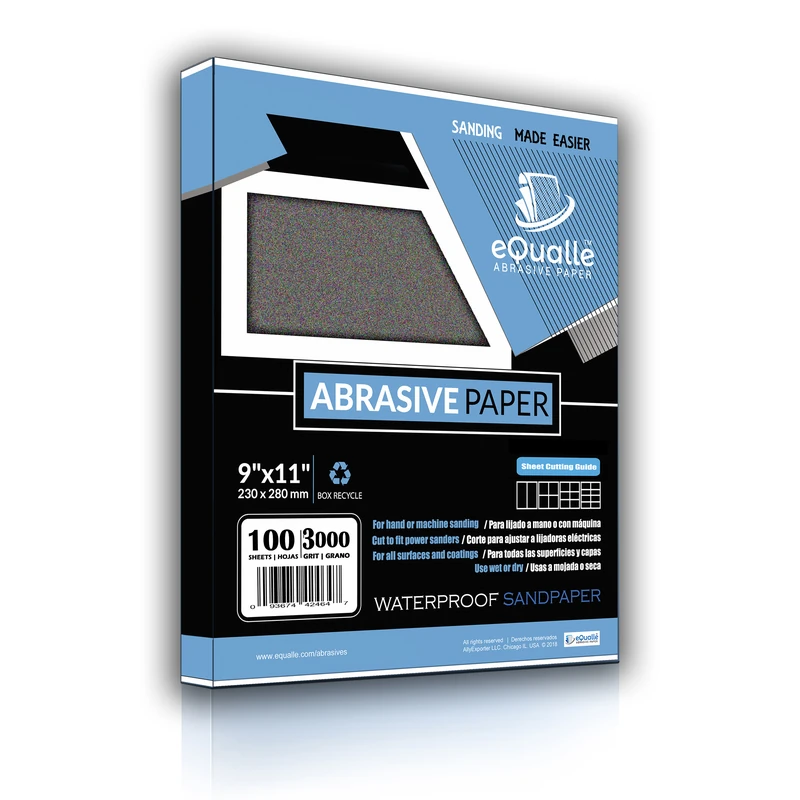
240 Grit Sandpaper Sheets (25-pack) — 9x11 in Silicon Carbide Abrasive for Wet or Dry Use — Light refinement grit that blends sanding marks and smooths primer layers. Perfect for wood, resin, or plastic before lacquer application. Produces consistent scratch patterns and controlled results when used wet or dry. (Professional Grade).
Frequently Asked Questions (FAQ)
Q: How do I choose durometer for a rubber sanding block?
A: For flats and edges, start in Shore A 80–95; for gentle curves, Shore A 50–70 with a 2–3 mm firm interface pad; for tight curves, move to flexible foam or shaped profiles (Shore 00 scale), using the softest option that still maintains control.
Q: Why do my edges round over even with a stiff block?
A: Two causes are common: using a soft interface pad that wraps the edge, or applying pressure near the arris. Remove or minimize padding for flattening, keep the block a few millimeters off edges during coarse grits, and chamfer intentionally at fine grits.
Q: Can I use the same grit on different block hardness levels?
A: Yes, but expect different behavior. On a hard backer, the same grit cuts deeper and truer; on a soft backer, it leaves a shallower, more diffuse scratch. Adjust pressure and grit progression accordingly, and rely on pencil maps and raking light to confirm scratch removal.
Q: When should I make a custom profiled block?
A: Any time you need repeatable results on a specific molding, tight radius, or concave feature. Custom profiles maximize contact where needed and protect adjacent details, reducing sanding time and preventing geometry loss.
Q: What’s the fastest way to verify I’m ready to change grits?
A: Use a pencil crosshatch before starting a grit, sand until all marks are removed uniformly, and then inspect under raking light. If any previous-grit scratches remain visible after a solvent wipe, stay on the current grit longer.