
Paper vs Film at Fine Sandpaper Grit
The raking light doesn’t lie. You step back from a newly lacquered side table, swipe your palm across the surface, and angle a work lamp until the beam scrapes across the sheen. There they are—ghost rings, faint pigtails, witness lines from a previous pass that seemed flawless under overhead lighting. If you’ve been here before, you already know this isn’t a matter of elbow grease—it’s about control. Control starts with substrate stability, mineral uniformity, and careful sequencing of sandpaper grit. At fine grades, the difference between paper-backed abrasives and polyester film is not academic; it’s the difference between hitting final gloss in one polishing cycle or chasing micro-scratches through an entire morning.
When finishing black polyurethane doors, rubbing out a violin back, de-nibbing a high-solids clearcoat, or leveling an epoxy pour, the margins shrink as grit climbs. Paper feels familiar and forgiving, but at P800 and finer, even a single rogue grain or a crease from a folded sheet can telegraph through your finish as a scratch you can’t buff out. Film, by contrast, stays flat, sheds fewer rogue particles, and delivers a narrower scratch-depth distribution—yet it can skate over pores in ring-porous woods or feel too aggressive when you want subtle topography rather than a glass-flat panel. Choosing the right backing at high grits is less about brand loyalty and more about physics: backing rigidity, coat uniformity, resin systems, electrostatic orientation, and whether you’ll run dry, with vacuum, or with a lubricant.
This article breaks down how paper and film actually behave at fine grades, how “grit” maps to microns in the real world, and how to design a sanding workflow that avoids heat, clogs, and edge burn throughs. You’ll get specific, field-tested steps to select, deploy, and verify fine abrasives—so the next time you tilt that lamp, the surface stays quiet.
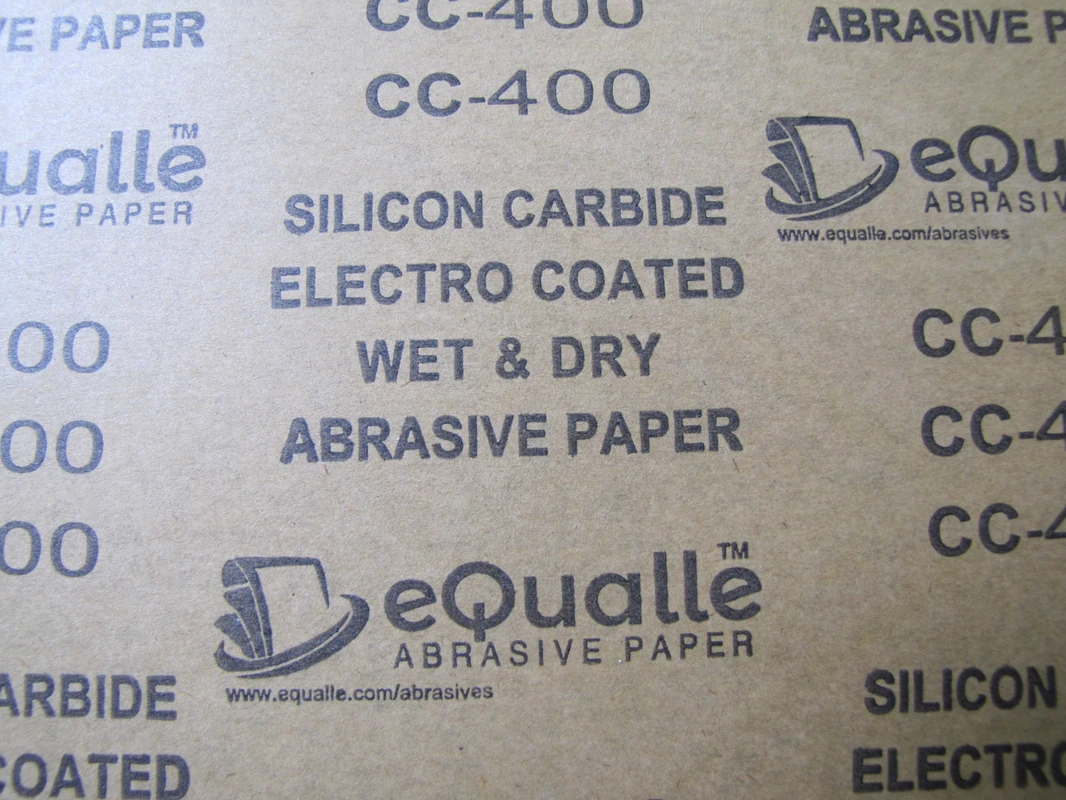
Quick Summary: At fine grades, film-backed abrasives deliver more uniform, shallow scratches and better wet performance, while paper-backed sheets conform better on profiles; pick the backing to match substrate, finish, and extraction, not just the grit number.
Where Fine Abrasives Diverge
The backing is the chassis of a coated abrasive. At fine grades (P800 and up or sub-20 µm), polyester film and paper behave differently under pressure, temperature, and dust loading.
Backing stability: Film is dimensionally stable and flat. That uniformity holds the resin/abrasive layer at a more consistent stand-off from the work, minimizing thickness undulations that become random deep scratches. Paper (A/C-weight at fine grits) is lighter and more compliant. It conforms to subtle surface undulations and profiles, which is helpful on complex mouldings and edge breaks, but it can crease and telegraph wrinkles that scratch unpredictably.
Grain and coat uniformity: Film abrasives often use precise, micron-graded minerals (frequently aluminum oxide or silicon carbide) with tight sieving and electrostatic orientation. Many premium films add anti-loading stearates without compromising cut. Paper can be equally well-graded in high-end lines, but the combination of paper fibers, resin soak, and open-coat patterns introduces slightly broader scratch-depth distributions at very fine grades. That variance is what you feel as “mystery scratches” that appear after polishing.
Durability and wet use: Film resists tearing and is inherently water-resistant. It excels for wet sanding clears, gelcoats, and resins where a water/soap mist floats swarf away. Paper—unless specifically resin-impregnated for wet/dry—swells, loses grit, or delaminates when soaked. Dry, paper can be more comfortable in hand, especially for folded detail work.
Heat and friction: Fine abrasives generate high friction. Film’s smooth, non-porous backing can reduce dust embedding and release swarf more readily when paired with vacuum extraction. Paper breathes a bit more but tends to load at the cutting interface if dust isn’t cleared aggressively.
The practical takeaway: when you need a uniform, non-directional finish that polishes predictably (e.g., clearcoat de-nibbing, epoxy leveling), film wins. When you need compliance and fingertip feedback on a shaped profile, or you’re finishing bare wood where pore structure matters more than absolute flatness, paper remains a powerful tool.
How sandpaper grit maps to microns
“Grit” isn’t a universal constant. Fine sandpaper is typically rated by FEPA “P” grades for coated abrasives, while microfinishing film is frequently labeled by micron size (µm). These systems overlap but don’t align perfectly, and real-world cut depends on grain type, coating density, and backing stiffness.
Typical approximations: In many datasets, P800 averages around 21–23 µm particle size, P1000 around 18–20 µm, P1500 around 12–15 µm, P2000 around 10–12 µm, and P2500 around 8–10 µm. Microfinishing films labeled 30 µm often track near P600–P800 feel; 15 µm near P1000–P1200; 9 µm near ~P2000; 5 µm near ~P3000–P4000; 3 µm near ~P5000. Expect overlap and variance among brands.
Distribution matters: A FEPA P-grade specifies a distribution window, not a singular particle size. Film products often use a narrowed distribution and highly uniform resin thickness, which reduces “rogue” deep scratches at the same nominal grade. That’s why a 9 µm film can polish out faster than a P2000 paper that, on average, is similar in size but exhibits a few outlier grains.
Mineral behavior: At these sizes, silicon carbide (SiC) fractures to maintain sharp cutting points, giving a finer, more consistent scratch on hard coatings—ideal for clearcoats and resins. Aluminum oxide (AlOx) is tougher and can be better for wood fibers where you want less aggressive micro-fracturing.
Scratch look vs number: Surface appearance is a function of scratch depth distribution and pattern density. Film’s consistent apex height yields a tighter Ra/Rz and a more uniform haze under raking light. Paper may leave a slightly more diffuse, forgiving appearance on open-grained woods but runs higher risk of single-line defects.
Don’t chase exact equivalence across brands; instead, calibrate on a test panel. Start with your target polish outcome (compound and pad system), then step back to find the coarsest fine grade that clears the prior step without leaving deep stragglers. That is your production “map,” not the label on the sleeve.
Film vs paper in real workflows
Translating differences into productivity requires context: substrate, finish chemistry, and tool choice.
Bare wood finishing: On hardwoods, a paper-backed P320–P400 progresses the surface without crushing springwood. As you approach seal and topcoats, jumping to film at P600–P800 can over-flatten pore contrast or skate over edges. Many shops stay on high-quality paper through P400–P600 for pre-finish, then de-nib between coats with a soft-backed paper or film P800–P1000 using light pressure. Film discs shine when leveling high-build sealers or waterborne finishes that load paper; use an interface pad to preserve edge roll-offs.
Painted/clear-coated panels: After cure, nib removal and texture leveling benefit from film’s controlled scratch. A 15 µm (≈P1000–P1200 feel) film clears dust nibs without leaving random deep cuts; follow with 9 µm (≈P2000) and then compound. For high-solids clear on automotive or cabinetry, wet film with a light surfactant mist and full dust extraction keeps temperatures down and eliminates chowdered swarf.
Epoxy, resin, and composites: Film dominates. Wet-sanding with 15/9/5 µm film yields a uniform satin that compounds quickly. Paper at these grits tends to soften, shed, or embed dust, and edge tear-offs can score cured resin.
Metals and hardware: For brushed stainless or aluminum prior to coating, film produces very regular scratch that blends predictably. Paper can conform better to small radii but introduces directional variability at high grits.
Hand work vs ROS: Film on a random orbital sander (ROS) reduces the risk of deep single-point cuts; pair with multi-hole extraction. For hand sanding, paper offers better tactile feedback, especially when folded or wrapped around a cork or foam block.
According to a article, equivalence across abrasives (e.g., stones vs coated abrasives) is not one-to-one; the substrate, bond, and abrasive geometry change cut behavior at the same nominal grade. Apply that same caution when swapping between paper P-grades and micron-rated films.
Heat, dust extraction, and loading control
At fine grits, friction and swarf accumulation are the enemy. Control them, and your abrasives cut faster, last longer, and leave cleaner scratch.
Heat generation: As scratches shallow, more surface area engages per unit time. Excess pressure or stalled pad rotation spikes temperature. Film resists deformation under heat, but resin bonds and finishes don’t. Keep pad rotation within the sander manufacturer’s spec to avoid “heel drag,” and use interface pads on contoured work to distribute pressure.
Dust extraction: Multi-hole patterns matter more than grit at fine grades. Film discs typically pair with 15–49 hole patterns; align accurately to the pad or use a universal mesh interface. Extraction reduces loading, prevents abrasive glazing, and lowers pigtail risk by evacuating loose grain and swarf that would otherwise recut.
Anti-loading chemistry: Stearate coatings reduce clogging in both paper and film formats, especially on paints and resins. However, stearates can interfere with subsequent coatings if not removed—wipe down with a compatible solvent or waterborne cleaner per finish system guidance.
Wet sanding: Water with a drop of dish soap lubricates the cut and floats debris when de-nibbing clears or leveling epoxy. Film is the safe choice here. Change water frequently; a dirty slurry is a scratch generator. Avoid soaking paper unless it’s clearly rated wet/dry and shows no fiber rise.
Actionable control tips:
- Use compressed air to “pulse clean” discs every 60–90 seconds; don’t rub with a crepe block at fine grits—it embeds contaminants and rounds grains.
- Mark the pad edge and watch rotation; if it stalls, lighten pressure or increase vacuum to restore pad motion and reduce heat rings.
- Add a 3–5 mm foam interface pad when sanding over edges to prevent cut-through and to spread contact pressure at high grits.
- For resin-rich swarf, switch to wet film at the same micron grade rather than advancing grit; you’ll clear the load and maintain step discipline.
Procurement and test methods that pay off
Consistency at fine grits is a supply-chain problem as much as a technique problem. Buy smart, verify, and lock the workflow.
Specify the system, not just the grit: For production, define backing (film or paper), grain (SiC or AlOx), grade (P or micron), coat type (open/closed, stearated), attachment (PSA or hook-and-loop), and hole pattern. That ensures repeatability when vendors substitute “equivalent” products.
Sample across micron steps: For clearcoats and epoxies, acquire a 15/9/5/3 µm film set from at least two brands. For wood, sample P400–P800 paper in A/C-weight, with and without stearate. Run the same panels, same sander, same extraction.
Verify with evidence: Use raking light on black gloss panels, or apply a guide coat (very light dry pigment or spray) to visualize scratch clearing between steps. A 10× loupe or inexpensive USB microscope reveals rogue lines. If you can, measure gloss after compounding to confirm finish readiness by grit path.
Track lot performance: Record disc life by square footage or panel count. Fine films often outlast paper by 1.5–3× in wet or high-load tasks; if that isn’t true in your shop, investigate extraction alignment or pressure.
Optimize attachment: PSA film gives the flattest interface for platen work and dead-flat edges; hook-and-loop speeds changeovers on ROS but adds compliance. For final leveling before polish, the slightly firmer PSA stack may yield a cleaner, shallower scratch-field.
Five practical steps to lock your fine-grit workflow:
- Build a mirrored test panel set (one for paper, one for film) finished with your actual coatings and cured to production timeframes.
- Map a minimal-step path that clears prior scratch reliably (e.g., 15 → 9 → 5 µm film wet for clear; P400 → P600 → P800 paper dry for wood pre-finish).
- Fix sander variables: pad hardness, interface thickness, RPM/OPM, and vacuum CFM; document them on the cart.
- Establish a disc retirement rule: if scratch uniformity drops or temperature rises noticeably, toss; false economy here costs hours in polishing.
- Train to pressure: use a spring scale or force-sensing pad to calibrate the light hand required at fine grades, then enforce with periodic checks.
How Do I — Video Guide
New to furniture refinishing or just refining your approach to final sanding? This video walks through how to select the right fine grades for each step of a flip, from stripping and leveling to de-nibbing between coats and prepping for polish. It emphasizes when to move up in grit, how to avoid pigtails, and why clean extraction and light pressure matter as grits climb.
Video source: How Do I Sand Furniture? | Sandpaper Grit 101 - Know Which Grit to Use for Each Step of Your Flip!
280 Grit Sandpaper Sheets (25-pack) — 9x11 in Silicon Carbide Abrasive for Wet or Dry Use — Fine abrasive for leveling varnish or clear coats with precision. Creates a refined surface before high-gloss finishing. Performs reliably on wood, resin, or painted materials in wet or dry conditions. (Professional Grade).
Frequently Asked Questions (FAQ)
Q: Does a 2000 sandpaper grit sheet equal a 9 µm film sheet?
A: Roughly, yes—both target a similar finish class. But film’s narrower particle-size distribution and flatter backing often leave a shallower, more uniform scratch than a P2000 paper, so polishing tends to be faster with 9 µm film.
Q: When should I prefer paper over film at fine grits?
A: Choose paper for bare wood pre-finish and complex profiles where conformity and tactile feedback matter. Use high-quality A/C-weight papers around P400–P800, then consider film for de-nibbing between coats if loading becomes an issue.
Q: Can I wet-sand with paper at P1000 and above?
A: Only if it’s explicitly rated wet/dry and remains dimensionally stable. Most fine paper swells and sheds grit when soaked. Film is the safer, longer-lasting choice for wet sanding clears, epoxies, and gelcoats.
Q: Is it okay to skip grits at the fine end?
A: You can skip if your next step fully clears the previous scratch without pressure spikes. For example, 15 → 9 µm often works; jumping from P800 paper directly to 5 µm film usually leaves persistent haze. Validate on a test panel under raking light.
Q: Why do I still get pigtails with fine film and good extraction?
A: Common causes include stalled pad rotation from excessive pressure, misaligned multi-hole discs, contaminated pads, or re-deposited swarf. Lighten pressure, realign holes, pulse-clean with air, and replace worn interface pads to restore clean cutting.