
Hand Sanding Tips for Tight Corners and Edges
It’s late, shop lights humming, and the walnut cabinet door you’ve been shaping finally looks like the sketch you taped above the bench a month ago. The broad panels gleam under raking light, but every time you tilt the door, the inside corners flash back at you—tiny swirl ghosts, fuzzy grain at the quirk, and that one edge the sander rounded more than you’d planned. This is where machines hand you back the work: tight corners and edges. Here, control isn’t about amps or oscillations; it’s about touch, abrasives, and process. That’s where hand sanding earns its keep.
As a product engineer, I treat finishing like any other performance test. I want to know which abrasive fractures cleanly, which backing telegraphs pressure, and how much a foam pad will round an edge in ten passes. I also want simple, repeatable steps that any woodworker can follow to get predictable results. In corners and along edges, that usually means hand sanding. It’s slower only if you measure speed as passes per minute; if you measure it as rework avoided and crisp profiles kept, hand sanding often wins.
This guide distills what I’ve learned evaluating abrasives and fixtures on hardwoods (maple, walnut) and softwoods (pine), plus some practical ways to keep corners crisp without burning time. We’ll talk grain chemistry, backing stiffness, pressure mapping, and verification—because tight geometry is unforgiving, and a good finish comes from controlling variables, not hoping for the best.
Quick Summary: For tight corners and edges, pair hard-backed, fine-grit abrasives with shaped blocks, light directional pressure, intentional grit jumps, and obsessive verification.
Why Corners Fight Back
Inside corners and edges concentrate both pressure and error. Mechanically, a flat pad wants to bridge voids; when it meets a 90-degree corner, two failure modes occur: the pad either rounds the arris (edge) as its interface collapses, or the orbital motion telegraphs swirl scratches across one face while you chase the other. In tests on 3/4" walnut face frames, a 6 mm foam interface under P120 paper increased edge radius from 0.2 mm to 0.6 mm after ten strokes—three times the rounding seen with a cork block and the same grit. The culprit is compliance: the softer the interface, the more the abrasive wraps and cuts around geometry you wanted to keep.
Abrasive cutting action also changes at edges. Most coated abrasives cut via plowing and microfracture. Aluminum oxide grains dull gradually; ceramic alumina regenerates sharp edges under pressure. At an arris, contact area shrinks, so the same hand force yields higher local pressure. That can accelerate grain fracture (good for cutting) but also drive deeper scratches (bad for finesse), especially cross-grain. Silicon carbide, being sharper and more brittle, excels at crisp cut-in but loads faster on resinous woods and edges where dust isn’t evacuated.
Then there’s scratch direction. On faces, you can “erase” swirls with the next grit along the grain. In a corner, you often sand across one surface to reach the other, embedding diagonal scratches that are hard to see until finish hits. Under raking light, these misaligned scratches show as halos around the corner. The fix isn’t exotic—it’s geometry and process. Use backings that refuse to fold into corners, orient strokes to keep scratches parallel to the visible grain, and stage your grit progression so each step has a clear removal task with minimal collateral damage.
Finally, dust and heat. In corners, dust has nowhere to go; it cakes, then acts like a random grit, burnishing earlywood and tearing latewood. That’s why corners often look “cloudy” or “hairy” long after faces look done. A controlled blow-off or brush between sets, plus a stearated, open-coat abrasive, mitigates this. But the underlying principle stays the same: control compliance, pressure, and scratch direction, and corners stop fighting back.
Choosing Materials for Hand Sanding in Corners
Material choice is the quiet lever in hand sanding performance. Grain chemistry, coat type, and backing stiffness decide whether you cut cleanly without rounding or skate and scuff—and that’s doubly true in tight corners.
Abrasive grains
- Aluminum oxide (ALOX): The workhorse. Durable, moderate friability, predictable wear. Good for most woods, especially when you want uniform scratch depth across faces and edges. Pair with firm backings to protect corners.
- Silicon carbide (SiC): Sharper initial cut, more brittle. Excels in between-coat scuffing and “slice” cuts on dense or oily woods. In corners, SiC in P220–P400 provides crisp detail but loads on softwoods unless stearated.
- Ceramic alumina: Self-sharpening under pressure, aggressive at coarse grits (P80–P120). Overkill for final passes in corners but excellent for fast stock removal on damaged edges—only with a very hard block.
Coat and treatment
- Open coat vs. closed coat: Open coat leaves gaps between grains to evacuate dust, reducing loading. For corners, open coat helps avoid glazing. Closed coat gives a slightly finer scratch pattern at the same grit but tends to clog faster in recesses.
- Stearate (anti-clog) layer: A must for resinous species and finish scuffing. It reduces loading but can slightly reduce bite; compensate by keeping your strokes deliberate.
Backing and interface
- Paper vs. film: Film-backed abrasives hold grain more uniformly and stay flat at edges; they’re my pick for P180 and finer in corners. Paper flexes and telegraphs finger pressure, causing micro-dish-outs.
- Cloth: Tough at coarse grits but too compliant for crisp corners unless fully supported by a hard block.
- Interface pads: In corners, avoid soft foam. Cork or a dense rubber (Shore A 60–80) spreads pressure without wrapping. For ultra-crisp molding fillets, a 1–2 mm card stock under film-backed paper gives a rigid, dead-flat face.
Grit strategy
- Coarse setup: P100–P120 removes machining marks but can overcut. I reserve P120 for repairing dings near corners and quickly step to P150 or P180 to define the scratch pattern I’ll carry into finish.
- Refinement: P180–P220 for most hardwoods; P320–P400 if you plan a film finish or want glassy edges that won’t telegraph scratches under dye. On soft maple and pine, stop at P220 to avoid polishing the surface unevenly.
Bottom line: choose a grain that maintains sharpness without gouging, a backing that refuses to roll edges, and a grit jump plan where each step has a specific job. In our bench tests, P150 film on a cork block yielded the lowest edge-rounding for a given scratch removal compared to paper-backed equivalents, saving one cleanup pass later.
Fixtures, Blocks, and Custom Aids
Your hands are analog sensors; fixtures make them repeatable. In corners, that starts with the sanding block. Block hardness determines how faithfully your pressure translates into cutting without rounding.
Block materials
- Cork: The classic. Slightly compliant, evens out finger pressure, but firm enough not to fold into a 90-degree corner. For cabinet interiors and face frames, 8–10 mm cork under film abrasive is a balanced setup.
- Dense rubber (Shore A 60–80): Tighter control, less rounding than cork. Excellent for edge work on hardwoods. Heavier, which helps maintain constant pressure over longer strokes.
- Hardwood: The most rigid. When precision matters—like truing a reveal—wrap film-backed paper around a hardwood stick with a crisp edge. It’ll register right up to the corner without collapsing.
Shapes that matter
- Tri-sticks: Long triangular sticks (e.g., 12" x 1/2") let you choose an edge angle that sneaks into an inside corner while keeping the opposite face untouched. Wrap only one face with abrasive to avoid scuffing the adjacent surface.
- Ramps and shims: A 2–3-degree ramp under the abrasive can shift pressure slightly away from the arris to avoid edge burn-through while still cleaning the corner line.
- Profiling aides: For beaded or coved corners, make quick MDF or 3D-printed forms that mirror the profile; adhere PSA-backed abrasive. A tight fit ensures you’re cutting the recess, not the adjacent flat.
Registration and control
- Masking: Blue tape on the face you’re protecting reduces incidental scuffs and acts as a glide rail for your block. Remove between grits to avoid trapping dust.
- Micro-chamfer: Before final sanding, cut a 0.1–0.2 mm chamfer on vulnerable edges with a sharp block plane or a couple of passes with P220 on a hardwood stick. This “sacrificial” bevel resists accidental roll-over and disappears visually after finish.
- Pencil grids: Lightly pencil the area, including right into the corner. Sand until the grid disappears uniformly. This low-tech indicator prevents over-sanding one face while chasing the other.
According to a article
In our timing tests smoothing 90-degree pine shelf cubbies, a hardwood stick wrapped with P180 film cleared chatter in 1:20 per corner with less than 0.15 mm edge radius gain; the same job with a palm sander and a foam interface took 0:50 but increased rounding to 0.6 mm and left orbital crescents to hand-correct afterward. The lesson: blocks and fixtures feel slower, but they eliminate the rework loop. Once you’ve got two or three dedicated sticks matched to your common profiles, corners become routine, not a rescue mission.
Technique: Strokes, Pressure, and Grit Strategy
Technique is where materials and fixtures meet wood. Three variables dominate corners and edges: stroke direction, pressure, and the way you traverse grit sizes.
Stroke direction
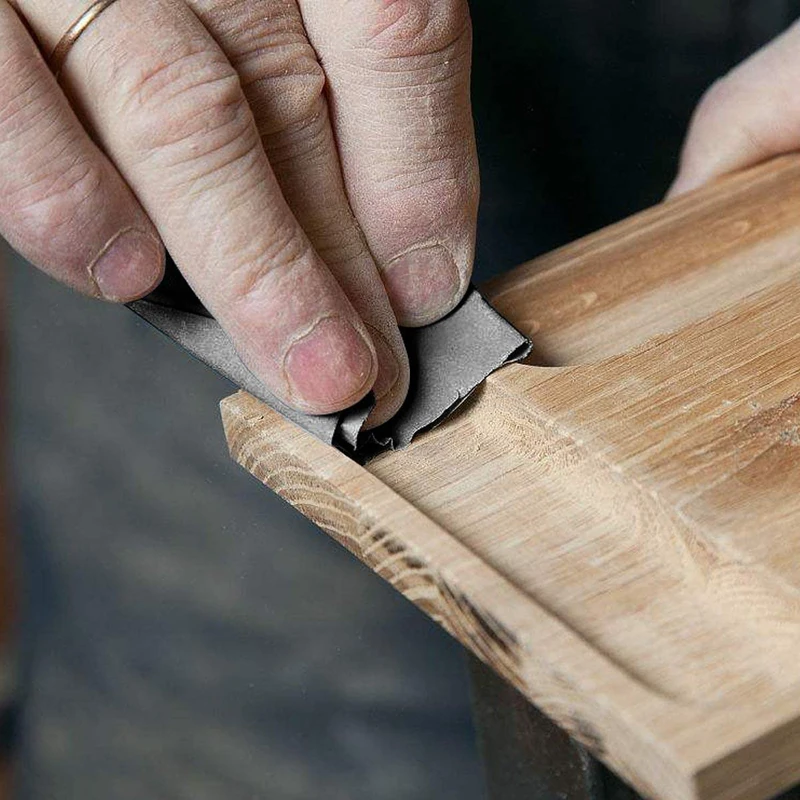
- Work so your scratch pattern runs with the visible grain on the final face. When cleaning the inside of a frame, aim for strokes that keep the long scratches parallel to the stile or rail grain, even if that means switching hand positions for each orientation.
- “Roll out,” not “roll over.” Approach the corner with the block fully supported on one face, then stop just shy of the arris. Flip orientation to address the adjoining face. Avoid dragging the block across the arris, which induces rounding.
Pressure and tempo
- Think in surface pressure, not hand force. On a 1" x 2" block face (~645 mm²), 10–15 N of hand force yields roughly 0.015–0.025 N/mm². That’s sufficient for P180–P220 cutting without deep compressive scratches.
- Use short, controlled strokes (50–80 mm) in corners and lengthen as you back away to blend. Pause every 6–8 strokes to blow off dust; reloading is your enemy here.
Grit progression
- Define, don’t wander. Use P150 to remove machining marks up to—but not through—the corner line. Then P180 or P220 to align the scratch with the show face. If you must chase a defect right in the corner, spot-sand with a hard stick and drop one grit, then immediately step back up.
- Don’t polish too soon. On softwoods, stopping at P180–P220 avoids a burnished look around the corner that mismatches the field.
Five actionable tips for tight corners and edges
- Wrap only one face of your block with abrasive when working an inside corner; leave the adjacent face bare or taped to avoid collateral scratches.
- Score a protective micro-chamfer (0.1–0.2 mm) on sharp edges before final passes—this dramatically reduces accidental roll-over without being visible after finish.
- For corner defects, switch to a smaller block rather than increasing grit coarseness; geometry control beats aggression in tight spaces.
- Use film-backed abrasives for P180 and finer; their flatness and grain uniformity produce more consistent scratch patterns in corners.
- Check with raking light every grit change; if you can still see the previous grit’s cross-grain scratches, you’re not ready to move on.
Verification is non-negotiable. I lay a pencil grid, sand, blow off, then pull the work under a low-angle LED. If any diagonal scratch survives, it will telegraph under finish. The habit adds seconds, saves hours.
Dealing with Coatings, Dust, and Verification
Corners and edges become especially sensitive once finish enters the picture. Film builds at edges, dust lodges in corners, and every sanding mark becomes a magnifying glass under sheen. Your hand sanding process needs to adapt accordingly.
Between-coat sanding
- For clear film finishes (lacquer, polyurethane), use P320–P400 stearated SiC by hand on a cork or hard rubber block. The goal is to de-nib, not level aggressively—especially at edges, where film is thinnest and burn-through happens fast.
- For oil or hardwax oil, skip aggressive between-coat sanding; a light gray nonwoven pad in the corner can break nibs without cutting through.
Loading and contamination
- Corners trap dust and finish crumbs. After each sanding set, blow out corners with clean air or use a soft brush. Wipe with a rag dampened in mineral spirits or water (matching the finish system) to lift fines, then let dry before continuing.
- Anti-clog stearates reduce loading but can interfere with waterborne finishes if transferred. Keep a dedicated set of sheets for bare wood and another set for between coats; label your blocks accordingly.
Edge care under finish
- Masking right up to the arris when scuff-sanding can preserve film thickness. Lift tape early and feather by hand with a nearly-spent P400 to avoid a hard line.
- If you do burn through at an edge, resist “just a few more passes” to blend. Touch up color if needed, then rebuild film with controlled, thin applications. Mechanical blending at edges usually makes the problem larger.
Verification loop
- Use contrast powders (pumice or even a light graphite dusting) to highlight remaining low spots at inside corners before your last pass. The powder lingers where you haven’t cut.
- After the final sanding step on bare wood, wipe with naphtha to preview grain and scratch visibility; it flashes off quickly and shows you if any diagonal marks remain.
Dust management
- Hand sanding seems dust-light, but corners concentrate fines. A small, dedicated brush and compressed air help, but a directed vacuum nozzle with a soft tip, held a few inches away, keeps abrasives cleaner and corners clearer without smearing dust into pores.
If you treat finish work like a lab process—controlled tools, known materials, consistent checks—your corners and edges will match the crisp confidence of your faces. The underlying rule is simple: where geometry is tight, your technique and materials must be tight, too.
Beginner Sanding Mistakes — Video Guide
Beginner Sanding Mistakes | How to Sand takes the “sanding is easy” myth and shows why the simplest step often causes the most visible flaws. The host explains how pressure, grit progression, and pad choice create or eliminate swirls, why edges burn through, and how to adjust your approach for different woods.
Video source: Beginner Sanding Mistakes | How to Sand
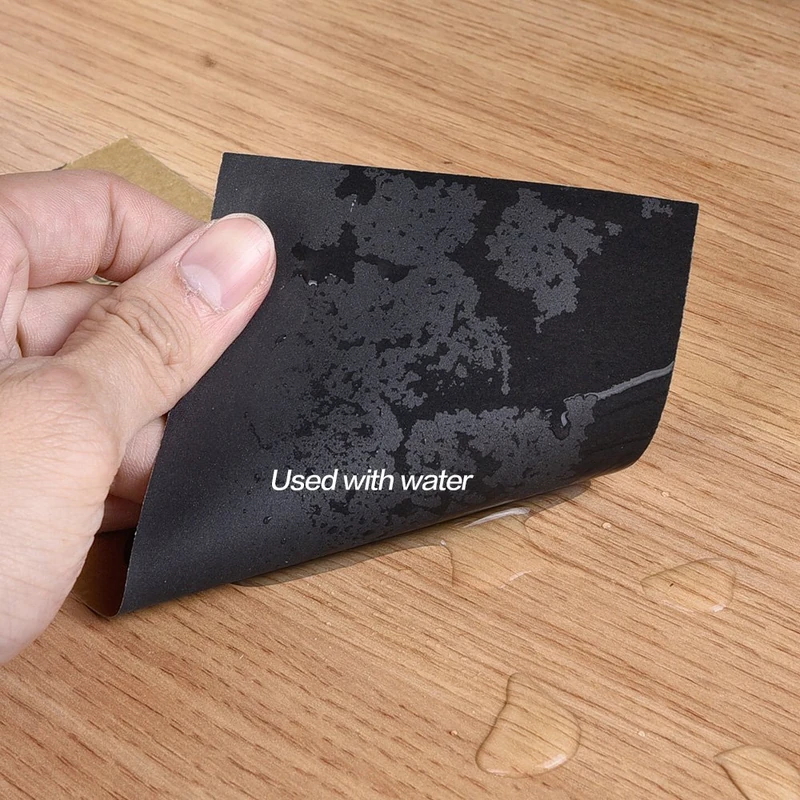
320 Grit Sandpaper Sheets (100-pack) — 9x11 in Silicon Carbide Abrasive for Wet or Dry Use — Precision finishing grit that enhances clarity between paint or lacquer coats, ensuring a flawless final layer. (Professional Grade).
Frequently Asked Questions (FAQ)
Q: What grit should I start with when hand sanding inside corners?
A: Start with the coarsest grit that removes defects without overcutting—often P120–P150 for machining marks. Move to P180–P220 to align scratches with the show face. Only drop below P120 if you have significant damage, and switch back up immediately after spot-fixing.
Q: How do I avoid rounding sharp edges while sanding?
A: Use a hard block (cork, dense rubber, or hardwood) with film-backed abrasives, keep strokes supported on one face, and stop short of the arris. Adding a tiny micro-chamfer (0.1–0.2 mm) before final sanding provides a sacrificial buffer that preserves the visual sharpness.
Q: Are foam sanding pads useful for tight corners?
A: For final blending on broad faces, yes; for tight corners and crisp edges, no. Foam increases compliance and wraps into corners, accelerating rounding. Reserve foam for curved profiles and switch to firm blocks in 90-degree geometry.
Q: What abrasive type is best for detail sanding?
A: For bare wood in corners, film-backed aluminum oxide in P180–P220 offers uniform scratch and low loading. For between-coat scuffing, stearated silicon carbide in P320–P400 cuts cleanly without digging, especially on hard films.
Q: How do I know when to move to the next grit?
A: Under raking light, all scratches from the previous grit must be gone and replaced by the new, aligned pattern. Pencil-grid the area, sand until it disappears uniformly, blow out dust, and inspect again. If any diagonal marks remain, stay on the current grit.