
Abrasive Testing for Repeatable Results Across Lots
I still remember the day a fresh box of sanding discs nearly derailed a deadline. Same grit, same vendor label, same color code—and yet my orbital sander carved a different scratch pattern, left a hazy swirl on walnut panels, and loaded up twice as fast as last week’s batch. I could feel the disc skating instead of cutting, hear the change in pitch, watch dust clump where it should have floated. If you’ve been in a shop long enough—wood, metal, composites, or protective coatings—you’ve met this ghost. It sneaks in through different lots and batches, and it turns your dialed-in process into guesswork right when clients expect consistency.
That morning, I stopped and did what I wish I’d done sooner: pulled a few discs for quick checks. A touch test across the edge told me the grain felt sharper but less uniform. A weight check suggested heavier resin loading. A two-minute hand-swipe on scrap aluminum showed a coarser, more open scratch field than last week’s run. Those tiny tests saved the job. I tweaked speed and pressure, shifted my grit progression, and logged the differences. And just like that, my “mystery” batch was mapped, controlled, and brought in line.
This is why abrasive testing belongs in every workshop, not just in a lab. When you’re chasing repeatability across batches and lots—sanding sheets, coated discs, blasting media, wire wheels, even nonwoven pads—you don’t need a white coat. You need a handful of practical checks, a couple of small tools, and a mindset that treats abrasives like the precision components they are. In the following guide, I’m laying out the exact steps I use to make lots behave the same, from micro shop runs to production-grade workflows. We’ll keep it real, hands-on, and focused on what you can do today to get identical results tomorrow.
Quick Summary: Build a simple, repeatable abrasive testing routine—verify particle size, hardness, and performance on scrap—so every batch and lot delivers the same surface finish with zero surprises.
Why Repeatability Beats Luck
If your finishes swing from flawless to “fix-it-later,” it’s rarely due to your hands suddenly forgetting technique. It’s batch-to-batch variability. Grit size, shape, distribution, bonding resin, backing stiffness, moisture in media, contamination—all can shift with lots and throw off cut rate, scratch pattern, and tool load.
Repeatability means that if you run 180-grit discs at 8,000–10,000 OPM with light pressure on quarter-sawn white oak, you’ll get the same haze level, scratch directionality, and readiness for 220, every single time—no matter which lot is feeding your sander. In blasting, it means the same surface profile (say, 2.5–3.5 mils) at the same pressure and standoff, even when you swap in a new pallet of steel grit.
Here’s where shops slip:
- Assuming vendor labels equal performance.
- Skipping incoming checks because “we used this brand last month.”
- Letting humidity or storage heat drift media moisture and resin behavior.
- Mixing partial boxes from different lots without marking the switch.
The fix isn’t complicated. You don’t need an in-house lab. You need a routine: verify incoming abrasives quickly, run a short performance test on scrap, log the results, and adjust a couple of dials (speed, pressure, grit progression, air pressure for blasting) if a batch runs hot or cold. Over time, that routine gives you data that outlives team turnover, seasonal humidity, and memory. Luck becomes a plan.
Dialing in abrasive testing for batch control
You can do serious abrasive testing with simple tools and a clear method. The goal: confirm what you bought is what you expected—and predict how it will perform before it touches a client’s part.
Core tests that fit any shop:
- Particle size distribution: For blasting media, run a quick sieve stack test to check cut aggressiveness and profile potential. For coated abrasives, compare labeled grit to a known reference sheet using a microscope or a high-quality loupe.
- Hardness and friability: Crush or scratch testing on a small sample tells you how fast the abrasive breaks down. More friability generally means faster initial cut but shorter life.
- Moisture and contamination: Media that’s damp or oily clumps and glazes. Weigh a sample before and after oven-drying (low-temp) to estimate moisture; visually inspect for rust flakes or polymer dust.
- Backing and bond integrity: With sandpaper and discs, flex-test the backing. Check resin hardness with a thumbnail press; too soft can smear, too hard can shed grit early.
Step-by-step: sieve check for blast media
- Sample correctly: Pull small scoops from the top, middle, and bottom of a bag or bin, then blend for a representative cup.
- Stack sieves (per your media’s spec) from coarse to fine; tare a small container on a digital scale.
- Pour, shake consistently for 1–2 minutes.
- Weigh retained fractions; calculate percentages.
- Compare to your target band. If more fines show up, expect higher dust and lower surface profile.
Step-by-step: coated abrasive spot check
- Take three discs or sheets from different points in the box.
- With a loupe, inspect grain spacing and orientation; look for resin overfill or exposed backing.
- Run a 10-second test on known scrap at your standard settings; assess dust color, heat, and scratch field density.
- Note load-up time and feel; log any deviation.
Do these once per incoming lot. It takes 10–15 minutes, and it’s the cheapest insurance in your shop.
Set up a shop-grade QC workflow
A good workflow turns ad-hoc checks into a repeatable process you can delegate. Keep it lean but disciplined.
Build your flow like this:
- Lot identification: Mark boxes and bins with supplier lot codes on arrival. If codes are cryptic, add your own internal label with arrival date.
- Sampling plan: For small shops, test 3–5 items per lot (e.g., three discs from different sleeves). For bulk media, pull at least a blended 250–500 g sample.
- Incoming tests: Run the quick suite—visual inspection, particle size/grit verification, and a brief performance pass on standard scrap.
- Acceptance criteria: Set practical go/no-go bands. Example: 180-grit must reach “ready for 220” haze in under 45 seconds on birch with a 5" random orbit at speed 4 and two-finger pressure. For blasting, require a 2.5–3.5 mil surface profile on A36 at 90 psi with your standard nozzle.
- Control and quarantine: Keep untested lots sealed. If a lot fails, quarantine it, notify the supplier with your data, and tag the pallet or shelf position.
According to a article, regulated industries formalize lot testing to ensure consistency. While your workshop may not be under FDA scope, the spirit holds: test, document, and only release what meets spec.
Five actionable tips you can implement this week:
- Standardize scrap: Keep a stack of identical test coupons (same species or alloy, same prep) for every incoming check so results are comparable.
- Time your cut: Use a 60-second timer and stop when the surface reaches a set visual cue; log the time-to-result for each lot.
- Use a pencil grid: Lightly crosshatch panels; count how many passes it takes to remove the lines. It’s a fast proxy for cut rate.
- Label your dials: Write your “normal” tool settings on a tag. If a batch needs +1 speed or lighter pressure, record that delta.
- One-page log: Date, lot code, quick test results, pass/fail, and any tuning notes. Keep it at the station, not in a drawer.
This workflow scales. Start with a clipboard. If you grow, digitize it. Either way, the outcome is the same: fewer surprises, faster setup, and consistent finishes.

Tools and metrics that actually matter
You don’t need a metrology lab to get lab-like repeatability. A few affordable tools will carry most of the load—and yes, even a luggage scale can earn a place on your wall.
Practical tools:
- Sieve set and digital kitchen scale: For blasting media size checks and distribution tracking.
- Hand loupe or USB microscope: To inspect coated abrasive grain, resin fill, and scratch field.
- Stopwatch and notebook: Time-to-result is a powerful, universal metric.
- Surface profile tape or a simple profilometer (for blasting): Verify mil profile on steel; document for repeatability.
- Gloss meter or haze meter (optional): If you finish high-visibility surfaces, these tools quantify your surface prep baseline.
- Luggage scale or hanging scale: Hang a small media hopper or bag and measure flow rate by weight over 60 seconds; log the pounds-per-minute. In sanding, use it to apply consistent vertical load when testing flat panels—hang a known weight to your sander’s handle for a truly repeatable pressure in trials.
Key metrics to track:
- Cut rate: Time required to reach a defined prep stage (e.g., remove pencil grid or reach “ready for finish” haze).
- Scratch uniformity: Under a loupe, look for even spacing and absence of rogue deep scratches that telegraph post-finish.
- Load-up rate: How quickly dust cakes; note differences between resin/stearate coats.
- Media consumption: For blasting, weigh the hopper before and after a timed run. For sanding, count panels per disc or square feet per sheet at a set standard.
- Surface profile or Ra: Record your target and achieved values for metal prep; keep it tied to lot codes.
Sanding-specific reality checks:
- Backing stiffness affects edge rounding. If a new lot’s backing is softer, expect more rounding on edges—compensate with a firmer pad or lighter pressure.
- Resin heat matters. When discs glaze early, step down speed or add a stearate-coated grit for the intermediate pass.
- Don’t skip grit jumps. If a “180” batch cuts rough, add an extra pass at 150 or 220 rather than pushing pressure. Pressure hides problems and creates swirl, it doesn’t solve them.
When lots drift: troubleshoot fast
Sometimes a batch won’t meet your normal numbers. Don’t toss it—triage quickly and decide whether to tune, segregate for a different use, or return.
Rapid troubleshooting steps:
- Confirm basics: Is storage dry? Did the lot sit near a heater? Any signs of moisture or contamination?
- Re-run your standard test on fresh scrap with documented settings.
- Map the variance: Is it cut rate, scratch depth, or loading that changed? One shift rarely moves all three equally.
- Tune dials in order: For sanding, adjust speed first, then pressure, then grit progression. For blasting, tweak nozzle distance and angle before changing pressure.
- Segregate use: If a sanding lot runs hot (aggressive), reserve it for first-pass stock removal; if it runs cold (sluggish), assign it to intermediate passes where it won’t matter.
- Decide return vs. keep: If you can’t bring the lot into spec within a small, logged adjustment, quarantine and call the supplier with your data.
Supplier conversations that work:
- Bring numbers: “Three discs from Lot 5 failed our 60-second haze target; average time was 85 seconds vs. 45 baseline.”
- Show images: Loupe photos of scratch fields help more than adjectives.
- Ask for their spec bands: Many vendors will share acceptable ranges for grit size, hardness, and resin content if you show you’re measuring.
Prevent repeats:
- Lock storage humidity below 50% for coated abrasives; above that, papers swell and resins behave differently.
- Rotate stock FIFO; aging can change bond performance.
- Keep “golden sample” discs or media vials: When a lot is perfect, save a labeled reference for quick side-by-side checks.
Abrasive Particle Size — Video Guide
In this week’s Primed Insight-style segment, Steven demonstrates how to verify abrasive particle size using a compact, shop-friendly kit. He walks through sampling, stacking sieves, and interpreting the distribution so you can predict cut and profile before a full production run.
Video source: Abrasive Particle Size Testing
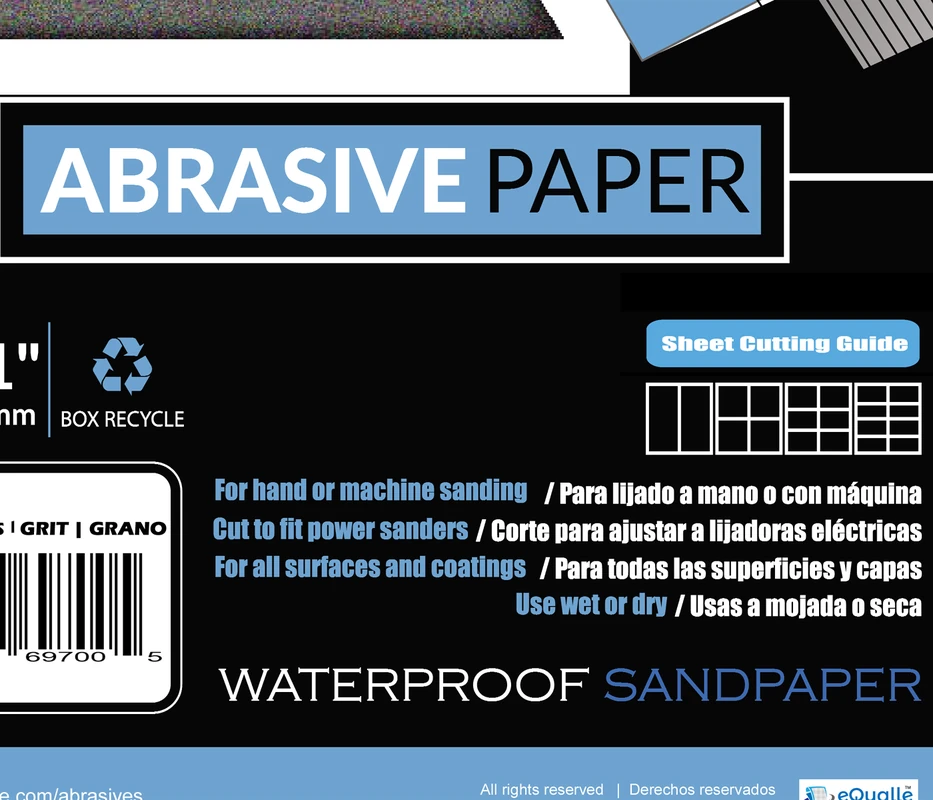
320 Grit Sandpaper Sheets (10-pack) — 9x11 in Silicon Carbide Abrasive for Wet or Dry Use — Fine finishing grit for sanding between coats of paint, primer, or lacquer. Provides smooth, even results for woodworking, automotive, and precision finishing. Works efficiently for wet or dry applications. (Professional Grade).
Frequently Asked Questions (FAQ)
Q: How often should I test abrasives from a familiar supplier?
A: Test at least one sample per incoming lot. If you increase order volume or notice seasonality (humidity shifts), double-check mid-lot as well.
Q: What’s the fastest way to catch a bad sanding batch?
A: Do a 60-second cut test on standard scrap, remove a pencil grid, and inspect the scratch field under a loupe. If time-to-result or scratch uniformity drifts, flag the lot.
Q: Can a luggage scale really help with abrasive testing?
A: Yes. Use it to measure abrasive media flow by weight per minute, or to apply consistent test pressure on a sander by suspending a known load from the handle during trials.
Q: How do I compare grit labels across brands?
A: Don’t rely on labels alone. Keep a known-good reference sheet, use a loupe, and run the same timed cut test to align performance, not just nominal grit numbers.
Q: What storage practices improve lot-to-lot consistency?
A: Keep abrasives sealed, dry, and away from heat. Store coated abrasives flat to avoid curl, maintain humidity under 50%, and follow first-in, first-out rotation.