
Masking Edges and Lines for UV Clear Coat
The first time I cured a spot repair with a UV clear coat, the light hit the panel and the whole shop seemed to pause. No hum of heat lamps, no guessing if the clear was ready to unmask—just two minutes of blue-white intensity and then a finish that was hard enough to polish. The customer’s car was still warm from the drive in, a metallic hatchback with a rock chip right on the fender’s character line. The owner ran a fingertip along that crease like it was a scar. “Can you make it disappear?” he asked.
That’s the challenge I live for. But speed is unforgiving. With UV clear coat, blends and edges can lock in fast. If you don’t read the panel correctly and mask the right body line, you’ll trap a ridge, halo, or tape mark that’s rock solid in minutes. Choose a poor line and you’ll chase the ghost of that edge through sanding and polishing. Choose the right one, and the repair fades into the factory geometry like it was never touched.
Masking before a UV cure is not just about blocking overspray. It’s about using the car’s own design—creases, returns, pinch welds, and style lines—as natural breaks that hide the transition. It’s also about protecting thin paint around edges where clear is historically weakest. The good news is, when you approach it methodically—identify the right line, prep thoughtfully, choose UV-stable tapes, and control your cure—you can deliver a repair that’s tight, clean, and fast. In this guide, I’ll walk you through how I mask edges and body lines before laying down a UV clear coat, with the hands-on steps and sanding moves I actually use at the bench.

Quick Summary: Read the panel, pick a natural break line, protect thin edges, choose UV-safe masking materials, control your spray-and-cure sequence, then finish the blend cleanly.
Read the Panel: Lines, Breaks, and Edges
Before a roll of tape leaves the cart, study the panel like a map. Manufacturers sculpt body lines for reflections and rigidity, and those same features are your best allies for hiding a blend. You’re looking for three types of geometry:
- Hard character lines: sharp creases along fenders, door tops, and quarter panels. These break light abruptly, making them excellent transition points for a repair. If the damage sits just above a crease, plan to blend the base within the upper zone and carry the clear across the line or terminate just over the peak, depending on panel size and color.
- Returns and recesses: mirror bases, door handle buckets, wheel arch lips, and window channels. These trap shadows, so any micro-variation in film build is visually masked. They’re also great for back-taping to create a soft edge.
- Panel separations and jambs: door-to-fender gaps, fuel doors, and hatch edges. When you can isolate a panel or use the gap to hide a feather edge, do it.
Identify thin or risky areas. Edges and crowns often have less OEM clear, and they’re the first to burn through during prep or polish. Run a fingernail over sharp bends; if it “sings,” it’s thin. Use oblique light (move a handheld LED at a low angle) to see how reflections travel along the surface. Chalk pencils or removable wax pencils help you mark target zones and “no-go” edges you’ll tape off during sanding.
If you’re unsure which fender line to mask, ask: Where will light change naturally? Where can I hide a 2–3 inch fade-out strip without seeing a halo in the sun? On darker colors and metallics, choose more aggressive geometry—a crisp line or deep recess. On solid lights and whites, you can often blend on a gentle curve, but still favor a defined break when available.
Finally, visualize your spray path. UV clears level quickly but cure hard fast. Your edge management hinges on lining up where your last pass and fade-out will live relative to the panel’s design. Plan it now; the lamp won’t give you a second chance.
Choose tapes and films for UV clear coat
Not every masking product likes UV. Some adhesives soften, print, or fuse under high-intensity curing lamps. Select tapes and films that are rated for UV exposure and maintain a clean release after a short, intense cure cycle.
- Edge definition: For crisp lines, use fine line tape (vinyl or polyethylene) 3–6 mm wide along the chosen crease. It bends smoothly without puckers, which prevents bleed and stair-stepped edges. Avoid cheap vinyls that shrink under heat or light.
- Soft-edge control: For fade-outs or when you don’t want a visible step, back-taping with standard automotive masking tape or using soft-edge foam tape creates a rounded profile that feathers the overspray. Foam tape shines around door edges, jambs, and wheel arch returns.
- Main masking: High-density, paint-specific masking films are preferable to paper around UV lamps; they resist static and won’t become brittle. If you prefer paper near the spray zone, keep it back from the beam path to prevent scorching or adhesive imprint.
- UV stability: Look for tapes marketed as precision or performance automotive tapes with UV resistance. They resist lifting and edge curl under UV lamps and reduce the risk of glue transfer. Products in this class are designed for sharp lines, minimal residue, and compatibility with UV-cured systems.
- Temperature behavior: UV lamps generate radiant energy; panel surface temperature can climb. Choose tapes that hold at elevated temps (often rated to 248°F/120°C). Even if your lamp is “cool,” reflective panels can spike locally.
Practical setup: Double-layer your tape in sacrificial zones. On razor-thin edges (door tops, fender lips), lay a narrow protective strip first, then your shaping tape on top. This gives you a safety buffer during prep sanding and polishing. When masking body lines for a hard stop, position the fine line tape just into the shadow side of the crease. That way, even if a microscopic ridge forms, light won’t highlight it.
Finally, stage your unmask. UV clear coat cures in minutes, so plan to pull or float specific tapes at a defined window—often right after gel and before full lock—if you’re aiming to relax a ridge. Keep tails of tape accessible and away from the spray path so you can grab them cleanly with gloved fingers.
Prep and Sand Without Burn-Through
Most blend disasters happen before the first pass of clear—during prep. The goal is twofold: create mechanical tooth for the UV clear coat and protect thin edges from cut-through.
- Degrease twice: Start with a water-based cleaner to lift water-solubles, then a solvent-based wipe for oils. Blow out seams with clean, dry air and tack thoroughly.
- Map your abrasives: In the spray zone, a uniform 800–1000 grit DA scratch with a soft interface pad gives excellent adhesion. Around edges and near your intended blend line, shift to hand sanding with 1000–1500 grit to reduce aggression. Use gray or ultrafine scuff pads with a dab of soap and water for complex curves and tight returns.
- Tape as a guard: Before sanding near high-risk edges, lay a strip of low-tack tape right on the edge as a sacrificial barrier. Sand up to it, not through it. On door tops and sharp creases, this simple move saves repairs.
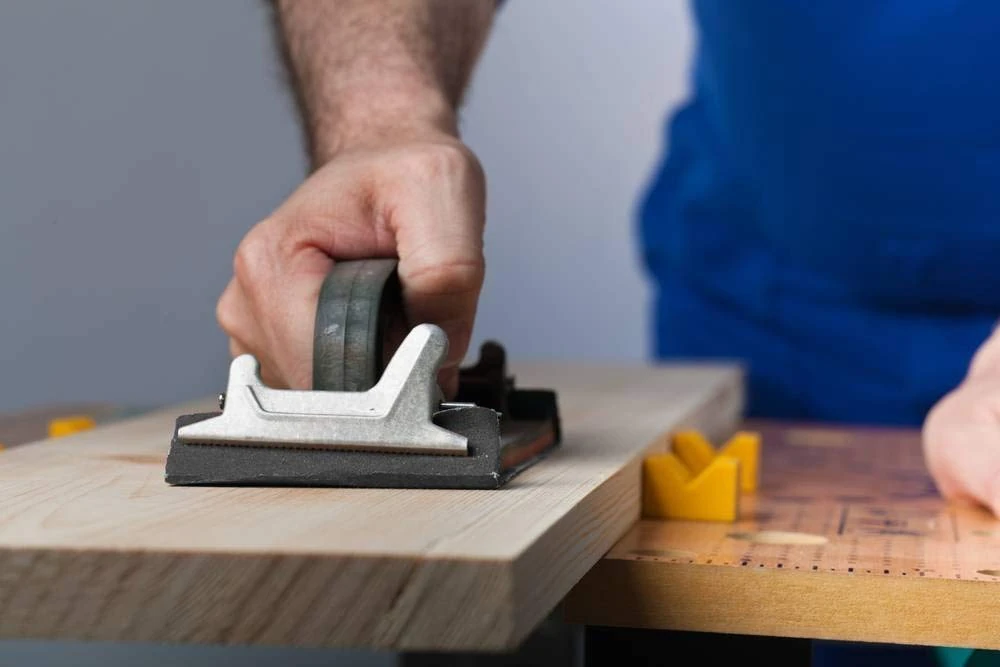
- Block where it matters: If you’re leveling minor defects in the repair zone, grab a small, flexible block rather than your fingertips. Fingers create trenches; blocks maintain planarity, which helps your clear lay and reflect evenly.
- Feather the old clear: Where you plan to fade the clear, gradually reduce pressure and grit to create a micro-gradient. Scuff pads in circular and directional passes help avoid a hard scratch “ring,” which can telegraph after cure.
Mind your cleanliness. UV-curable clears are sensitive to contaminants. After sanding, rinse or panel-wipe until your towel drags uniformly. Keep masking edges dry—water under tape can swell adhesives and print under light. Before you wheel in the lamp, think ahead: any sanding haze you leave right at a blend boundary will need to be polished out fast while the fresh film is still manageable.
And remember: a clean, uniform scratch inside the clear zone, a softened scuff near the fade area, and protected edges add up to a blend that disappears—without chasing nibs on razor-thin OEM film.
Masking Strategy: Sharp or Soft Edge
Decide early if your repair calls for a defined stop or a feathered fade. Both approaches work with UV clear coat—what changes is how you place and manipulate your masking.
- Sharp stop on a crease: When repairing just above or below a strong character line, run fine line tape precisely in the valley side of the crease, then back it with standard tape and film. Spray past the crest, and either stop just over the line or carry clear across entirely depending on coverage needs. A sharp stop can be nearly invisible because the break in reflection hides it.
- Soft fade in open field: If your damage sits in a broader area with no strong crease, set a blend band. Back-tape a perimeter 2–4 inches beyond the basecoat edge, rolling the tape back on itself to create a soft ramp. This soft edge keeps the clear from forming a hard ridge. Plan to “melt” the fade-out with controlled final passes and, if your system allows, a blending solvent.
- Jambs and openings: Use foam tape to seal gaps without making a hard tape mark. This prevents blowback while allowing air movement, which helps avoid trapped solvents.
Sequencing matters with UV. Because the cure is rapid, you’ll often want to peel certain tapes just after the clear has gelled but before it hardens completely—especially if you created a soft ramp you want to relax. If your product sheet recommends de-masking pre-cure, do it decisively and protect the fresh film from dust.
According to a article, removing masking paper before UV curing can help avoid trapping edge marks, and applying two to three spray coats over the fade-out zone helps melt the transition. That aligns with shop-floor reality: if you wait until after full cure, you’ll fight a locked-in edge. Time your pull while the film still has “give,” and keep your lamp ready so you can finish the cure immediately after.
Final check: sight along your tape lines at multiple angles. Any kink or pucker now will show as a nib or step later. Re-lay anything that looks suspect. When it’s right, it looks right—smooth, continuous, and tucked into the panel’s geometry.
Spray, Cure, and Polish Like a Pro
With the panel masked and prepped, it’s time to lay down the UV clear coat. Your technique should prioritize even film build in the repair zone, a controlled fade, and a cure that doesn’t shock the edge.
Spray setup:
- Use a clean 1.2–1.3 tip HVLP or compliant gun recommended for your clear. Set pressure per TDS; UV clears are often a touch thicker, so atomization matters.
- Test pattern on a card. You want a fine, even fan with no tails. UV clears level fast; an orange-peel start will lock in if you under-atomize.
- First pass: a light control coat to wet-in the repair area. Focus on coverage without drowning the edge.
- Second pass: full, even coat over the repair zone, overlapping 70%. Stretch slightly beyond the first pass to avoid a hard ring.
- Fade pass: reduce gun speed and material slightly; aim your fan to half-lay beyond the blend boundary. If your system provides a fade-out additive or blending agent, use it per instructions to soften the overspray edge.
Curing:
- Shield adjacent areas from direct lamp exposure to prevent tape print and unintended curing of overspray. Matte black cards work well as movable shields.
- Distance and time: follow your lamp and product spec. Typically, place the lamp at a set distance and “walk” it across complex curves so the energy stays consistent. Don’t blast the edge first; warm the area progressively so solvents have a moment to surface.
- De-mask at gel: If you’ve created a soft edge or are worried about a ridge, pull the critical tapes cleanly once the clear gels (no transfer to a gloved fingertip) but before it’s rock hard. Then complete the cure immediately with the lamp.
Polish:
- Once fully cured, you can refine any light texture or overspray in the fade band. Start with 2000–3000 grit on an interface pad, staying away from razor edges. Refine to 4000–5000, then compound with a medium cut, finishing with a fine polish. Keep the pad flat and the speed moderate—edges are still thin, even if the new film is tough.
Actionable tips:
- Mask to the shadow side of a crease. A half-millimeter shift into shadow hides more sins than perfection on the bright side.
- Double-tape razor lines during prep and polish. Peel the top strip just before clear to expose a clean edge, then replace for polishing.
- Keep the lamp moving on crowns. Stationary curing on a peak can bake tape and print an edge.
- Tack between coats, lightly. UV clears can attract dust through static; a gentle tack prevents inclusions without dragging the film.
- Use fresh, solvent-clean gloves for de-masking. One fingerprint at gel equals a permanent smudge at cure.
CLEAR COAT CURED — Video Guide
There’s a short demo showing a modern UV-cured clear reaching full hardness in roughly two minutes and being ready to polish immediately. The clip runs through a small-panel application, then jumps straight into post-cure finishing—no bake cycle, no long wait.
Video source: CLEAR COAT CURED IN 2 MINS
1500 Grit Sandpaper Sheets (100-pack) — 9x11 in Silicon Carbide Abrasive for Wet or Dry Use — Refining grit that bridges polishing and buffing—perfect for restoring a subtle satin or semi-gloss look on painted finishes. (Professional Grade).
Frequently Asked Questions (FAQ)
Q: Should I mask directly on the highest point of a crease?
A: No. Place fine line tape just into the shadow side of the crease. This hides any microscopic ridge and avoids a bright-side highlight that can expose the transition.
Q: What grit should I use near edges to avoid burn-through?
A: Hand sand with 1000–1500 grit near edges and creases, using a tape guard on the edge. Reserve 800–1000 grit DA for open areas with a soft interface pad.
Q: Can any masking tape handle UV curing lamps?
A: Use automotive tapes rated for UV exposure and elevated temperatures. Some general-purpose tapes can soften or leave residue when exposed to UV lamps.
Q: When is the best time to unmask with UV clear?
A: Pull critical tapes at gel—when the film is set but not rock hard—then finish the cure immediately. This minimizes locked-in ridges and tape marks.
Q: How do I blend the fade-out so it won’t show later?
A: Create a soft-edge ramp with back-taping, apply a controlled fade pass, and if your system allows, use a blending agent. After full cure, refine lightly with 3000–5000 grit and polish to merge the textures.