
Detail Sander Sheets for Curved Surface Prep
Rebuilding an heirloom chair rail or smoothing a guitar’s carved heel starts long before the finish can shine. It begins with how you approach the curve itself—its changing grain direction, tight radii, and vulnerable edges. If you reach for a detail sander without a plan, you’ll trade crisp profiles for flats and create scratch patterns that telegraph through stain or lacquer. With the right detail sander sheets, a stable workflow, and control over pressure and pad compliance, you can tune a surface that’s both geometrically faithful and finish-ready. The small triangular pad can be a scalpel or a chisel; your choices of abrasive mineral, grit sequence, and interface layer decide which it becomes. And on curves, those choices matter more than on any flat panel.
Picture the process: a bent-laminated rail with a 30 mm concave sweep leading into a 12 mm round-over, sapwood threading through heartwood. You mark a pencil grid, set raking light, and start the sander on a moderate speed to avoid digging. The first passes are quiet—shavings turn to dust, a faint guide-coat remains, and the grain lifts in places where the curve tightens. Instead of chasing remaining marks with heavy pressure, you switch to a fresh tip of the triangle, leverage a softer interface, and adjust stroke angle to follow the local grain tangent. The result isn’t an accident; it’s the product of reading the curvature, selecting detail sander sheets that cut without loading, and executing a repeatable path. That’s the mindset this guide cultivates: disciplined surface preparation focused on abrasive performance and control so your curved parts emerge true, smooth, and ready to finish.

Quick Summary: Prepare curved parts by matching abrasive mineral and grit to the curve, using compliant interfaces, controlled pressure, and a structured, finish-focused sanding workflow.
Read the curve, not just the grit
Curves force you to reconcile two competing goals: maintain geometry and remove defects. Every decision—abrasive type, grit jump, pad compliance, travel speed—should preserve contour fidelity first, then optimize cut rate.
Start by measuring the curve. Note the smallest radius you must maintain and where the profile transitions (convex to concave, fillet to cove, bead to ogee). Sketch no-sand zones at sharp edges and carve-outs. If the profile includes tight internal corners, plan to blend by hand or with micro-scrapers and reserve the sander for broader sweeps.
Grain direction on curves is dynamic. Instead of chasing the global grain, track the local tangent. Angle your passes to stay as parallel as possible to the fibers at each segment. Where end grain or short grain appears (often on the inside of a bend), reduce grit aggressiveness and lighten pressure to prevent tear-out and deep scratches that are hard to erase.
Establish a surface map. Use a soft pencil to lay a light crosshatch (guide coat). This doesn’t just reveal low/high spots; it also helps you gauge contact uniformity—if the grid erases faster at the edges, your pad is too stiff or your pressure is biased. Set raking light at 20–30 degrees; it makes shallow troughs and swirl patterns obvious early, when they’re cheap to correct.
Finally, define your objective. There’s a big difference between shaping (correcting mill marks and fairing a curve) and surface prep (erasing minor scratches and preparing for finish). For shaping, you sometimes accept slightly more aggressive grits with a softer interface to protect geometry. For prep, you lock in geometry and reduce scratch depth predictably through tight grit intervals and careful path control.
Choosing detail sander sheets for curves
Your abrasive is the “cutting edge.” For curves, you need sharp grains that maintain bite under light pressure and a backing that conforms without kinking. The right detail sander sheets minimize heat, loading, and edge-cutting.
Mineral selection:
- Ceramic alumina: Best for hardwoods and tough finishes. It self-sharpens under pressure and maintains consistent cut on tight radii. Great for 80–180 grits when fairing curves.
- Aluminum oxide (premium): Versatile and economical; good for 120–220 grits in prep stages. Choose stearated (anti-loading) versions for resinous softwoods.
- Silicon carbide: Fast initial cut and crisp scratch for between-coat sanding or on dense exotics; tends to dull faster on wood but excels at 220–320 grits where you need clean finishing passes.
Coating and backing:
- Open-coat sheets shed dust and reduce clogging on softwoods; closed-coat delivers a finer, more uniform scratch on tight-grained hardwoods.
- Flexible C/D-weight backings conform better on curves than stiff E-weight. For the triangular “delta” pad, ensure the sheet’s tip won’t fracture or lift when used on tight inside corners.
Hook-and-loop quality:
- Poor loop engagement leads to micro-chatter and wandering. Use quality sheets whose loop height matches your pad. Rotate the sheet periodically so fresh tips do the finish work, and replace when the loop begins to fuzz.
Hole patterns and dust extraction:
- Match the pattern to your pad for efficient capture; dust is an abrasive, and recutting it expands the scratch field. On curves, clean extraction also keeps the pad cooler and reduces resin smear.
Recommended grit sequencing for curves:
- Fairing or machine marks: 80 → 120 → 150/180
- Pre-finish on hardwoods: 120 → 150 → 180/220 (stop at 180 if staining to avoid burnishing)
- Pre-finish on softwoods: 120 → 150/180 (avoid jumping beyond 180 before stain)
Change sheets earlier than you do on flats; as grains dull, you’ll press harder, flattening profiles. Fresh detail sander sheets cut cooler and force you to keep pressure honest—exactly what curves demand.
Interfaces, pads, and pressure control
Interface layers are the unsung heroes of curved sanding. A foam interface (2–5 mm) between pad and detail sander sheets adapts to local topography, distributing pressure away from edges that otherwise gouge or flatten. Softer interfaces (lower Shore hardness) follow tight convex radii; firmer ones hold shape on broad sweeps. Keep two or three options on hand; swapping interfaces can be more impactful than changing grit.
Pressure is your primary failure mode on curves. Think “contact, not compression.” If your pencil grid disappears faster at edges, you’re over-driving the pad or the interface is too stiff. Let the abrasive do the work and ride the vibration—pressing harder only increases heat, resin smear, and scratch depth. On a variable-speed detail sander, run mid-range for stock removal (e.g., 12–15k OPM) and slightly slower for finishing passes (e.g., 9–11k OPM) to tighten the scratch and reduce edge chatter. Avoid full speed on tight profiles; it amplifies any oscillation into visible scallops.
Mind pad health. A worn hook surface transmits uneven motion and causes the triangle tip to skate. Use pad protectors; they’re sacrificial and keep your base pad crisp. Also, check that the triangular pad edges are not rounded off—rounded pad lips will roll the interface and concentrate pressure inward, distorting the curve.
Path strategy matters. Use controlled, overlapping strokes with a 10–15% overlap, and crosshatch at 30–45 degrees between grits to erase directional bias without cutting across grain sharply. Keep the pad moving before it touches down and after lift-off to avoid dwell marks. For transitions (bead-to-cove, fillet-to-round-over), lighten up and “feather” the last 10–15 mm with reduced pressure and a finer grit to avoid flat spots.
Dust extraction is your ally. A small, dual-HEPA extractor with an anti-static hose minimizes dust recutting and keeps the pad cool. Hot pads soften resin binders in abrasives, accelerating glazing and causing “mystery swirls.” If you don’t have extraction, purge dust between passes with a soft brush or compressed air at low pressure.
According to a article, disciplined motion and light pressure are key to preserving crisp profiles while eliminating tooling marks—principles that apply directly to curved work.
Workflow for complex profiles
A structured process removes guesswork and keeps your geometry intact. Below is a field-tested workflow you can adapt to cabriole legs, bent rails, or carved transitions.
Setup
- Define no-go lines around sharp fillets and edges with low-tack tape. The tape reminds you to de-pressurize before crossing delicate transitions.
- Apply a pencil guide coat and set raking light. Keep a small engineer’s radius gauge handy to check that you’re not growing radii as you progress.
Pass strategy
- Fairing pass (80–120, as needed): Mount a softer interface for convex sweeps. Use side-of-pad passes on broad arcs and tip-of-triangle only where access demands. Keep strokes parallel to local grain; on concave sweeps, shorten the stroke to avoid rocking.
- Scratch refinement (120–150/180): Swap to a slightly firmer interface for stability. Crosshatch at a shallow angle to your previous passes, maintaining motion through transitions. Use minimal pressure; if you need more cut, change sheets, not force.
- Pre-finish (180–220): Reduce speed slightly and feather transitions. For stain-grade work on hardwoods, many pros stop at 180 to avoid burnishing. If you intend a film finish (e.g., clear lacquer), 220 with a light touch is appropriate.
Edge management
- Approach edges obliquely, letting the pad just kiss the arris. Avoid perpendicular contact with the triangle tip; it’s a flat-spot factory.
- Where profiles meet, switch to a fresh sheet corner for crispness, then blend with two or three light, sweeping passes across the transition.
Actionable tips:
- Use a 3–5 mm foam interface for convex curves; drop to 2 mm for flats near curves to prevent roll-over.
- Rotate detail sander sheets 120 degrees periodically so the tip does not overheat and glaze.
- On resinous softwoods, choose stearated open-coat sheets and clean with a rubber abrasive stick between passes to keep cut consistent.
- Make smaller grit jumps on curves (e.g., 120→150 instead of 120→180) to avoid chasing stubborn deep scratches that tempt over-sanding.
- For tight inside radii the pad cannot follow, pre-shape with a matching dowel wrapped in the same grit, then blend with the sander on the adjacent surfaces.
Defect detection and finish readiness
Curves hide defects well in ambient light and reveal them under finish. Build a disciplined inspection loop into your workflow.
- Guide coat: Reapply a light pencil crosshatch after each grit change. Any remaining 80-grit trenches will stand out under the 120-grit pass; remove them now, not at 180 where you’ll be tempted to overwork geometry.
- Raking light: Use a portable LED at a low angle to the surface. Rotate the piece and adjust the light so you can see both along-grain and across-grain reflections. Swirls on curves often appear as small crescents; if you see them, your pressure was uneven or your interface too firm.
- Tactile check: Close your eyes and run fingertips across transitions. Your hands will catch flats and ridges your eyes miss. On mirrored parts (left/right), use a contour gauge or templates to ensure symmetry.
- Solvent preview: A quick wipe with mineral spirits or naphtha (on bare wood, in a ventilated area) temporarily deepens the grain and exposes scratches that will telegraph under finish. Allow full evaporation before resuming sanding.
- Raise the grain intelligently: For waterborne finishes, consider a light damp-wipe after the 150/180 pass to raise fibers, then final sand at the same grit. On softwoods, avoid exceeding 180 before staining to keep color absorption even.
Watch for burnishing. If a surface feels glossy after a 180 pass, you may have pressed too hard or used a dull sheet. Burnished spots resist stain and show as light patches. The fix is not simply “sand more,” but “sand smarter”: back up one grit, lighten pressure, and ensure your detail sander sheets are fresh.
Finally, stop on time. The finish will add film thickness that visually flattens micro-scratches. Don’t erase geometry chasing microscopic marks that the first coat would have hidden; trust your process and inspection checkpoints.
Orbital Sander Basics — Video Guide
If you’re new to powered sanding or want to revisit the foundations, this short primer on orbital sanders explains the core mechanics—pad motion, speed control, abrasive choices, and common configurations. It compares different sander options and clarifies when to choose each, which helps you understand what your triangle-pad detail sander is doing to the surface.
Video source: Orbital Sander Basics | Beginner Tool
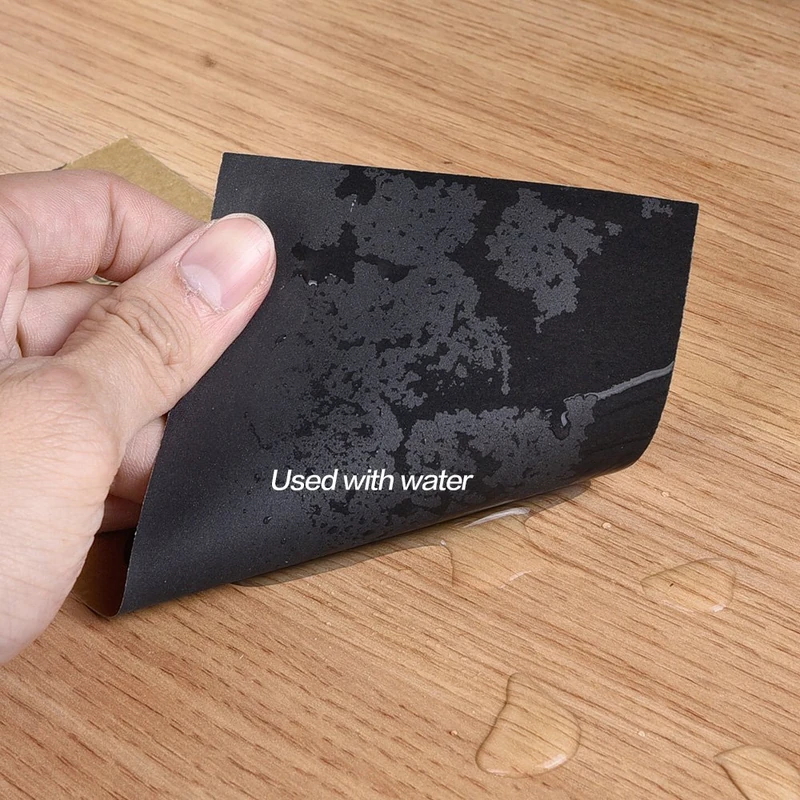
100 Grit Sandpaper Sheets (100-pack) — 9x11 in Silicon Carbide Abrasive for Wet or Dry Use — Balanced coarse grit combining power and control—perfect for blending rough sanding marks before progressing to finer grades like 150 or 180. (Professional Grade).
Frequently Asked Questions (FAQ)
Q: What grit should I start with on a curved hardwood handrail?
A: If you’re fairing machine marks, start at 80 or 100 with a soft interface to protect geometry, then move to 120 and 150/180. If the surface is already fair and you’re prepping for finish, begin at 120 and proceed to 150/180. Avoid jumping more than ~1.5× in grit on curves.
Q: How do I prevent flat spots where two profiles meet?
A: Use a compliant (3–5 mm) interface for the initial passes, feather pressure as you cross transitions, and work obliquely with the side of the pad rather than pointing the triangle tip straight at the junction. Finish by blending with two light passes at the next finer grit.
Q: My sheets load quickly on pine curves—what should I change?
A: Switch to open-coat, stearated aluminum oxide detail sander sheets, lower speed slightly to reduce resin smear, and use active dust extraction. Clean the sheet periodically with a rubber abrasive stick and replace early; on softwoods, dull grains glaze faster and force damaging pressure.
Q: Should I use 220 grit before staining curved parts?
A: On many hardwoods, stopping at 180 preserves color consistency and avoids burnishing. For film finishes without stain, 220 with light pressure is appropriate. Always perform a solvent preview to detect burnished areas before committing.
Q: What interface thickness is best for tight radii?
A: For tight convex radii, a 3–5 mm soft interface helps the pad conform without edge-cutting. For broader curves or flats near curves, drop to 2 mm for stability. Keep multiple interfaces and choose based on radius and aggressiveness needed.