
Blend Sanded Edges with Microfinishing Film
The repair looked simple enough: a shallow scratch that cut just into the clear on the edge of a quarter panel. Under fluorescent lights it was barely visible; under the sun it would shout. You masked a crisp repair box, feathered the scratch, and leveled it fast. But after the spot repair, the outline of your work telegraphed through the topcoat—an unmistakable witness line around the blend. The finish felt flat in the hand but mapped under a polarized light, showing micro-steps where abrasives had not transitioned cleanly into the untouched surface. This is where technique matters more than time. And it’s where the choice of abrasives—especially precision-coated microfinishing film on a stable polyester backing—determines whether your sanding transitions disappear or print back the next day.
Blending a sanded repair seamlessly into the surrounding area is an exercise in geometry and control. You’re not just removing material—you’re distributing scratch depth and profile so uniformly that the human eye, a camera sensor, and raking light can’t detect a boundary. That means predictable cut, consistent mineral spacing, a pad stack that conforms without trenching, and a grit path disciplined enough to taper the energy of the scratch into nothing. Microfinishing film excels here because its mineral distribution, film flatness, and resin system cut clean and wear slowly, producing a tight, uniform scratch field that polishes out without surprises. Used as part of a purposeful workflow—correct grit selection, correct orbit, correct interface—this class of abrasives helps you blend edges that vanish in gloss.
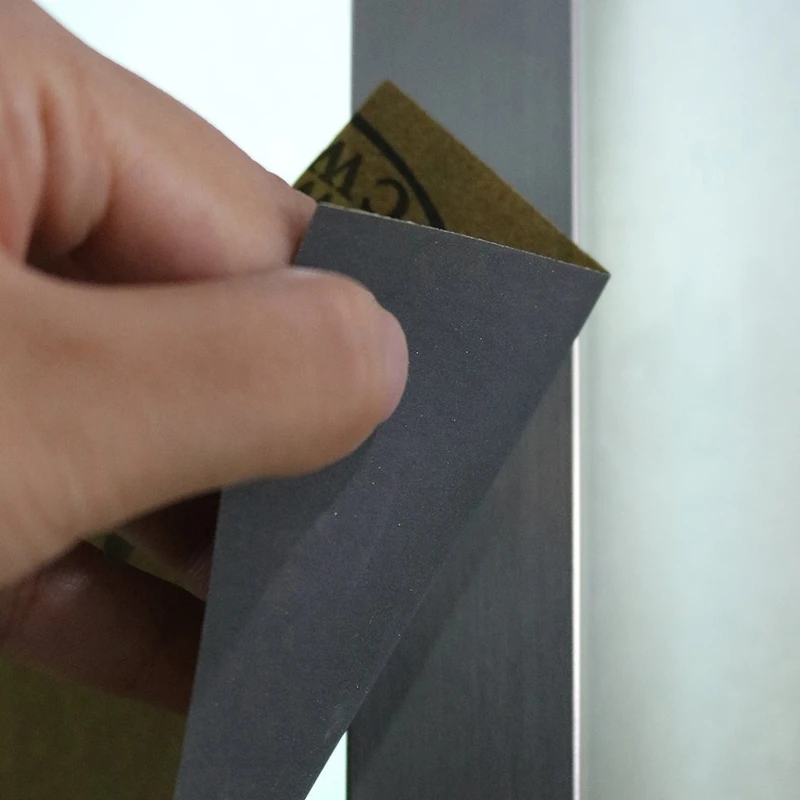
Quick Summary: Use controlled pad pressure, a progressive grit path, and uniform-cut microfinishing film on a stable backing to taper scratch energy so your repair disappears into surrounding finish.
What makes a seamless blend
A seamless blend is the convergence of geometry, surface energy, and optical uniformity. Start by thinking in cones, not boxes: you want the deepest cut (defect removal) focused at the epicenter, then a radial reduction of cut intensity toward the perimeter. If you stop your sanding field at a hard edge, you create a step; if you taper too slowly, you over-thin adjacent coating.
Three physics-driven variables govern the result:
- Scratch profile and spacing: Uniform minerals and a flat film backing generate a predictable V-shaped scratch with tight spacing, which polishes out faster and leaves fewer optical cues.
- Contact mechanics: An interface pad (3–6 mm) distributes load over micro-topography, preventing trenching on high spots. It also helps maintain consistent pressure as you move off the repair into the uncut area.
- Heat and chip management: Resin-bonded films with open or precision patterns clear swarf and reduce heat, limiting resoftening of thermoplastic or partially cured topcoats.
For dual-action (DA) sanding, orbit matters. A 3/16-inch (5 mm) orbit removes material faster and can create longer scratches; a 3/32-inch (2.5 mm) orbit is preferred for finishing because it reduces scratch length and randomizes the pattern. When hand-sanding edges and apertures, use a soft, flexible block to maintain plane control but allow roll-off over transitions.
The “cone” approach typically uses concentric passes: center with a leveling grit, then expand the footprint while stepping up in grit. Each successive grit should extend 10–20 mm beyond the previous field. The micro-topography left behind must show no abrupt change in Ra (average roughness); if your profilometer (or your trained fingertips) detects a boundary, the finish will, too. Finally, keep the surface clean. Contamination (dust nibs, silicone smear) forces you to chase defects, elongating your cone and increasing risk of edge mapping.
Optimizing blends with microfinishing film
Microfinishing film on a polyester backing creates a flat, durable platform that delivers highly uniform cut—ideal for blending a local repair into an adjacent, untouched finish. The advantage over paper-backed abrasives shows up in reduced scratch wildcards and slower, more linear wear. That stability lets you predict when a scratch will polish out and how far to expand your field.
Use microfinishing film strategically:
- Leveling and mid-grits: P800–P1200 film discs or strips remove minor texture and unify the repair zone without gouging. For automotive clear blends, P1000 foam-backed film is excellent for scuffing the halo around the repair before basecoat and clear.
- Transition grits: P1500–P2000 film builds the gradient into the untouched area. A foam interface (3–6 mm) helps feather edges without cutting through.
- Pre-polish: Ultra-fine films (P2500–P3000 equivalent) or structured abrasives bridge to compound stages, making the final polish faster and cooler.
Control the pad stack. A thin hard pad transmits more point pressure and can trench; a soft interface spreads energy but can mute cut, so adjust your orbit and passes accordingly. If you’re chasing orange peel leveling before a blend, start with a film disc that mirrors the profile you want to achieve—films cut peaks predictably without burrowing into valleys when used with light, even pressure.
Actionable tips:
- Keep stroke cadence consistent: Move 1–2 inches per second with 30–50% overlap, increasing speed slightly as you move outward to soften the cut at the perimeter.
- Clock your disc: Rotate the backing disc 1/8 turn between passes to avoid repeating the same scratch vectors when using a DA.
- Use “pressure zoning”: Center = featherlight-to-light pressure for leveling; mid-zone = feathery touch; perimeter = just pad weight.
- Refresh film early: Replace at the first sign of dull cut; glazed film drifts into burnishing, which smears rather than cleans the scratch.
- Dry-wipe between grits: One clean microfiber pass reveals remaining deeper scratches so you don’t lock them in under finer film.
Microfinishing film’s clarity of scratch also helps diagnose issues early. Under raking light, you’ll see a uniform frost without dark, linear outliers. If you spot random deeper scratches, you’re either trapping debris or overloading the disc—stop, blow off the surface, and resume with a fresh piece.
Grit path and tool choices
Your grit path is the choreography of scratch energy from removal to invisibility. For small defect blends in clearcoat:
- P800–P1000 (film) localized to the defect center for quick leveling.
- P1500 (film) extending 10–20 mm beyond P1000 to begin feathering.
- P2000 (film) or P3000 structured abrasive to globalize the frost into a uniform haze ready for polish.
- Compound with a diminishing abrasive, then refine with a finishing polish.
In repaints or sensitive OEM clears, start one grit finer (P1200) to minimize removal, but expand the field slightly to compensate. On harder 2K clears, P1000–P1500 is safe with precise pressure control. When confronting orange peel, target peak removal equal to half the peel amplitude; too aggressive and you risk thin clear and future dieback.
Tooling:
- DA sander: 2.5 mm orbit for finishing, 5 mm for faster leveling. Keep speed moderate (e.g., 6,000–8,000 OPM) to limit heat.
- Interface pad: 3–6 mm for blends; 10 mm only when extreme conformability is required and cut is minimal.
- Blocks: For hand-controlled edges, use a soft foam block with a radiused edge to roll over transitions.
- Dust extraction: Light suction improves cut consistency and keeps film from hydroplaning on swarf.
Paint-edge management is critical. Feather existing edges with a refined grit (P1500–P2000) and low pressure; any sharp transition is an optical magnet. In metal finishing or precision-polished plastics, adapt the same logic: keep your grit jumps conservative (no more than 30–40% reduction in scratch depth per step), and verify with cross-lighting before moving on.
Use process control checks:
- Tactile check: Glide two fingertips from outside-in; you should feel no “speed bump” as you cross the sanded halo.
- Optical check: Raking LED at 15–20 degrees shows uniform haze with no rings.
- Thickness awareness: If you have a mil gauge, confirm you’re within safe clear margins before starting and after leveling.
According to a article
That reference underscores why a resin-bonded, aluminum oxide on a high-strength polyester film backing maintains cut and flatness during defect repair and leveling—exactly what you need when the surrounding area must remain pristine.
Blend area prep, scuff, and feather
Preparation determines whether your blend disappears or prints back. Surface energy, cleanliness, and profile uniformity all impact adhesion and the way fresh film builds across the transition.
Start with decontamination. Use a dedicated wax-and-grease remover suitable for the coating chemistry. Wipe on with a lint-free towel, wipe off dry before it flashes. Follow with a panel wipe and anti-static treatment if the substrate tends to charge under sanding. Any silicone, oil, or soap residue will repel topcoat, creating fisheyes or craters you’ll have to chase into the blend.
Mask intelligently. Avoid hard tape lines at the perimeter of the intended blend. Instead, soft-edge with foam tape or lift the edge of the masking paper so atomization overspray can taper naturally. When scuffing the surrounding blend area before base and clear, foam-backed P1000–P1500 microfinishing film excels because it follows slight contour while leaving a uniform, paint-friendly scratch. On denser OEM clears or in cooler shops, P1000 foam discs give the right bite without over-roughening.
Feathering strategy:
- Central defect: Level with P800–P1200 film on a 2.5–5 mm orbit DA; keep your footprint tight.
- Mid-zone: Switch to P1500–P2000 film with a 3–6 mm interface, expand the cone 10–20 mm beyond the last pass.
- Perimeter scuff: Foam-backed P1000–P1500 to create global uniformity without deepening the scratch beyond polishable levels.
Tack and inspect under cross-lighting. If you can detect a ring or texture breakpoint before paint, you will see it after paint. For wood or solid-surface work, a thin sanding sealer can stabilize end-grain or porous zones at the perimeter, reducing differential absorption that telegraphs a blend line.
Practical steps:
- Always blow the surface and disc between passes; trapped swarf is the fastest path to rogue scratches.
- Re-wet-sand only if your film is rated for wet and you can fully dry between coats; lingering moisture under fresh film build leads to dieback.
- Adjust your DA speed downward as you approach the perimeter to minimize thermal softening at the edge.
- Use a light-colored guide coat even in clear blends; it reveals low micro-valleys you might miss in a white frost.
Defect control and troubleshooting
Despite careful prep and a disciplined grit path, issues can appear at or after polish. Understanding root causes speeds recovery while preserving coating thickness.
Common problems and fixes:
- Witness lines (rings around the repair): Usually from an abrupt grit transition or a hard stop in your sanding field. Re-establish the cone: re-open with a mid-grit (e.g., P1500), extend 10–15 mm, then finish with P2000–P3000 before repolishing. Ensure your interface pad is soft enough to diffuse pressure.
- Edge mapping after cure: Caused by differential film build over a rough perimeter or by solvent entrapment. Scuff wider with P1000 foam film before re-spraying, allow full flash times, and consider a blending solvent to melt the edge if the system allows.
- Trenching (grooves) at the blend perimeter: Almost always from a hard pad or too much downforce. Switch to a 3–6 mm interface, reduce pressure to pad weight at the perimeter, and use shorter dwell.
- Holograms after polish: From over-aggressive compounding on a too-coarse scratch. Step back: ensure your final sanding was truly P3000-equivalent, then re-compound with a non-dusting, diminishing abrasive on a foam finishing pad at lower RPM.
- Dieback: The gloss sinks over time around the repair zone due to solvent entrapment or over-sanded, heat-softened clear. Improve cure windows, reduce sanding heat (slower OPM, fresh film, less pressure), and don’t leapfrog grits.
Diagnostic aids:
- Magnification: A 10x loupe reveals whether a stray deeper scratch is from debris or grit mismatch.
- Temperature touch: If the surface feels warm, you’re accumulating thermal load—pause and let it normalize.
- Profilometry (if available): Confirm your Ra reduction per step; if it’s not dropping predictably, your film is spent or loaded.
Finally, document your stack: abrasive type and grit, orbit, interface thickness, machine speed, passes. Repeatability is the fastest way to perfection—especially when the goal is to leave no trace that sanding ever happened.
How to Applying — Video Guide
This short video covers when a separate sanding sealer is appropriate and how it differs from self-sealing finishes. While it focuses on film-building clear coats, the core takeaway is universal: sealing evens porosity and stabilizes the surface so your subsequent coats and polishing steps behave predictably.
Video source: How to Applying Sanding Sealer
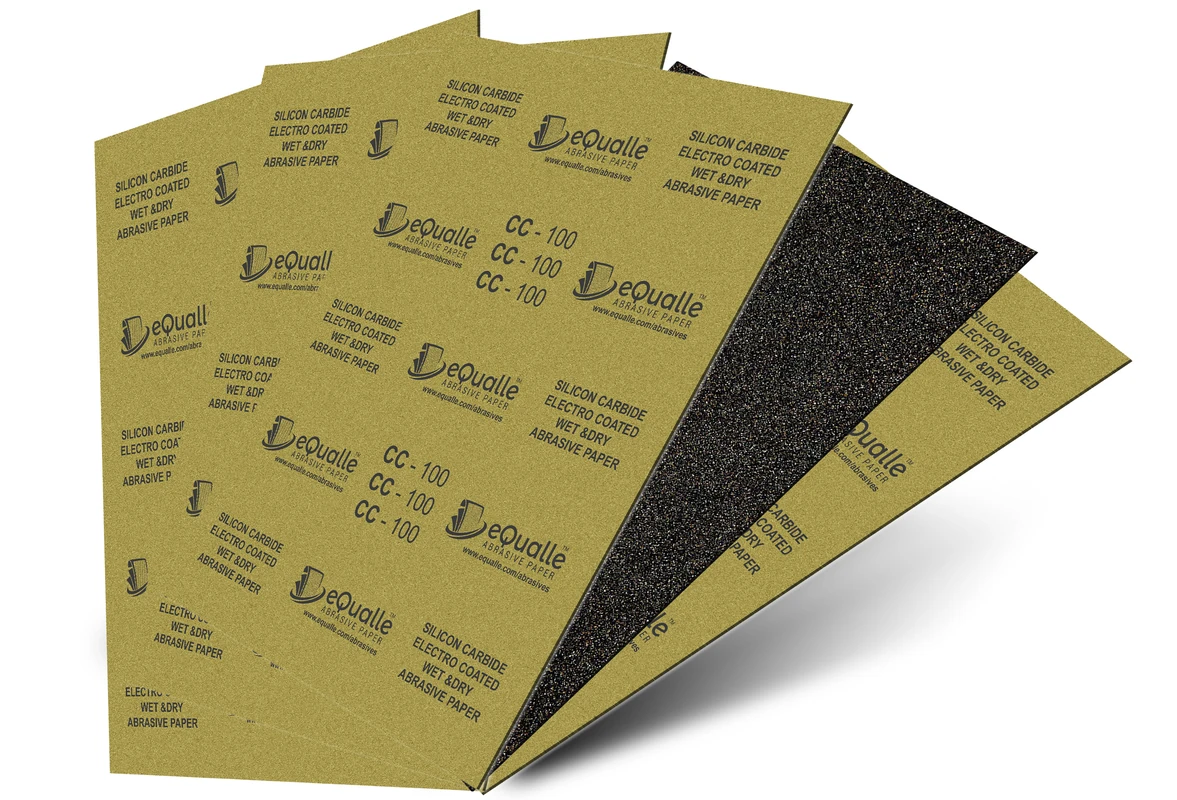
2000 Grit Sandpaper Sheets (100-pack) — 9x11 in Silicon Carbide Abrasive for Wet or Dry Use — Precision polishing grit designed to remove haze and restore clarity to clear coats and high-gloss automotive paint. (Professional Grade).
Frequently Asked Questions (FAQ)
Q: What grit should I stop at before compounding a blend area?
A: For most automotive clears, finish at P3000-equivalent (structured abrasive or ultra-fine microfinishing film). This leaves a uniform haze that compounds quickly without holograms. On softer clears, P2000 may be adequate if you use a fine compound and a foam finishing pad.
Q: Do I need a foam interface for blending, or can I run film discs on a hard backing pad?
A: Use a 3–6 mm foam interface for blend zones. It smooths pressure spikes and prevents trenches at the perimeter. Reserve hard pads for flat, aggressive leveling only, and reduce downforce as you approach the untouched area.
Q: How wide should my blend halo be around a small defect?
A: Start tight (25–40 mm diameter) with your leveling grit, then expand each subsequent grit by 10–20 mm. A final pre-polish pass may extend 60–90 mm beyond center. Let the defect size and coating hardness dictate how far you go; aim for no abrupt Ra changes.
Q: Can I wet-sand with microfinishing film for blends?
A: Yes, if the specific film is rated for wet use. Wet-sanding can improve cut control and dust management, but ensure complete drying before coating. Avoid prolonged wetting near fresh film builds to reduce dieback and solvent entrapment risks.
Q: How do I avoid edge mapping after a spot repair and polish?
A: Eliminate sharp transitions: scuff the perimeter with foam-backed P1000–P1500 microfinishing film, use a soft-edge mask, respect flash times, and finish sanding at P3000-equivalent. Keep heat low during both sanding and polishing, and consider a compatible blending solvent to melt the clear edge when allowed by the system.