
Crosshatch Block Sanding: Revealing Highs and Lows
You hear it before you see it—the faint rasp of paper on primer as dawn light angles across a garage bay. Coffee on the sill, fender on the stand, you pick up the long block and make the first pass. The panel still wears its guide coat like a night sky, but the diagonal strokes quickly carve pale constellations across the surface. The high spots flash bare; the lows stay shadowed. This is the quiet, resolute moment where a paint job’s outcome is decided, long before the spray gun ever comes out. It’s where craft meets physics, and where block sanding, done in a disciplined crosshatch, turns guesswork into data you can see and feel.
I’ve tested abrasives and blocks in controlled shop trials for years, measuring cut rate, flatness retention, and how different backers transmit pressure across complex curves. The takeaway is simple: the longer and flatter your reference (the block), and the more predictable your stroke pattern (the crosshatch), the more honest your panel becomes. Every scratch is a plot point; every clean patch tells you where material is proud. No app, gauge, or gadget replaces the reliability of an even, 45-degree crosshatch with consistent pressure. It’s a human-powered CMM (coordinate measuring machine) for bodywork.
That first session also recalibrates expectations. You realize how little pressure you actually need and how much control you gain when the tool, the grit, and the pattern are dialed. Step by step, the panel stops being a composite of filler, primer, and hopes—it becomes a flat, predictable substrate that will let the topcoat read as glass. In the end, the gloss is just a mirror; it only reflects what the block already wrote underneath.

Quick Summary: Use a long, rigid block with a 45-degree crosshatch, light pressure, and a clear guide coat to make highs and lows visible and correctable with precision.
Why flatness matters to the finish
In coatings, the eye doesn’t see color first; it reads shape. A glossy finish amplifies minute deviations because specular reflection is unforgiving—waves, flats, and crowns bend light at different angles, telegraphing every inconsistency. That’s why flatness is not just cosmetic but functional: it sets the stage for uniform film build, consistent orange peel, and accurate color perception along body lines.
From a mechanics perspective, a long, rigid sanding block averages the surface over its length. Imagine it as a straightedge that also removes material: the high spots bear more contact pressure, so they cut first. The lows have less contact and remain darker under a guide coat. This is why finger-sanding or using a soft pad tends to sculpt grooves; flexible tools deform into lows, equalizing pressure where you least want it and preserving the very errors you’re trying to eliminate.
There’s also heat and wear to consider. Concentrated points—edges, crowns, body lines—generate frictional heat faster. If you chase a crown with a short block, you’ll overcut the peak and undercut the shoulders, producing a saddle that reads as a wobble in raking light. A longer block rides those features like a bridge, skimming them evenly so you can make micro-corrections without creating new geometry errors.
Practically, every stage—filler, epoxy, high-build primer—has a “flatness budget.” If you try to fix shape during final sand, you’ll either burn through or spend hours grinding a hard primer with too fine a grit. The efficient path is to establish straightness early with 80–120 on filler and 150–180 on primer, prove it with crosshatch, then only refine texture later. Flat first; finish second.
Abrasive science: blocks, papers, and pressure
Not all blocks or papers cut equally, and understanding the physics saves time and panels. Blocks come in three broad types:
- Rigid long boards (aluminum, composite, hardwood): Best for flats and long, gentle curves. Minimal flex maintains a true datum.
- Semi-rigid foam-core blocks (e.g., closed-cell EVA forms): Conform slightly to mild contours while resisting edge digging.
- Flexible foam or interface-backed sanding pads: For complex curves only; their compliance can blur geometry if misused.
Abrasive grain matters. Aluminum oxide is the reliable baseline: tough, inexpensive, and decent on primers and fillers. Ceramic alumina (often branded as “ceramic” or “seeded gel”) fractures micro-finely under load, presenting fresh cutting edges; it tends to last longer and cut cooler, especially in coarser grits. Silicon carbide is sharper but brittle—excellent wet on hard substrates, less efficient dry on softer polyester fillers where loading can occur.
Backing and attachment also influence results. PSA (pressure-sensitive adhesive) on a dead-flat block gives the most intimate contact and flattest scratch pattern, helpful for mapping highs/lows. Hook-and-loop adds micro-cushioning; it’s faster to change sheets but can soften the edge definition of the block unless paired with a thin, firm interface. Paper weight matters too: C–D weight for coarse grits resists tearing, while flexible J-weight cloth can adapt to subtle curves without wrinkling.
Stearate (a dry lubricant coating) reduces loading, especially on primers. It doesn’t magically prevent clogging but delays it, keeping cut rates predictable. And dust control isn’t just about lungs; dust acts like a rolling bearing between grit and surface, reducing effective cut and smearing lows. A clean panel, vacuumed or blown off frequently, maintains a direct, measurable interaction between abrasive and substrate.
Pressure is the last variable—and it’s the one most overdone. Think of light, even pressure—around the force you’d use to press a bathroom scale to 2–5 psi with a palm-sized footprint. Overpressure collapses semi-rigid blocks, changing their geometry and accelerating cut on edges. Under pressure, the block rides; the abrasive does the work.
Crosshatch block sanding for surface mapping
The crosshatch isn’t tradition; it’s a mapping algorithm you run with your hands. By sanding diagonally at roughly 45 degrees across the panel, then reversing to the opposing 45, you create intersecting scratch fields. High spots will clean in both directions quickly; lows hold guide coat in both, making anomalies unmistakable. A straight-ahead, with-the-panel stroke cannot resolve certain directional waves; the crosshatch resolves them.
Set up with a contrasting, dry guide coat—powder or a very light aerosol dusting. Step back and plan: on a typical fender, run 8–12 inch strokes with a 16–24 inch block; on a door skin, scale up. Overlap each pass by about one-third of the block length to ensure even coverage. Keep wrists neutral; let your shoulders drive the motion to maintain consistent pressure along the block.
Four actionable tips for predictable, repeatable results:
- Standardize your angles: 45 degrees one way, 45 the other. Deviate only for tight geometry.
- Count strokes: e.g., 12 passes per quadrant at light pressure before re-checking guide coat. Consistency turns your eye into an instrument.
- Don’t chase specks: If a single dark pinhole remains after uniform clearing, stop cutting; address it with spot glaze, not more global removal.
- Refresh often: Wipe and re-dust the guide coat as soon as 60–70% of it has cleared; mapping loses value if you’re guessing at shadow.
As you work, watch the pattern “resolve.” When the panel clears uniformly in both hatch directions with 150–180 grit on primer (and no fresh burn-throughs to bare metal or filler), you’ve reached a shape checkpoint. If lows remain as coherent islands larger than a coin, don’t brute-force them with more cutting. Either re-prime to raise the floor or apply a skim glaze if the area is localized and shallow. The goal isn’t to sand more; it’s to sand smarter, using the crosshatch to tell you when to change tactics.
Guide coats, light, and measuring progress
Guide coat and raking light are your truth serum. A proper guide coat is thin enough to erase in two or three light passes on highs yet persistent in lows, making them readable in photos and from multiple angles. Powder types excel for dry sanding and easy re-application; aerosols work too but watch solvent strength on fresh primer.
Set raking light at a low angle—15 to 30 degrees off the surface—and move it as you work. LED bars on tripods are excellent for stationary panels; for on-car work, a handheld light swept across the surface reveals subtle cross-waves you might miss head-on. Your eyes read specular highlight movement; any stutter in the highlight screams a wave.
Verification tools help. A 24–36 inch straightedge or an extrusion with chamfered edges lets you probe across crowns without gouging. Feeler gauges can quantify gaps under the straightedge if you want numbers—anything over about 0.3–0.5 mm on a door skin is often visible under gloss, depending on panel length and curvature. On body lines, aim for crispness first, then feather to flats—don’t try to carve a line into a wavy field; flatten the field, then refine the line.
Decision logic matters. If your lows are wide, uniform, and shallow, more primer is often the fastest, safest fix. If they’re small, discrete, and scattered, a thin polyester glaze will spot-correct without building thickness everywhere. And if you’re still seeing structural flatness problems after uniform clearing in 180 grit, step back to earlier substrate work rather than forcing correction at a finishing stage. The crosshatch is your red flag to change strategy, not an invitation to keep cutting.
According to a article, deep lows call for a glaze skim sanded in the same crosshatch manner; otherwise, build with more primer and re-block. That echoes what testing shows: use the least aggressive corrective that preserves surrounding geometry.
Grit progression and epoxy/primer strategy
Grit is a language. You’re telling the panel what you expect to happen next. Too coarse for too long, and you create a deep scratch field that takes forever to erase. Too fine too early, and you polish the tops while leaving untouched lows—an optical trap that reads as smooth but sprays as wavy.
A proven, efficient sequence for typical bodywork:
- Body filler shaping: 80 → 120 grit on a rigid or semi-rigid long block. Finish in 120 to reduce scratch depth before sealing.
- Epoxy primer (sealer or build): After filler is straight, seal with epoxy. For build, allow proper cure, then block in 150–180. Clear uniformly via crosshatch; this step is where you “pay off” flatness.
- High-build primer (if needed): Apply 2–3 coats to address minor texture or pinholes. Once cured, block 180 → 220 (or 240), confirm with guide coat each change.
- Pre-topcoat refinement: Depending on the topcoat system, 320–400 on primer for solid colors; 400–600 for metallics and pearls to minimize scratch telegraphing. Always verify manufacturer recommendations.
A few performance notes grounded in material behavior:
- On epoxy primer, 150–180 grit cuts predictably without skating, especially with ceramic-alumina paper. Epoxy is tougher than polyester primer; sharp grains maintain a consistent micro-fracture pattern and don’t smear.
- High-build polyester primers sand more easily; you can run 180 → 220 faster, but that ease can lure you into overcutting edges. Maintain block discipline and re-mask edges if necessary.
- Switching to finer grits only after uniform guide-coat clearing avoids “optical lies.” If you still see islands of guide coat at 180, jumping to 320 just polishes around them.
When everything blocks out in 180 with no highs or lows visible, it’s efficient to add one to two uniform coats of epoxy as a re-seal, then final-sand with 320–400 depending on paint system. This preserves shape while giving the topcoat a fresh, controlled substrate. In testing, panels treated this way showed fewer post-cure sink-backs because scratch-depth distribution was more uniform.
Three execution tips to avoid rework:
- Re-coat before you “chase ghosts.” If you’re more than halfway to breakthrough on a spot and it’s still low, stop and build material instead of eroding the rest of the panel to meet it.
- Protect edges and body lines. Tape edges as you approach final grit so the block rides but doesn’t bite; remove tape for the last two light passes.
- Document your passes. A grease pencil grid or quadrant marks keep you from overserving one area. It sounds fussy; it’s cheaper than repainting.
Block Sanding Primer — Video Guide
The video “Block Sanding Primer - Essential Steps to a Mirror Finish” walks through the post-filler phase: how to set up your primer for success and block it to optical flatness. It emphasizes the order of operations—guide coat, long-block crosshatch, light pressure—and shows why highs clean fast while lows persist.
Video source: Block Sanding Primer - Essential Steps to a Mirror Finish
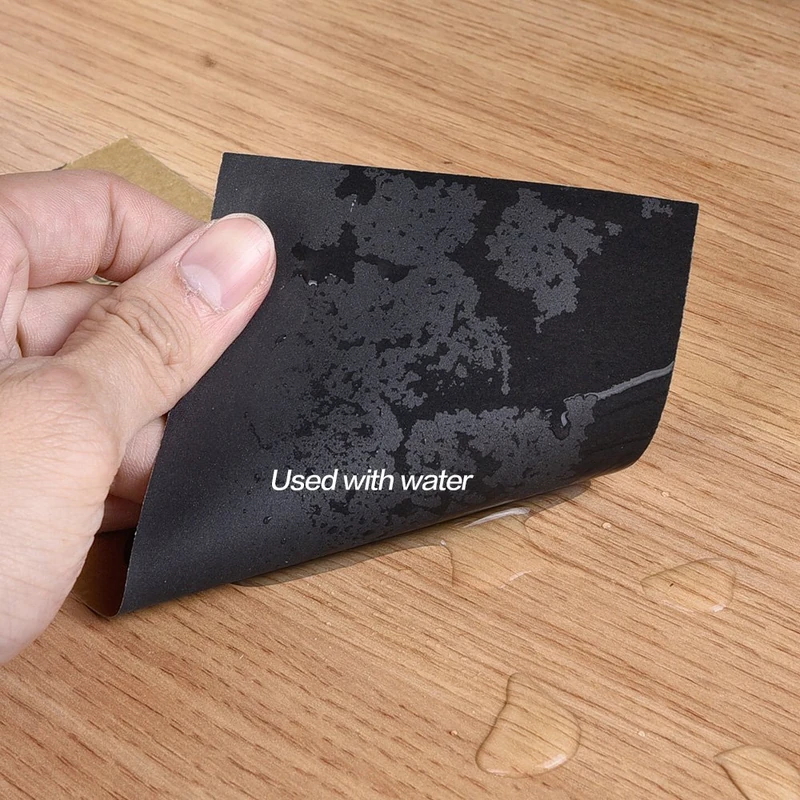
80 Grit Sandpaper Sheets (25-pack) — 9x11 in Silicon Carbide Abrasive for Wet or Dry Use — Durable coarse sandpaper made with Silicon Carbide for fast stock removal and surface leveling. Excellent for woodworking, metalwork, and fiberglass preparation. Works effectively for both wet and dry sanding before moving to 120 grit. (Professional Grade).
Frequently Asked Questions (FAQ)
Q: Why does a crosshatch pattern reveal highs and lows better than straight sanding?
A: The intersecting 45-degree passes average the surface in two directions. Highs contact the block more in both directions and clean rapidly; lows retain guide coat from either pass. Straight, with-the-panel strokes can miss directional waves, masking errors.
Q: What grit should I start with on primer for block sanding?
A: For epoxy or high-build primers, 150–180 is a reliable start for shape work. Once the guide coat clears uniformly in crosshatch, refine to 220–320 depending on the paint system. Jumping too fine too early only polishes highs and leaves lows untouched.
Q: How much pressure should I apply with a long block?
A: Use light, even pressure—enough to keep the block fully engaged without collapsing foam or deforming semi-rigid cores. Think 2–5 psi of contact force; let the abrasive do the cutting, not your arms.
Q: When should I add glaze versus more primer?
A: Localized, shallow defects (pinholes, coin-sized lows) are efficient to spot with a thin polyester glaze, then re-block in the same crosshatch. Larger, uniform lows across a panel are better addressed by adding primer build and re-blocking to maintain even geometry.
Q: Do I need wet sanding for block work on primer?
A: Dry sanding with a dusting guide coat is preferred for mapping highs/lows because it’s immediately readable. Wet sanding is useful for final refinement of texture but can hide lows by washing away contrast. Reserve wet work for later stages once shape is verified.