
Metal polishing without waves on flat panels
The first time you see it under raking light, your stomach drops. The panel looks glossy at noon, but as the sun angles toward evening, faint undulations drift across the surface like ripples frozen in steel. It’s not orange peel or deep scoring—just soft waves that refuse to disappear no matter how much you buff. You back off the wheel, clean the compound haze, and try again. More shine, same ripple. Anyone who has attempted high-end metal polishing on a large, flat panel has stood in that exact spot: a gleaming finish on a subtly warped plane.
This is where technique separates a cosmetic glow from true flatness. Waves form when the removal mechanism—the abrasive or the wheel—doesn’t cut uniformly across the surface. Pressure concentrates at peaks, energy spreads through soft interfaces, and the panel warms or flexes. You’re not just refining; you’re reshaping, even if it’s on a microscopic scale. The solution isn’t “more polish,” it’s precise control: hard, stable references for sanding; abrasive sequences that promote planarity; and a buffing workflow that adds reflectivity without pushing lows deeper.
In practice, this means trading convenience for control. A firm block beats a fingertip. A verified flat backing surface beats a random foam pad. A measured grit jump prevents the carryover that locks in low areas. And, critically, your aim shifts from “shiny” to “geometrically flat,” with reflectivity as a byproduct, not the early goal. When the surface is truly flat, light behaves—gloss becomes coherent, edges stay crisp, and reflections stop swimming. Tackle metal polishing with that mindset and the waves recede, replaced by a mirror finish that remains honest under any light.
Quick Summary: Waves vanish when you prioritize planarity—use hard-backed abrasives, controlled grit progression, low-heat buffing, and rigorous verification under raking light to refine without distorting.
Diagnose and define “waves” on flat panels
Before changing tools or compounds, pin down what you’re seeing. “Waves” are broad, low-amplitude undulations that persist through grit changes and appear as flowing distortions under raking light. They differ from:
- Scratches: linear defects tied to abrasive size or contamination.
- Dishes: localized lows, often from soft backing or finger pressure.
- Ripples from heat: localized warping adjacent to welds or thin spots.
Start with controlled lighting. Use a single, bright linear source (LED strip or fluorescent tube) placed at a low grazing angle. Observe reflection across the panel while slowly shifting your viewpoint. A steady, parallel line indicates flatness; bending or “swimming” denotes waves. Map them with a marker grid: draw 50–75 mm squares, then lightly pass with a hard block and 320–400 grit to reveal highs (marker clears) and lows (marker remains).
Verify mechanically:
- Straightedge and feeler gauges: span known flats (e.g., diagonals, centerline). Capture gaps to quantify amplitude.
- Dye or bluing: a thin application helps visualize contact area as you lap with a known-flat plate.
- Squeegee testing: flood with a thin film of water plus a drop of dish soap; pull a stiff squeegee and watch how the film breaks—persistent puddling trails indicate lows.
Finally, consider panel stiffness and mounting. A loosely supported panel flexes when sanded or buffed, mimicking wave behavior. Rigidly support the work (MDF over steel frame, vacuum table, or sandwich between compliant mat and rigid platen) to stabilize geometry. If the surface presents consistent directional waves, look upstream: a DA sander with soft pad, or aggressive buffing on a wide airway wheel, often lays the groundwork for these low-frequency distortions.
Abrasive planarity control and grit progression
Flattening requires transferring force through a hard, stable plane. Fingers, foam pads, and oversized DA strokes distribute pressure unevenly and imprint curvature. Replace them with:
- Hard blocks: micarta, phenolic, precision-ground aluminum, glass, or granite-backed lapping plates.
- Interface control: use thin (1–2 mm) cork or hard felt only when necessary to bridge micro-steps; avoid soft foam for flat work.
- PSA or film-backed abrasives: tighter mineral distribution and better edge integrity than paper for consistent cutting.
Work dry to reveal true topography when flattening ferrous alloys; use controlled lubrication for gall-prone metals (kerosene/mineral spirits blends on aluminum, light water-soluble oil for titanium). Keep lubrication minimal to avoid hydroplaning.
Grit progression matters. Large jumps leave underlying troughs intact and encourage you to “chase shine.” Instead:
- Begin with the coarsest grit that just kisses the high areas across the entire panel (often 120–220 for prior machine marks; 320–400 if you’re correcting mild waves only).
- Advance in 1.4–1.8x increments in abrasive size (e.g., P220 → P320 → P400 → P600 → P800). For micron film: 30 µm → 15 µm → 9 µm → 3 µm before buffing.
- Cross-hatch: 30–45° bias relative to panel edge, alternating direction at each grit to reveal carryover.
- Reset the grid: redraw the marker grid at each stage and require uniform clearance before moving on.
Actionable tips to preserve flatness during sanding:
- Mount abrasives to a known-flat reference like 10 mm float glass; use light spray adhesive for temporary mounting when you need ultra-flat lapping.
- Add mass: a heavier block (0.8–1.5 kg) reduces hand-induced oscillation and evens pressure across the stroke.
- Shorten strokes: 100–150 mm linear passes control camber; long sweeping arcs tend to dig valleys at stroke reversals.
- Clean aggressively between grits: vacuum, tack, and replace the sheet early; spent minerals round off and stop cutting highs.
- Keep count: fixed pass counts per zone prevent overworking edges or open areas.
Stop when your 9–3 µm film yields a uniform, matte, scratch-consistent plane that reads straight under raking light. Only then is the surface ready to translate into gloss.
Compound control and metal polishing workflow
Polishing should refine peaks without reintroducing geometry errors. Pick tools and compounds that match panel size and alloy.
Wheels and mops:
- For stainless: start with a tightly sewn sisal or spiral-sewn cotton for cut, then transition to a loose section or airway for color. Keep diameters modest (150–200 mm) for better control and lower surface speed.
- For aluminum: use treated spiral-sewn cotton for initial cut to avoid excessive grab, then loose or untreated airway for color. Avoid loading—dress wheels frequently.
Compounds:
- Cut stage: black emery or fast-cut “steel” compound for ferrous; brown/tripoli for aluminum.
- Color stage: green chromium oxide (stainless) or white rouge/alumina (aluminum).
- Final refine: on flat work, consider hard felt blocks with diamond paste (3 µm → 1 µm) as a controlled, small-area alternative to big mops.
Technique to prevent waves:
- Limit dwell: 2–4 seconds per pass area; keep the wheel moving in linear, slightly overlapping tracks.
- Neutralize pressure: let the bottom third of the wheel engage, and avoid edge-leading digs. Keep tool rpm in a band that cuts but doesn’t heat—often 1,500–2,800 sfm for control, not the 5,000+ sfm used on small parts.
- Dress often: glaze and compound cakes convert the wheel to a friction heater. Use a rake to open the face every few passes.
According to a article, specular reflection demands surface flatness relative to the wavelength of visible light; any residual waviness will bend reflected lines even when gloss appears high. That is why you must separate “cut to flat” from “color to gloss”: the first is geometric correction, the second is micro-texture reduction. If you find yourself polishing forever with no change in line-straightness under raking light, stop—return to a hard-backed abrasive several microns coarser and re-establish planarity before another brief, cool polish.
Heat, pressure, and tool stiffness management
Heat is the quiet saboteur. It relaxes residual stresses, thins sections, and makes thin panels dish under contact pressure. Control it actively:
- Lower surface speed: choose smaller wheels or reduce rpm; surface feet per minute (sfm) drives frictional heating.
- Pulse the work: brief, consistent passes with cool-down intervals. Keep the surface under 43–49°C (warm to the touch, not hot). Infrared thermometer or simple “three-second touch” rule helps.
- Compound sparingly: fresh, light charge per pass. Excess compound insulates and increases drag.
Pressure errors create waves. Your goal is consistent, low deflection loading:
- Use two-hand, neutral wrist positioning; avoid thumb-led pressure points.
- Keep the panel rigid: clamp to a flat platen with a compliant underlay (thin neoprene) to distribute clamping load, especially on large sheets.
- Avoid foam interfaces on polishers for flat planes; if you must use a handheld machine, switch to hard rubber pads or rigid backing plates.
Tool stiffness matters upstream too:
- Random orbital (RO/DA) sanders: fine for texture removal, risky for final flattening without a hard interface. If used, retrofit with a fiberglass-reinforced hard pad and constrain orbit to 2.5–3 mm with low pad softness.
- Belt sanders: excellent for flat control when set up with a graphite platen and a dead-flat contact wheel; proceed carefully with feather pressure and jigs to maintain square engagement.
- Lapping blocks: for precision flats, progress to glass-plate lapping with micron film, pulling the part across rather than shuttling the block. This reverses compliance and favors planarity.
Prevent panel “oil canning” during process. If you notice a zone that pops in/out under light finger pressure, pause polishing there and redistribute load with backer blocks or temporary stiffeners taped to the reverse side. Bring temperature down, then resume with lighter, broader contact. Waves often bloom where the panel was allowed to flex, not simply where the wheel ran.
Verification, defect correction, and prevention
Inspection is a workflow, not a finish-line ritual. Build it into each stage:
- Lighting: swap between raking light, diffused overhead, and a handheld point source to triangulate defects. Raking light is most sensitive to waves; point sources reveal micro-scratches.
- Contrast agents: alternating marker grids and dye spreads ensure you’re cutting uniformly. For stainless, a water-and-alcohol wipe flashes off clean to reveal subtle topography.
- Straightedge sweeps: run them early and often. Mark and number zones, then track feeler readings so you know where metal is leaving.
If waves persist post-polish, correct diagnostically:
- Confirm flatness first with 9–15 µm film on a hard block; if the marker remains in troughs, continue cutting until it clears uniformly. Jumping straight to compound at this point only burnishes the lows.
- Local lows: for shallow dishes, use a narrow, hard block with 9–15 µm to “sneak up” from surrounding highs; avoid focusing too long in the center of a low or you’ll crater it—blend edges, test, repeat.
- Local highs: lightly spot on a small, hard block at 15–30 µm until the high just kisses surrounding plane; then re-lap the broader area to integrate.
Prevention strategies going forward:
- Standardize grit steps and pass counts per alloy and thickness; document what clears your grids consistently.
- Dedicate wheels to compounds to prevent cross-contamination; label arbors and store wheels covered.
- Dress wheels at fixed intervals, not by feel alone; a 2–3 pass cadence before raking minimizes glazing.
- Maintain dedicated flat blocks; periodically verify your blocks against a granite surface plate using bluing and correct any deviations.
Finally, accept that large, very thin panels have a practical flatness ceiling without fixturing or stress-relief. For those, consider pre-polish stress relief, strategic backing, or process variants like low-energy vibratory finishing followed by controlled lapping before any wheel touches the surface. You’ll remove less material, generate less heat, and drastically reduce the onset of long-wavelength distortions that read as waves in the final reflection.
Polishing Aluminium and — Video Guide
This overview demonstrates how a bench grinder outfitted with a dedicated metal polishing kit can cut and color both aluminum and steel effectively. It walks through wheel selection, compound pairing, and the sequencing needed to move from a matte, sanded surface to a high-reflectivity finish.
Video source: Polishing Aluminium and Steels with a Bench Grinder Metal Polishing Kit.
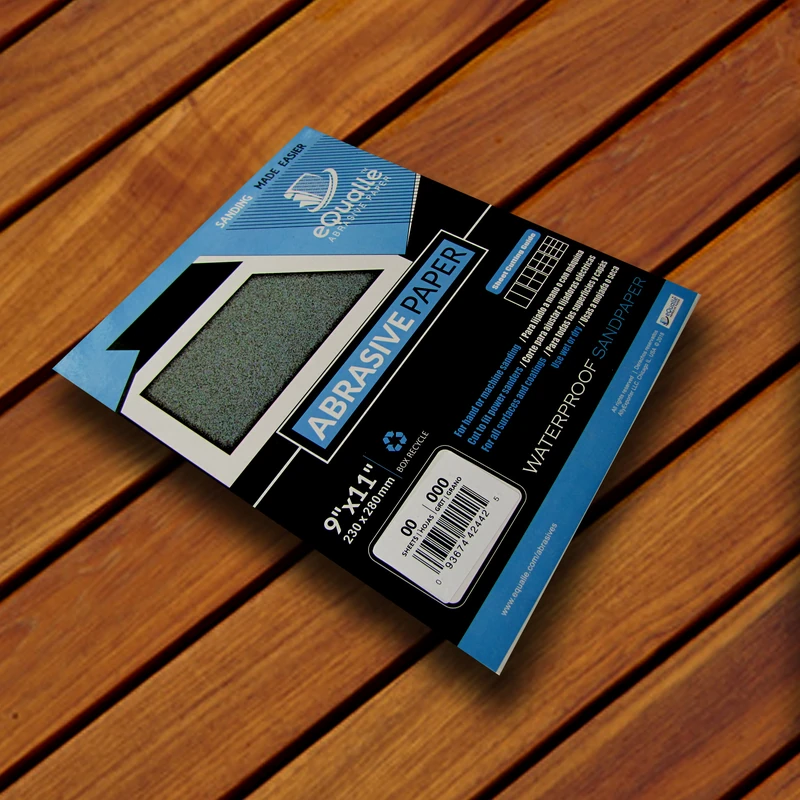
1000 Grit Sandpaper Sheets (10-pack) — 9x11 in Silicon Carbide Abrasive for Wet or Dry Use — Gentle polishing grit that removes swirl marks and fine scratches on automotive or resin finishes. (Professional Grade).
Frequently Asked Questions (FAQ)
Q: Why do waves appear even after I’ve reached a mirror shine?
A: Gloss and flatness are different metrics. You can achieve high specular reflectivity while still carrying low-frequency undulations. If the abrasive stages didn’t fully flatten the plane, polishing only burnishes the existing geometry. Return to a hard-backed 9–15 µm abrasive, re-establish planarity under raking light, then repolish briefly at low heat.
Q: What abrasive sequence best avoids waves on stainless sheet?
A: For previously ground sheet: P220 → P320 → P400 → P600 (film) → 15 µm (film) → 9 µm (film). Cross-hatch each step with hard blocks, verify with a marker grid, then cut with a spiral-sewn wheel and green compound, finishing with a loose wheel for color. Keep sfm moderate and dress frequently.
Q: Can I use a DA sander for the final flattening stage?
A: Not reliably without a very hard backing interface. DA motion and soft pads imprint curvature and promote waves. For true flat work, switch to hard-block sanding or lapping on a flat plate with PSA or film abrasives, then use the DA only for intermediate texture removal with a hard pad.
Q: How do I stop heat from warping thin aluminum during polish?
A: Reduce surface speed and dwell, charge the wheel lightly, and clamp the panel to a rigid, flat support with a thin compliant layer beneath. Consider a smaller wheel for lower sfm. If temperature rises above warm-to-touch, pause and cool before continuing. For cut on aluminum, prefer treated spiral-sewn cotton with brown/tripoli to keep engagement predictable.
Q: What’s the quickest test to confirm I’ve removed waves before polishing?
A: Under raking light, redraw a fine marker grid and make a few linear passes with 9–15 µm film on a hard block. If the grid clears uniformly and reflected light lines stay straight across the panel, you’re ready to polish. If lines bend or the grid persists in zones, continue flattening before you switch to compound.