
Flatten Glued Panels on a Belt Table with Sanding Belts
The shop was still cold when I set the panel down—a freshly glued ash countertop that looked perfect until the raking light revealed faint steps between boards and a shallow cup that clamped cauls had only mostly bullied into line. The clock was already ticking: the client wanted a dead-flat surface that would make an oil finish glow, not telegraph tooling errors. The wide-belt was booked across town, so the belt table had to earn its keep. I’ve flattened enough panels on belt tables to know the difference between a controlled, technical removal and an anxiety-producing skate across the grit. Done right—with tuned machinery, disciplined pressure, and the correct sanding belts—you can true a glue-up to planer-grade flatness and leave a predictable scratch field for final ROS cleanup.
The first passes are the most consequential. A belt table with a well-prepped platen lets you work like a human CNC, mapping high zones and erasing them layer by layer without building heat or dubbing edges. The wrong abrasive—cheap joint, wrong backing, or the incorrect grain type—turns the exercise into a burn-and-washboard session. The right setup keeps the work predictable: straightedge readings that converge, chalk that disappears evenly, temperature that stays well below resin-softening thresholds, and a scratch pattern that hands off cleanly to 120–180 ROS. The result is not just “flat enough,” but measurably flat, square to edges, and finish-ready inside a controlled grit progression. That’s the goal, and the belt table can absolutely deliver it.
Quick Summary: Calibrate the belt table, select the right sanding belts, map and sequence the cut, then manage pressure, feed, and heat for a flat, scratch-controlled panel.
Setup that makes panels truly flat
Flattening starts before the first pass. Treat the belt table like a calibration instrument. Verify table and platen co-planarity with a precision straightedge and 0.001 in feeler gauges across the working footprint. If your machine uses a platen shoe, install fresh graphite slip cloth and check for uniform adhesion—any bubble becomes a localized convexity that prints as a low spot in the panel. Confirm belt tracking and tension per the manufacturer spec; an under-tensioned belt will squirm under lateral load and wash out edges.
Next, index your reference. Lightly scribble the panel surface with soft graphite in a diagonal crosshatch. This makes high/low mapping visible on the first pass. Check for clamp bow: lay the panel on three points or a verified flat auxiliary board. If the panel rocks, shim for a stable, neutral posture so the cut doesn’t lock in twist. Set your dust collection to maximum and verify clean, even airflow across the platen; dust trapped between abrasive and work is a heat generator and scratch multiplier.
Set an initial grit that cuts but respects glue lines: 60 or 80 for significant step removal on hardwoods, 100 if the panel is close and you want to minimize deep scratch debt. Establish a pass plan: work the panel in slightly overlapping lanes with the long axis roughly perpendicular to belt travel during flattening passes, then finish with a with-grain, light-pressure refinement. Keep the work fully supported across the platen before initiating contact; never “dip” a corner into the belt. Use two hands and a stance that prioritizes even pressure through the center of mass rather than fingertip “hot spots.”
Finally, quantify removal. On a platen-style belt table, think in terms of time-under-belt and local pressure rather than a fixed depth of cut. Plan multiple light, uniform passes rather than heroic single removals; heat and geometry are easier to control this way.
Selecting sanding belts for precision removal
Abrasive choice determines whether you carve micro-washboards or establish a flat, uniform plane. For hardwood glue-ups, tough grain ceramics (microfracturing ceramic alumina) or zirconia alumina sanding belts in X- or Y-weight cloth backings are the workhorses. Ceramic excels at high stock removal with cooler cutting; zirconia is slightly less aggressive but forgiving and cost-effective. Reserve aluminum oxide for lighter refinement or resinous softwoods where “sharp but not grabby” is beneficial. Favor resin-over-resin bonding and closed- or semi-open coat depending on your species and expected loading.
Belt construction matters. Insist on high-quality splice joints—bi-directional butt splices for platen work minimize the thump that can imprint as periodic lows. Poor seams telegraph into the panel as a regular wave that no pressure finesse can hide. Choose antistatic-treated belts when flattening wide surfaces; static charges attract fines that clog the cutting zone and spike temperatures.
Match belt width to your platen footprint and panel size. Wider isn’t always better: a properly tensioned belt that fully covers the platen with even tracking is the priority. Run recommended surface feet per minute (SFPM) for your abrasive; ceramics often prefer higher belt speeds to keep the grit self-sharpening. Break in a fresh belt with two or three light passes on scrap to knock off loose grain and stabilize the splice.
Useful selection cues:
- Species and glue: Ceramic for dense hardwoods and UF/epoxy glues; zirconia for mixed hardwoods and PVA glue lines; aluminum oxide for softwoods and final refinement.
- Backing: X-weight for better conformability on slight crowns; Y-weight for maximum flatness under sustained pressure.
- Coat: Closed coat for stubborn, even cutting; semi-open for oily, resinous woods to delay loading.
- Belt life: Retire flattening belts early to ROS duty; dull flattening belts make heat, not flatness.
Glue-line prep and defect mapping
Flat panels start at glue-up. If your seam geometry is off, the belt table becomes a corrective device rather than a finishing tool. Joint boards with a consistent, minute spring joint and remove mill-marks that can bias clamping pressure. Use cauls to control cup, but don’t expect them to erase twist born from asymmetrical stock. Let PVA glues cure to a “scrapable” state, then remove squeeze-out flush before sanding; hardened ridges spike belt temperature and scar the scratch field.
Map defects before committing to heavy cutting. Under raking light, circle any step joints, localized snipe from prior machinery, or mill compression at the edges. For cups or bows, take feeler-gauge readings under a straightedge at grid points (e.g., every 8 in) and jot the delta to target thickness. This lets you predict removal requirements and decide whether to split the correction between faces or correct one reference face and then thickness the opposite side later.
On the belt table, start by knocking down isolated highs in a controlled spot-sand with minimal pressure—just enough to erase the top of the scribble without burning. Then progress to systematic lanes across the surface. Keep chalking between passes; you’re not guessing, you’re verifying. For severe twist, it may be faster to rough-correct with a jointer sled or hand plane to bring the panel into the belt table’s operational window. According to a article. This perspective is consistent: the sander is superb at referencing flat, but it won’t magically un-wind geometry you bring to it.
Finally, respect glue chemistry. PVA softens with heat; UF and epoxy stay firm but can glaze. If you detect a sweet gum smell or feel tack on the belt near a glue line, you’re running too hot. Pause, clean the belt, and resume with lighter, faster strokes.
Feed, pressure, and heat control
Heat is the primary enemy during flattening. It dulls abrasives, softens PVA glue lines, and invites chatters and burn streaks. Your control variables are contact time, pressure distribution, and chip evacuation. Work in steady, overlapping lanes with even travel speed; pauses equal hotspots. Keep your hands broad and weight centered over the platen contact zone. Avoid fingertip or edge-only pressure—these dig trenches that take multiple corrective passes to remove.
Watch the dust plume and sound. A healthy cut throws consistent fines and sings at a stable pitch. A strained, squealing tone or smoky scent signals loading or too much pressure. Clean the belt with a crepe stick or air blast at the first hint of loading; don’t “push through” a dull zone. If your machine has interchangeable platens, use a fresh graphite slip and a flat, well-supported shoe for flattening; switch to a slightly crowned contact roller only when you intend to blend, not to establish flat.
Five actionable controls to keep the cut cold and true:
- Temperature check: Touch-free IR thermometer on the belt and panel every few passes; keep the panel under 120°F around glue lines and the belt under 150°F to preserve resin bonds.
- Stop-stripe test: Lay three parallel pencil lines across the width; make one pass. If lines fade unevenly left-to-right, your pressure or table alignment needs correction.
- Lane index: Overlap each lane 30–40% and reverse your travel direction every second pass to average out micro-bias in your stance and belt seam.
- Edge save: Approach edges with a slight toe-up attitude and release pressure before exiting to avoid dubbing; finish edges with a dedicated, light with-grain skim.
- Clean cycle: Every 2–3 minutes, vacuum the platen and blow the belt from the non-cutting side to eject fines; loaded belts cut hot and hollow.
If you must remove more than roughly 0.5–0.8 mm across a broad area, stage the process: coarse flattening to erase highs and cup, rest to cool, intermediate cutting to refine the plane, then a light finishing skim before handing off to ROS.
Grit progression and finish-ready workflow
Your grit sequence is the choreography that transforms “flat enough” into finish-ready. Flatten with 60–80 grit only as long as needed to remove step joints and primary cup/twist. The moment your scribble disappears uniformly and straightedge readings are within your flatness tolerance (e.g., ≤0.15 mm over 1 m), move up. A practical progression for hardwood panels: 80 → 100 → 120 on the belt table. Each step should remove just enough of the prior scratch to prevent ghosting under finish; don’t skip more than about a 1.4× jump in grit size.
At 120, pivot your stroke orientation to favor with-grain passes and reduce cross-grain visibility. If your belt table allows, drop belt speed slightly and lighten pressure to minimize fresh scratch depth. Inspect under raking light; any remaining cross-hatch or swirls should be shallow and uniform. Hand off to a 5–6 in ROS with 150 then 180/220, strictly with-grain and with a firm, flat interface pad. Avoid soft pads that conform to small undulations; you’ll reintroduce the waviness you just eliminated.
Two small but consequential habits: re-scribe a very light pencil map at each grit change to verify that you’re uniformly contacting the surface; and frequently clear dust from the panel so fines don’t bruise pores and create false readings of scratch removal. Keep dedicated, labeled sanding belts for flattening vs refinement—flattening belts lead hard lives, and once the grain dulls, they belong in the ROS stack, not on the platen.
Finally, manage your edges and show faces intentionally. Break edges with a tiny, consistent bevel after flattening to prevent splintering during ROS. Confirm thickness targets with calipers at quadrants and center. With a dialed workflow, you’ll land within ±0.1 mm thickness variation and a reliably flat reference—exactly what glue-ups deserve.
Choosing sanding belts for flatness and speed
When you’re flattening panels routinely, belts become a consumable strategy. Don’t buy them like general-purpose shop stock; buy them to match your removal targets, wood species, and heat budget. For dense exotics or stubborn domestic hardwoods (maple, hickory), ceramic belts in Y-weight polyester backings sustain pressure and heat without stretching. On mixed-species panels or where you want slightly more forgiveness, zirconia on X-weight cotton backings balances cut and contour-following without telegraphing micro-crowns from the platen.
Antistatic treatments, worth calling out, do more than keep dust off the machine—they reduce charge accumulation in the belt, which reduces fines clinging in the cutting interface. That keeps temperatures down and maintains scratch consistency across long passes. If you regularly work resinous woods, consider semi-open coat belts to mitigate loading, and keep a crepe stick nearby.
Belt joint design is non-negotiable for flatness. Look for precision butt-splice joints ground flush to minimize periodic bump. Check joint orientation when installing: run the feathered edge in the downhill direction relative to work travel to avoid a catch. Break-in matters too; two light, cool passes on scrap align the splice and shed weak grains. Track belt life with a simple tally on the belt’s back—flattening work is unforgiving, and “almost dull” translates into heat and geometry drift.
Procurement tip: buy in small lots from suppliers that can hold joint consistency across orders. If you must mix vendors, segregate belts by vendor and project to avoid mid-panel scratch variability. A predictable belt equals a predictable plane.
Make Your Own — Video Guide
A shop-made-belt demo by a scroll-saw reviewer shows the BeltBinder multi-fiber strips from BigFoot Products being used to assemble custom-length sanding belts. The video walks through trimming, staggering, and bonding the splice, then test-running the belt under light load.
Video source: Make Your Own Sanding Belts With BeltBinder
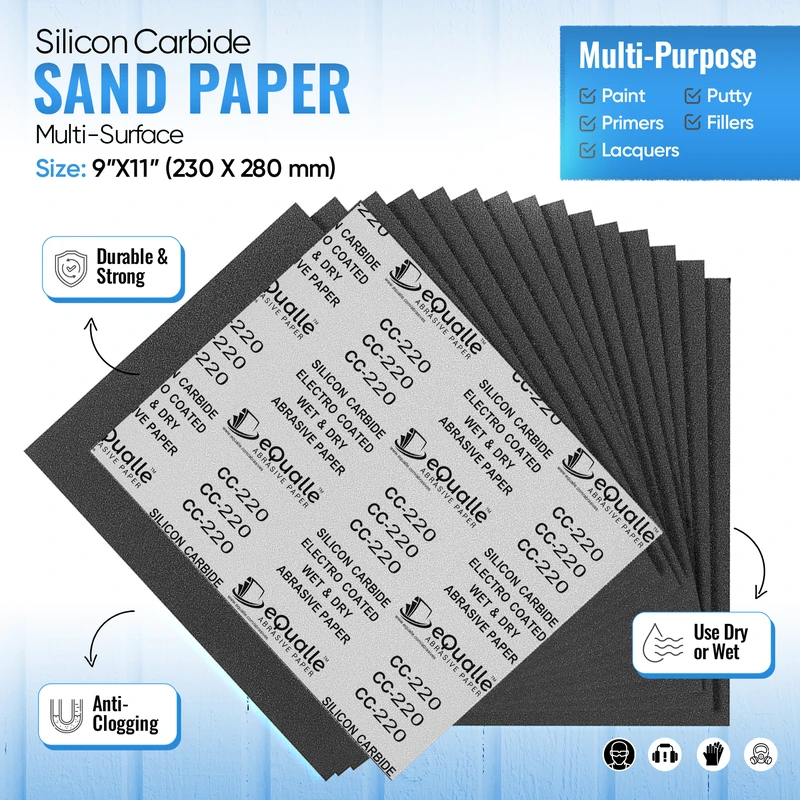
280 Grit Sandpaper Sheets (25-pack) — 9x11 in Silicon Carbide Abrasive for Wet or Dry Use — Fine finishing grit for delicate work—ideal for flattening varnish layers and creating a pre-polish smoothness on wood or resin. (Professional Grade).
Frequently Asked Questions (FAQ)
Q: Can a belt table replace a wide-belt sander for flattening? A: For panels within moderate size and removal needs, yes—if the platen is truly flat, abrasives are high quality, and you manage heat and pressure. Wide-belts are faster and more automatic, but a tuned belt table can achieve comparable flatness.
Q: What grit should I start with on a freshly glued panel? A: Start with 80 if there are measurable steps or cup; use 100–120 if the panel is close and you want to limit scratch depth. Move up as soon as highs are erased uniformly.
Q: How do I avoid rounding the panel’s edges? A: Keep the work fully supported on the platen before contact, maintain even central pressure, and release pressure slightly before the edge exits. Add a light post-flattening edge bevel to protect fibers.
Q: Why do my glue lines look shiny or smeared after sanding? A: You’re generating heat. Reduce contact time, lighten pressure, clean the belt, and consider a cooler-cutting ceramic or zirconia belt. Keep panel and belt temperatures in a safe range.
Q: How flat is “flat enough” for a tabletop? A: Aim for ≤0.15 mm (0.006 in) variation over 1 m and consistent thickness within ±0.1–0.2 mm across the panel. Verify with a straightedge and feeler gauges under raking light.