
How to Read Scratches Under Light: Sandpaper Grit Chart
Late afternoon light has a way of telling the truth. I had a walnut side table on my bench—a clean repair, fresh finish, and from most angles it looked flawless. Then the sun dropped and a low beam through the shop window revealed a faint set of lines sweeping diagonally across the field. They weren’t cracks or dye streaks. They were directional sanding scratches left over from an earlier grit, now amplified by the oblique light. Over the years I’ve learned not to resent these moments; they’re data. With a flashlight or a phone LED held at a shallow angle, those lines become a map of your previous steps and the next action you should take. Reading them correctly saves time and protects the surface. Reading them poorly leads to over-sanding, dishing, and an endless loop of “just one more pass.” This is where a practical mindset—and yes, a reliable sandpaper grit chart—earns its keep: know what you’re seeing, choose the right next grit, and verify in the same light.
As a product engineer and reviewer, I evaluate abrasives the way I evaluate any tool: by how predictably and efficiently they convert effort into a controlled, measurable surface. That starts with understanding scratch direction under raking light. Scratches are micro-grooves. Their orientation reveals the last stroke direction; their density and brightness correlate with grit and abrasive type; their uniformity signals whether you’re done with a stage. The method is material-agnostic: wood, clear coat, aluminum—each tells the story in light, just with different contrast. In this article, I’ll cover how to set up the light, decode what you see, translate that into a step on a sandpaper grit chart, and validate your work with simple tests so you stop exactly when you should.

Quick Summary: Use raking light to read scratch direction, pick the next grit from a practical chart, and validate with fast, repeatable checks to avoid oversanding.
Raking light: see the scratch story
The fastest way to improve your finishing is to control the lighting. “Raking light” means placing a bright source low to the surface—20–40 degrees—to create long, high-contrast reflections from the peaks and valleys. I test with three setups: a handheld LED at 30°, a movable task lamp with a barn door to keep glare out of my eyes, and, when possible, a sunbeam across the bench. The goal is not brightness for its own sake; it’s directional light that exaggerates topography.
What to look for:
- Orientation: Scratches from the last grit form a consistent field—little train tracks pointing in one direction. If you sanded cross-grain or in a circular motion, you’ll see a noisy, multi-directional field instead.
- Brightness/contrast: Coarser grits leave deeper, wider grooves that glint more intensely at a range of viewing angles. Finer grits produce faint, tight lines visible only at a narrow sweet spot.
- Uniformity: A completed stage shows a single, uniform pattern. Patches with a second, misaligned pattern are leftover scratches from a previous grit.
To verify removal, I use controlled cross-hatching. For example, run P180 with strokes at 0°, then P240 at 90°. Under raking light, the surface is “done” with P240 only when every 0° line is replaced by 90° lines. Any remaining 0° marks are carryover from P180. This method removes guesswork and gives you a binary pass/fail.
Practical checks:
- Pencil grid: Lightly crosshatch the area with a pencil before starting a grit. Sand until all lines vanish uniformly; incomplete removal shows as islands.
- Tactile sweep: Use the pad of your index finger gliding obliquely across the grain; deep scratches “sing” back as faint ridges. Confirm with light.
- Rotate the part: If the pattern disappears with a small change in angle, it’s likely a fine-grit field and you’re close. If it glares from most angles, you’re still in coarse territory.
These cues scale across materials. On clear coat or acrylic, scratches reveal themselves as bands of diffuse haze; on aluminum they appear as directional satin. The physics is the same: anisotropic scattering makes grooves brighter or darker depending on angle.
From raking light to your sandpaper grit chart
Once you can read the scratch field, plug what you see into a disciplined progression. A sandpaper grit chart is not a rigid recipe; it’s a decision tree based on scratch size, material, and target finish. I prefer FEPA “P” grits because the ranges are well-defined and most premium sheets are labeled this way. Typical mean particle sizes:
- P120 ≈ 125 µm: flattening, removing planer marks
- P180 ≈ 82 µm: wood prep after minor repair; starting point for light scratches
- P240 ≈ 58.5 µm: pre-finish smoothing; blending repair zones
- P320 ≈ 46.2 µm: primer flattening; intercoat scuff
- P400 ≈ 35 µm: sealer sand; start of automotive wet-sand on primers
- P600 ≈ 26 µm: pre-polish on clear coats or film finishes
- P800 ≈ 21.8 µm: refining before compound on clear coat, plastics
- P1000–P1500 ≈ 18–12 µm: scratch removal before polishing stages
- P2000–P3000 ≈ 10–6 µm: final pre-polish haze
Rule of thumb for step size: reduce the mean particle size by 30–50% each stage. Jumping too far wastes time; jumping too little risks loading and heat without benefit. If raking light shows bold, high-contrast lines, you’re likely at P120–P180 territory. If the lines are faint and only visible at a narrow angle, you’re in the P600+ region.
Reading specific scenarios:
- Leftover “ghosts” after stepping up: Under raking light, you’ll see a secondary field at the previous angle. Drop back one grit, re-establish a single uniform direction, and proceed.
- Swirl vs. straight-line: Random-orbit swirls show as circular haloes. Eliminate them by finishing the stage with a straight-line, light-pass orientation, then validate under raking light.
- Film finishes: Clear coats magnify defects. After P800, always verify in two light angles; if any banding remains, don’t progress to P1000 yet.
Helpful pairing from the chart:
- Stripping paint on metal: P80 → P120 → P180 (then switch to abrasives designed for metal to reduce glazing)
- Refinishing wood tabletop after a dent repair: P120 → P180 → P240 → P320
- Headlight restoration: P800 (wet) → P1000 (wet) → P1500 (wet) → compound
One more detail: CAMI and FEPA labels differ slightly (e.g., CAMI 320 is closer to FEPA P360). If mixing brands, rely on the published micron size rather than the number alone and confirm by how the scratch field behaves under raking light.
Abrasives: materials, coats, and backings
Understanding why scratch fields look the way they do requires a quick dive into abrasive materials and construction.
- Aluminum oxide (AlOx): Tough, blocky grains that micro-fracture slowly. Great general-purpose abrasive for wood and steel. Leaves a consistent, slightly rounded scratch profile. Under light, the pattern tends to be even, with fewer random deep tracks.
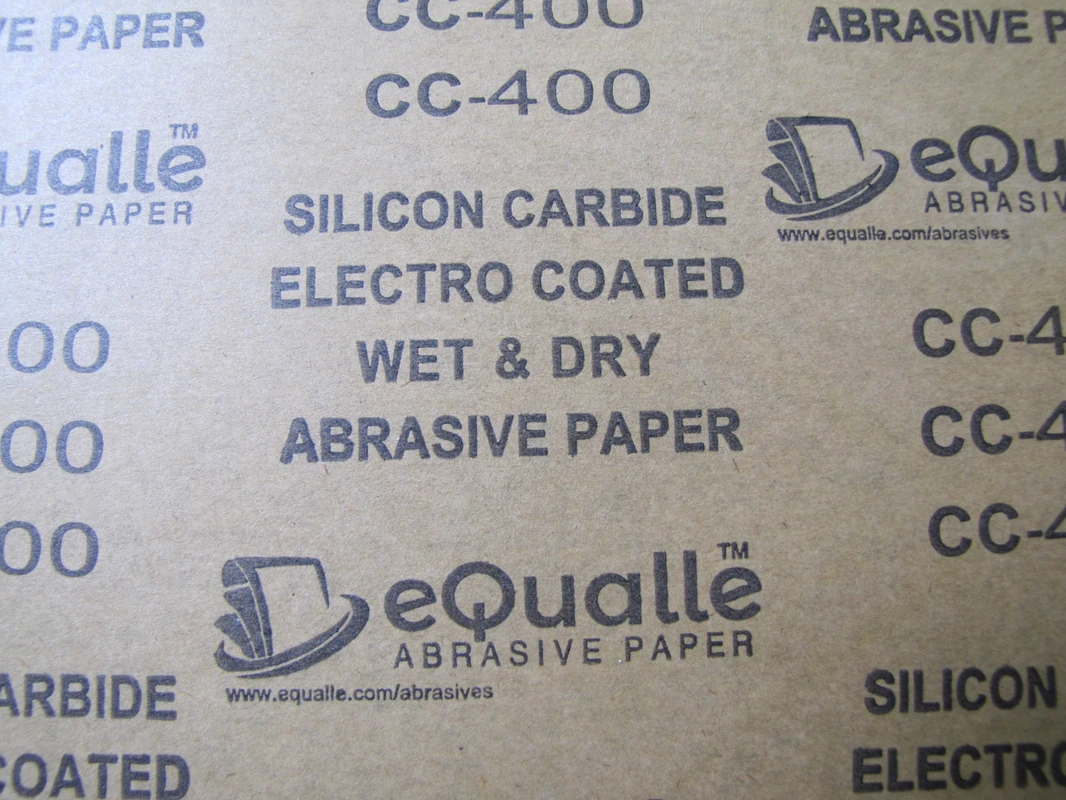
- Silicon carbide (SiC): Sharper, more brittle grains that fracture into new points. Excels on finishes, plastics, and non-ferrous metals. Creates cleaner, narrower grooves with higher reflectivity at fine grits—ideal for wet-sanding clear coat because the scratch field “reads” clearly.
- Ceramic alumina: Engineered microstructures that self-sharpen under pressure. Efficient on metal removal and hard woods. The scratch field can look “tight” even at coarser grits because of controlled fracture.
- Garnet: Softer, fractures quickly. Traditional for hand-sanding wood between coats. Leaves a warm, diffuse haze that’s easy to level but wears fast.
Coating density matters:
- Open coat (50–70% grain coverage) reduces loading in resinous woods and paints. The scratch field can appear more dotted because fewer grains contact at once, but heat is lower and clogging is reduced.
- Closed coat (90–100% coverage) cuts faster on hard materials and gives a more uniform field—useful when you need predictable, even scratch direction for light reading.
Backings influence the consistency:
- Paper (A–F weight): Lighter A/C for flexibility; heavier E/F for flatness. Heavier backings maintain plane and produce more consistent line geometry—a win for readable fields on large panels.
- Film: Extremely flat, dimensionally stable, and tear-resistant. At P600 and finer, film-backed SiC produces very uniform scratch fields, which makes raking-light evaluation surgical.
- Cloth: Strong and conformable for curves. Scratch fields can be more varied if you apply uneven pressure.
Binders and stearates:
- Resin-over-resin bonds grains more securely, reducing random grain pull-out that causes rogue deep scratches.
- Stearated (anti-clog) coatings keep finishes from loading. That maintains a predictable scratch field longer and reduces “stiction” marks that can confuse what you see under light.
Wet vs. dry:
- Water or soapy water lubricates, floats swarf, and cools the surface. Wet-sanding tightens the scratch field and lowers contrast—hence the need for even more deliberate raking-light checks at each step.
In practice, the best “readable” scratch patterns for finish-critical work come from film-backed SiC at P600+, resin-over-resin binders, and a light, consistent hand. On raw hardwood stock removal, ceramic or premium AlOx on E-weight paper yields a stable pattern across a large surface. According to a article.
Bench tests: how I verify scratch removal
I evaluate abrasives and techniques in controlled tests before trusting them on projects. Here’s my method for correlating scratch direction under light with actual progress.
Test panels and setup:
- Wood: Maple and walnut boards jointed and planed flat, then sanded with a known “starting” grit orientation at 0°.
- Coated surfaces: Automotive clear-coated panels and acrylic sheets.
- Metal: 6061 aluminum plates.
I mark each panel with a pencil grid, then run the “next” grit at 90° until the pencil marks disappear uniformly. After every 10 strokes (or 5 passes with a random-orbit sander at a set speed), I inspect under raking light at two angles, 25° and 35°, noting when the 0° scratch field is fully replaced by 90° lines.
Findings (typical, hand-sanding with a flat block, light pressure):
- P180 → P240 on maple: Full replacement in 30–40 strokes over 12" x 12". Under raking light, leftover P180 shows as bright, widely spaced rails; they must vanish entirely before progressing.
- P240 → P320 on walnut: 25–35 strokes. The P240 field becomes a faint “ghost” only visible at one angle just before it’s completely gone—this is the critical point where many users incorrectly advance.
- P800 → P1000 on clear coat (wet): 10–20 strokes with light circular motion followed by straight-line “set” passes at 90°. Validation under raking light is essential because water reduces contrast.
Microscope checks at 50–200x confirm what light suggests: the outlier defects that persist late in a stage are often a few microns deeper than the mean groove depth, usually caused by stray embedded grit or a momentary pressure spike. The fix isn’t to grind longer across the whole panel; it’s to spot-sand the defect with the current grit and relevel with two feathered passes—then recheck under light.
Actionable tips that shorten your cycle:
- Always finish each grit with 3–5 light, straight strokes in a single direction. This creates a clean, readable field for the next step.
- Replace sheets early. If the scratch field starts looking random or you see occasional rogue deep marks, the abrasive is dull or shedding. Fresh paper writes a cleaner story under light.
- On edges and corners, lower pressure by 30–50% and use a block with a soft interface pad. Raking light will otherwise exaggerate “burn-through” and rounding.
- For clear coats, add a surfactant (one drop of dish soap per cup of water). It keeps the field even, so your raking-light read is honest rather than masked by loading.
- Record your winning progressions by material. A tiny card taped to the cabinet—“Maple top: P120 0°, P180 90°, P240 0°, P320 90°”—becomes your personal sandpaper grit chart in practice.
Benchmarking abrasive families:
- Film-backed SiC at P800+ consistently gave clearer, more uniform scratch fields versus paper-backed in my tests, making raking-light reads easier and reducing total strokes by ~15%.
- Premium ceramic at P120–P180 outperformed economy AlOx by ~20% fewer strokes on hard maple, with less random deep scratching.
General Sandpaper Selection — Video Guide
If you’re working on automotive panels, the video “General Sandpaper Selection & Grit Guide for Auto Body Work” distills the essentials of picking the right abrasive and sequence for body repair. It walks through which grits to use for shaping filler, leveling primer, and refining clear coat before polishing, and why stepping too aggressively can trap coarse scratches that later bloom as haze.
Video source: General Sandpaper Selection & Grit Guide for Auto Body Work
150 Grit Sandpaper Sheets (50-pack) — 9x11 in Silicon Carbide Abrasive for Wet or Dry Use — Balanced medium grit for surface preparation and between-coat sanding. Smooths minor imperfections in wood, paint, or primer. Works equally well for wet or dry applications in both DIY and professional projects. (Professional Grade).
Frequently Asked Questions (FAQ)
Q: How do I know when to move to the next grit without over-sanding?
A: Under raking light, the surface is ready only when you see one uniform scratch field at the current orientation with no “ghosts” of the previous direction. If any lines from the earlier grit remain—even faintly—do not advance. Finish with three light, straight strokes, recheck the light, then move on.
Q: What angle is best for raking light?
A: Aim for 20–40 degrees off the surface with a strong, directional source. I typically inspect at 25° and 35° from two sides. Too steep and you lose contrast; too shallow and glare can obscure detail.
Q: Why do scratches look brighter in some directions?
A: Grooves act like tiny mirrors and prisms. At certain angles, they reflect light directly to your eye (specular highlight), increasing brightness. The effect is anisotropic—dependent on orientation—so rotating the light or the workpiece reveals direction and uniformity.
Q: Is circular sanding bad if I’m using a random-orbit sander?
A: Not inherently, but finish each stage with light, straight-line strokes in a single direction. This creates a readable field so you can confirm removal of prior scratches. Without that set, swirls can hide coarser marks that later telegraph through.
Q: How many grit steps do I need for furniture refinishing?
A: For most hardwoods: P120 (flatten), P180 (prep), P240 (pre-finish), optionally P320 (between coats). If you start finer due to minor scratches, P180 → P240 → P320 is often sufficient. Always let raking light decide; if you can’t see P180 marks after P240, you’re safe to stop or progress.