
Inspect True Scratch Patterns with Wet Dry Sandpaper
The first time you really see a surface is the moment you wipe it clean. Shop quiet, fan barely moving the air, you roll your wrist and squeegee off a wet veil of slurry. One second you’re looking at a reflective haze; the next, the light turns sharp and honest. At a low angle, raking across the panel or blade, the micro-topography comes alive: long, uniform striations running 90 degrees to the last pass, punctuated by a few stubborn ghosts that didn’t get the memo. That moment—post-wipe, pre-judgment—is where good sanding becomes precise surface engineering. Whether you’re flattening a chisel back, lapping a heat sink, or leveling a finish, the wipe-down to inspect the true scratch pattern is the control point that keeps you from laddering grits on false assumptions.
If you sand wet, as most of us do with wet dry sandpaper on hard substrates, you’re navigating a system where fluid, swarf, abrasive geometry, and backer stiffness all conspire to either cut clean or smear and burnish. Slurry equalizes gloss and masks valleys; oily fingerprints and surfactants flatten specular highlights; even a drop of leftover solvent can lie about whether you’ve fully erased the previous grit’s pattern. Only a clean, intentionally dried surface—interrogated under raking light—tells you the truth. That’s the goal of this workflow: create a repeatable wipe-down protocol that reveals the actual scratch morphology so you can decide, with confidence, whether to continue at the current grit, change orientation, or progress.
This article details how to structure your station, select appropriate wet dry sandpaper, and use inspection steps that eliminate misleading variables. You’ll learn to read the difference between plowed vs. sliced scratches, detect embedded contaminants early, and map your progress with witness marks. The result is predictable, linear surface refinement instead of guesswork—and zero surprises when the finish finally hits the surface.
Quick Summary: Clean, controlled wipe-downs followed by raking-light inspection expose the real scratch pattern so you can make precise, data-driven grit decisions.
Read the surface, not the mess
A wipe-down is about collapsing variables. Wet sanding generates a slurry that enhances lubricity and keeps abrasive cutting edges from overheating or loading, but it also fills valleys, rounds over peaks optically, and produces a glossy film that hides directional scratches. Your aim is to remove that film completely, then assess under lighting that exaggerates topography.
Key elements:
Fluid removal: Use a firm rubber or plastic squeegee to shear off the liquid phase. Follow with a lint-free microfiber or clean lab wipe. For metal and glass, a single pass of isopropyl alcohol (90%+) or naphtha flashes off moisture and reveals true contrast. On finished wood, avoid harsh solvents—use water with a drop of surfactant, then dry air and a clean cloth.
Lighting geometry: Set a single, narrow-beam light (3,000–5,000K) at a shallow angle (10–30 degrees) to the surface. Raking light collapses glare across peaks and throws valleys into shadow, making the scratch field readable. If available, add a diffuse fill light from above to reduce harsh speculars. Magnification helps: 3–5x headband loupes will show micro-scratches without forcing you to change posture.
Orientation strategy: Always alternate scratch direction between grits by 45–90 degrees. The wipe-down then becomes a binary inspection: any lines still oriented to the old grit are defects not yet erased. If you maintain the same direction across grits, wipe-downs still help, but you’ll need closer examination to distinguish older, deeper cuts from newer, shallower tracks.
Backer stiffness: The trueness of a scratch pattern depends on pressure distribution. Hard, flat backers (float glass, granite, machined plates, or hard sanding blocks) produce honest, straight scratches. Soft pads can mute deep scratches temporarily by burnishing shoulders—especially when wet—which will reappear later under finish. For inspection passes, favor hard backers.
Your wipe-down is complete when the surface is uniformly dry, free of streaks, and shows consistent reflectivity under raking light. If you see a mottled sheen, you’re still reading fluid, not metal or wood.
Choose wet dry sandpaper for accurate reads
Not all sheets tell the truth the same way. The abrasive, coating density, and backing of your wet dry sandpaper directly affect scratch shape, load behavior, and inspection clarity.
Considerations:
Abrasive type: Silicon carbide (SiC) excels on hard, brittle substrates (glass, ceramics, hardened steels) and during lapping because it fractures to expose new sharp edges, producing crisp, linear scratches that are easy to read post-wipe. Aluminum oxide (AlOx) is tougher and favors ductile materials (non-ferrous metals, wood) with a slightly more rounded scratch morphology. For inspection-critical passes, SiC often yields clearer directional evidence.
Grain size and grading: Favor FEPA “P” graded sheets (e.g., P400, P800, P1500) for tighter size distribution and predictable step-downs. A reliable progression for metals/glass might run P320 → P600 → P1000 → P1500; for wood, P120 → P180 → P220 → P320 prior to finish. Jumping more than 2x in grit size invites survivors from the previous pattern.
Coating density and stearates: Closed-coat sheets cut faster and leave denser, more uniform patterns; open-coat sheets resist loading in wood. Stearated (anti-loading) coatings are helpful on resinous woods and finishes but can leave residues that alter wipe-down reads. If you use them, add a solvent flash-off step to neutralize optical artifacts.
Backing and bond: Premium resin-over-resin bonds keep grains anchored during wet use, preserving contour fidelity. Waterproof paper backings should remain dimensionally stable when soaked. If you mount sheets to glass for lapping, use water tension or a fine mist of spray adhesive; avoid wrinkles that create local pressure highs and misleading scratch clusters.
Sheet conditioning: Pre-rinse a new sheet to wash off manufacturing dust. On a hard substrate, “kiss” the sheet with a sacrificial pass to knock down rogue high grains that might carve outliers you’ll chase for the next two grits.
In short, select wet dry sandpaper that cuts cleanly for your material, keeps its geometry when wet, and doesn’t mask reality with residues. The clearer the cut, the more honest the wipe-down read.
Wipe-down protocols and scratch mapping
A formal protocol turns sanding from art into process control. Here’s a repeatable cycle that reveals the surface you actually have, not the one the slurry pretends you have.
Cycle outline:
Establish directionality: Choose an initial stroke angle (e.g., left-to-right, 0 degrees). Use a Sharpie crosshatch or scribe a couple of witness lines lightly across the surface. Sand at your chosen grit until all marks are uniformly erased.
Wipe to neutral: Squeegee off fluid, blot with microfiber, and flash with a compatible solvent. Don’t use a tack cloth on bare metal or glass; it can deposit waxy residues that skew readings.
Inspect under raking light: Look for survivors oriented to the previous grit’s direction. If you alternated 90 degrees, these will be obvious. Map defects mentally: isolated deep gouges vs. field-wide remnants.
Decide: If more than ~5% of the field shows old orientation, stay on the current grit. Focus targeted passes on the defect cluster, then take two blending passes over the full area with reduced pressure.
Reset orientation: Progress to the next grit and rotate your stroke angle by 45–90 degrees. Repeat steps 2–4.
According to a article
Actionable tips for reliable reads:
- Use a surfactant: Add one drop of dish soap per liter of water. It breaks surface tension so the wipe removes, rather than smears, the slurry.
- Color-code directions: Keep a note card at the bench that records grit and stroke angle. It prevents accidental same-direction repeats that hide survivors.
- Control cloths: Dedicate one microfiber to each grit stage to avoid back-contamination. Dark cloths help reveal pale residues; white cloths show metal swarf.
- Freeze-frame with alcohol: On metals, a quick mist of 90% isopropyl creates a temporary matte that vanishes evenly where the surface is truly uniform. Uneven evaporation often flags oil contamination or shallow dish-outs.
- Validate with a short dry pass: Do 3–5 gentle, lubricant-free strokes at the same grit on a hard backer. Then wipe. A resurgence of hidden scratches indicates previous wet passes were burnishing, not cutting.
Scratch mapping is just metrology by eye. The more consistently you wipe, the more the pattern reads like data you can trust.
Control variables: flats, fixtures, fluids
If your wipe-downs keep finding “mystery” survivors, the culprit is often a variable you haven’t locked down: flatness, workholding, or fluid management.
Flatness and backing:
- Reference planes: For lapping operations (e.g., MCPCBs, plane soles), use a known-flat surface like thick float glass or a granite plate. Check with a straightedge; the wipe-down will not compensate for a dish in your reference.
- Backer selection: Hard blocks (acrylic, hardwood, aluminum) keep pressure distribution even. Soft foam pads conform and can “bridge” low areas, creating a false uniform sheen when wet that the wipe-down later exposes as convexity or concavity.
- Edge management: Chamfer edges lightly before higher grits to avoid catching and gouging; wipe-downs will reveal edge-focused scratch blooms caused by pressure ramps at boundaries.
Workholding and motion:
- Secure clamping: Micro-movements generate cross-scratches that won’t align with your intentional pattern. Use non-slip mats or toggle clamps; a fixed workpiece gives clean reads.
- Stroke discipline: Keep strokes long and overlapping by one-third, with constant pressure. Random arcs produce stochastic patterns that make wipe-down decisions ambiguous.
- Pressure mapping: Start with moderate pressure to engage fresh grains, then taper to light finishing strokes. Wipe-downs after pressure reduction should show finer, more uniform striations of the same orientation—if not, you changed an uncontrolled variable.
Fluids and contamination:
- Clean bath: Change water frequently; swarf acts like rogue abrasive that rounds peaks and smears valleys, confusing the read. A squeeze bottle beats a stagnant tub for cleanliness.
- Solvent compatibility: Match solvent to substrate and any finishes present. Alcohol for metals and cured finishes; odorless mineral spirits for oil contaminants; distilled water for bare wood to avoid mineral spots.
- Environmental stability: High humidity slows evaporation and can leave streak artifacts. A small fan aimed past (not at) the work zone speeds flash-off for consistent wipe-downs.
Three pro moves to lock it in:
- Use a boundary tape: Masking tape at perimeter acts as a stroke stop and keeps edges crisp—wipe-downs won’t surprise you with over-sanded corners.
- Pre-label grits: Write the grit number on the sheet’s back edge. In a wet station, unlabeled grays look identical; the wrong sheet invalidates the next inspection.
- Squeegee check: After your final wipe, pull a clean squeegee lightly across. If it hydroplanes in spots, you’ve still got a film; if it chatters uniformly, you’re on dry surface and can trust the read.
How To Sand — Video Guide
This short walkthrough demonstrates efficient hand-sanding on polymer clay using common automotive wet/dry sheets. It highlights proper lubrication, light pressure, and frequent cleaning to keep the abrasive cutting instead of smearing. The presenter rotates directions between grits and pauses to dry and inspect, making the scratch field easy to interpret.
Video source: How To Sand Polymer Clay Using Wet/Dry Sandpaper
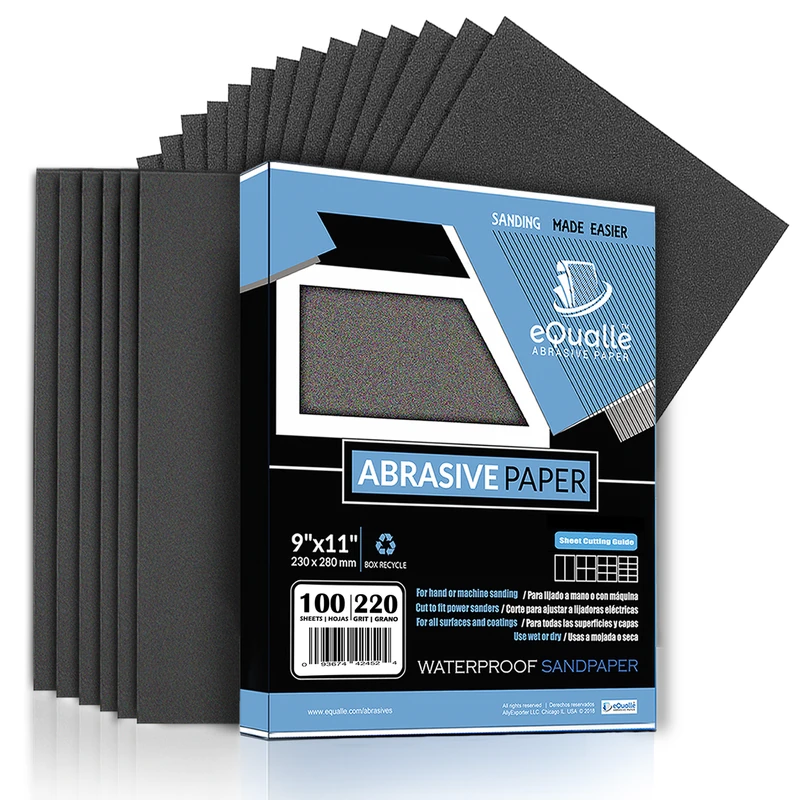
150 Grit Sandpaper Sheets (10-pack) — 9x11 in Silicon Carbide Abrasive for Wet or Dry Use — Balanced medium grit for surface preparation and between-coat sanding. Smooths minor imperfections in wood, paint, or primer. Works equally well for wet or dry applications in both DIY and professional projects. (Professional Grade).
Frequently Asked Questions (FAQ)
Q: Why do scratches reappear after I thought I removed them?
A: They were likely masked by slurry or burnished shoulders during wet passes. Use a hard backer, take a short dry finishing pass at the same grit, then wipe down with alcohol to confirm complete removal before progressing.
Q: What’s the best grit jump to ensure full erase between steps?
A: Keep jumps to roughly 1.5–2× in FEPA “P” scale (e.g., P400 → P600 → P1000). Larger jumps leave survivors from the coarser grit that only show up after finishing or under raking light.
Q: Should I always alternate sanding direction by 90 degrees?
A: Alternating by 45–90 degrees is ideal. Bigger angles make survivors stand out during inspection. For contoured parts where 90 degrees is impractical, maintain a consistent, documented angle change so you can read orientation confidently.
Q: Is stearated wet dry sandpaper bad for inspection?
A: Not inherently, but stearates can leave residues that flatten gloss and obscure fine scratches. If you use stearated sheets, include a solvent flash step and a fresh, lint-free wipe before reading the surface.
Q: How do I keep contaminants from a previous grit off my work?
A: Dedicate separate trays, cloths, and squeeze bottles per grit stage. Rinse the workpiece and your hands between changes, and store sheets in labeled sleeves. Even a few rogue grains can seed deep tracks that survive multiple steps.