
Rigid Pad Backing for Flat Work and glass sanding
The light catches the tabletop just right, and the truth is undeniable: a shallow, dish-shaped hollow blooms across the finish. You feel it before you see it—your fingertips dragging slightly as they cross the depression. It’s the kind of flaw that only appears after a day of sanding, when the first coat of finish or the first pass of polish makes the geometry visible. You didn’t want a contour; you wanted a plane. You wanted crisp reflections, a surface that reads as a sheet of light from every angle. Whether you’re bringing a maple desk to final grit, flattening an aluminum fixture plate, or taking the bite off a cut bottle rim during glass sanding, flatness is not a suggestion—it’s the benchmark.
Most makers blame technique, grit sequence, or even the abrasive brand. Those matter, but the seed of most flatness problems is subtler: pad compliance. If your backing substrate yields under pressure, the abrasive will telegraph the pad’s shape into your work. Round over an edge unintentionally? That’s pad roll-off. Telephoto reflections that “smile” back? That’s a crowned platen. Chatter valleys that never leave? That’s a soft interface in the wrong application. Achieving rigid flat support is neither guesswork nor mysticism; it’s an engineered choice about durometer, thickness, and coupling between machine and abrasive.
In practice, rigid pad backing is a control system. It determines how force distributes across the contact patch, how edges are defended or attacked, and how scratches stack into a uniform field you can later refine or polish. Get the backing right and scratches cut to depth uniformly with a predictable removal rate. Get it wrong and you’ll chase ghosts for hours—ghosts that show up only after the last wipe-down. This guide breaks the cycle, giving you the mechanics and workflows to select and tune backing pads for true flatness across wood, metal, composites, and glass.
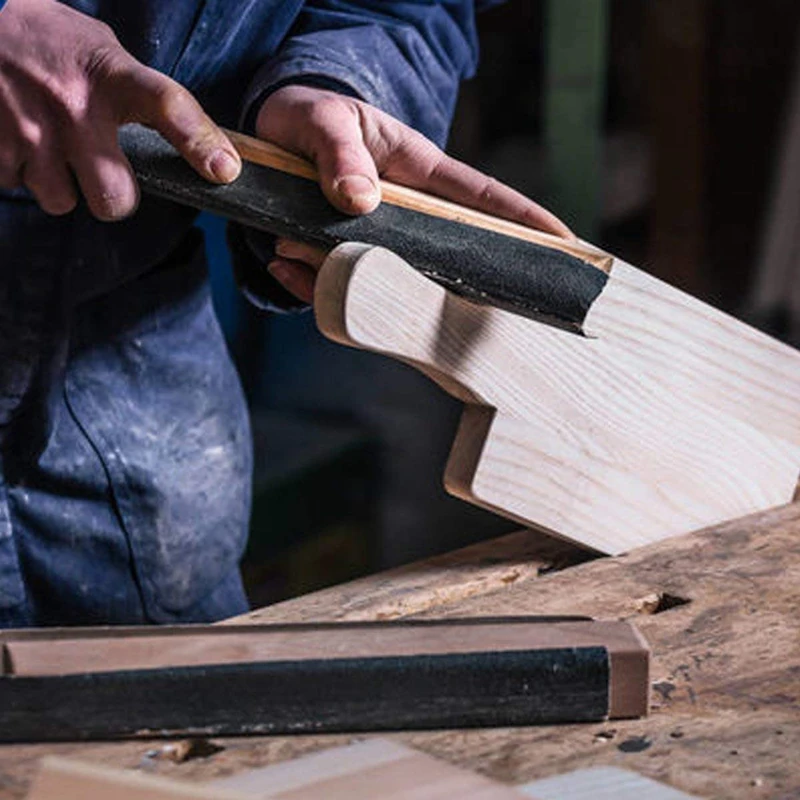
Quick Summary: Flatness comes from controlling pad stiffness, thickness, and coupling so abrasives cut uniformly; choose rigid backing, manage interfaces, and tune pressure, stroke, and grit progression for dead-flat results.
Why Rigid Backing Determines Flatness
When an abrasive meets a surface, the distribution of contact pressure defines the geometry of material removal. Rigid backing maintains a broad, uniform pressure field; compliant backing concentrates pressure at high spots and edges. That difference determines whether you level a surface or sculpt unintended curves.
Think of the pad as a spring in series with the abrasive grain and the work. A soft spring (low durometer or thick foam) compresses locally at high spots, causing the abrasive to wrap and cut more aggressively there, often rounding edges and imprinting the pad’s micro-topography. A hard spring (high durometer, minimal thickness) holds geometry, forcing high spots down without collapsing into adjacent lows. On flat work, you want the backing to behave like a platen, not a cushion.
Key variables:
- Durometer: Shore A 70–95 for rigid discs; Shore D for aluminum or phenolic plates. Higher is flatter.
- Thickness: 1–3 mm for rigid work; thicker layers add compliance and edge roll-off.
- Material: Aluminum, magnesium, or phenolic plates for machines; cork or dense rubber blocks for hand sanding; avoid soft open-cell foams for flattening.
- Coupling: PSA (pressure-sensitive adhesive) couples abrasives more rigidly than hook-and-loop; hook-and-loop adds about 0.5–1.0 mm of compliance and can trap runout.
Machine dynamics matter. Random orbit sanders (ROS) introduce orbital motion and pad inertia; adding mass (aluminum plate) damps chatter and reduces “dishing” under load. Rotary polishers concentrate shear; with rigid backing they level aggressively but risk micro-marring if grit is too coarse or pressure too high. Belt sanders distribute force along a line; platen stiffness and belt tension dominate flatness control.
For diagnosis, use a pencil grid across the panel, then perform a few passes with minimal pressure. If the grid erases everywhere except the edges, your backing is too soft and rolling into the center. If it erases only at edges, your backing or platen is crowned, or you’re biasing pressure at the perimeter. For glass or metal, read with a squeegee and a raking light; for wood, use a straightedge and feeler gauges. The pattern tells you whether to stiffen the backing, change interface thickness, or re-true the platen.
Selecting Rigid Backing Pads for glass sanding
Glass is unforgiving: it reflects errors with cruel honesty and chips readily when edges are over-pressured. For glass sanding, rigid backing is not just about flatness—it’s about crack control. A pad that collapses at an edge will spike contact pressure, initiating chips; one that holds geometry lets you feather edges safely and keep planes true for polishing.
Recommended backings by task:
- Plane flattening and leveling: Aluminum or phenolic discs with PSA diamond films (e.g., 60–200 micron) or vitrified-bond abrasives. Keep interface thickness under 2 mm.
- Edge work and bevel setting: Dense cork or hard rubber hand blocks with diamond sheets. Cork adds micro-compliance that tolerates minor edge waviness while remaining sufficiently rigid.
- Curved transitions: Reserve flexible foam-backed diamond pads for contours only; do not use them for flat calibration.
Durometer and size considerations:
- Use Shore A 90+ plates for rotary leveling of flat panels or bottle bases; the stiffer backing reduces dishing.
- For ROS heads, choose low-profile hook-and-loop plates labeled “hard” or “super-hard,” often 3–5 mm overall, and consider PSA conversion for maximum rigidity.
- Diameter influences edge pressure: smaller discs increase edge pressure; larger discs distribute load and help maintain planar contact.
Coolant and loading control:
- Always wet-sand glass with water plus a drop of surfactant to manage heat and swarf. Heat induces tensile stress and subsurface damage; water controls temperature and debris.
- Monitor the scratch field under raking light; a uniform matte is your stop signal before stepping down in grit size.
Actionable tips for glass:
- Pre-chamfer sharp edges lightly with a hard block before planar work; this prevents edge spall from later passes.
- Use marker ring tests on bottle rims: ink a ring, touch the surface for one revolution at low pressure; read where the ink remains to spot high/low zones.
- Keep feed pressure under ~5 N for hand blocks on thin glass; exceed that and you risk microcracks.
- Replace diamond sheets promptly when cutting slows; dull diamonds rub, heat up, and bruise the surface.
Abrasive Mechanics and Interface Layers
Flatness control isn’t binary hard vs. soft; it’s a layered system. Your base plate delivers macro rigidity, while an interface pad—if used—tunes micro-conformity and scratch character. Thin interfaces (0.5–2 mm) can homogenize cut on materials with micro-variability (veneered panels, etched glass) without sacrificing plane control. Thick foams (>3 mm) are for contouring, not flattening.
H3: Interface materials and use-cases
- Cork: Dense, micro-compliant, and thermally stable. Excellent for hand blocks on flat substrates and for edges where a bare metal plate would chatter. It damps vibration and spreads pressure modestly without rounding aggressively.
- Hard rubber (Shore A 80–90): Durable and water-tolerant, suited to wet glass and metal work with diamond abrasives.
- Closed-cell foam (high density, 1–2 mm): Use sparingly under films to reduce “grain print-through” on brittle coatings while retaining plane.
- Felt: For polishing, not leveling; it smears pressure and will round quickly under load.
H3: Coupling strategy
- PSA-backed abrasive films bond directly to the plate/interface, maximizing stiffness. Best for calibration steps (coarser grits).
- Hook-and-loop adds compliance and can introduce runout; reserve it for intermediate and finishing steps where minor conformity benefits scratch blending.
Grit bridges and step-downs
- On glass and metal, step grit approximately 2:1 in particle size (e.g., 120 micron to 60 micron to 30 micron). Larger jumps risk residual deep scratches telegraphing through.
- On wood, ROS with a hard plate can advance 80 > 120 > 150 > 180 > 220, suppressing dish while maintaining control of cross-grain scratches.
Thermal and loading management
- Rigid backing concentrates shear; monitor heat. On glass or metal, if the surface becomes warm to the touch, extend dwell in water or pause for cooling.
- Maintain a clean slurry. Spent abrasive acts like rogue grit, causing random deep scratches that require backtracking.
For a tactile, hand-driven option, dense cork blocks provide a balanced compromise: planar support with slight micro-yield for comfort and consistency. According to a article, cork blocks enable even results on flat surfaces because they’re rigid enough to support effective sanding while remaining comfortable to hold. Use them with PSA films for maximum control on small flats and edges.
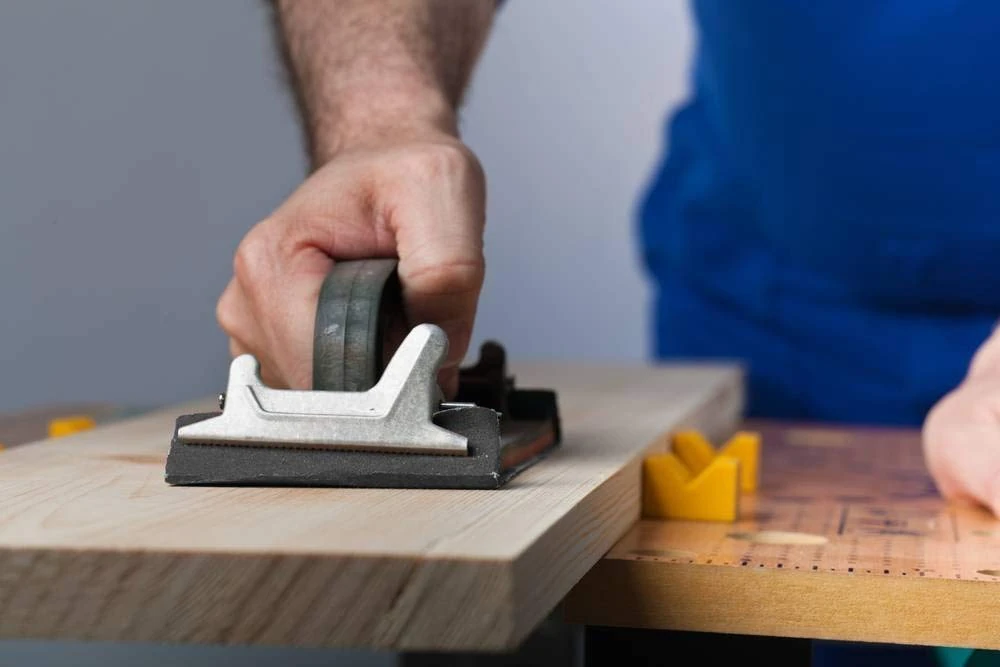
Workflow: Calibrating Flat Surfaces End-to-End
A disciplined workflow prevents rework. Below is a repeatable approach adaptable to wood, metals, and glass using rigid pad backing to establish and hold plane.
- Assess and map
- Clean the surface thoroughly.
- Mark a light pencil grid (wood/metal) or use a water-squeegee film (glass).
- Check with a precision straightedge and feeler gauges (0.02–0.10 mm) across multiple diagonals. Record highest deviation; this sets your starting grit and expectations.
- Choose the backing stack
- Calibration step: hard or super-hard plate, minimal or no interface, PSA abrasive.
- Refinement steps: same plate or slightly firmer interface (≤2 mm) to blend scratch without reintroducing dish.
- Edge defense: micro-chamfer edges (0.2–0.4 mm) before calibration to prevent breakout.
- Set process parameters
- Pressure: use the weight of the tool plus a light assist. On ROS, target 3–7 N; on hand blocks, 5–10 N for wood/metal, 3–5 N for glass.
- Stroke: maintain consistent, overlapping passes at 10–20 mm/s; cross-hatch between passes to average out directional bias.
- Dwell: equalize dwell time per zone; count strokes or use a metronome. Unequal dwell is a common cause of scalloping.
- Cut and verify
- Begin with the coarsest grit that clears high spots within 6–10 passes; avoid going coarser than necessary as deeper scratches take longer to remove.
- After each pass set, wipe and inspect. On glass, use raking LEDs; on wood/metal, use magnification and a scratch comparator.
- Do not advance grit until the previous scratch field is fully replaced. If in doubt, stop and examine under a different light angle.
- Refine and finish
- Step grit sizes conservatively (2:1 particle-size rule).
- For glass, move from diamond 120 µm > 60 µm > 30 µm > 15 µm before pre-polish. Introduce a thin felt only at the polishing stage, never earlier.
- For wood, end at 180–220 before finishing systems that raise grain; plan for a light resand at the same grit after grain raising.
- Control variables
- Temperature: if the surface exceeds 35–40°C, pause; heat expansion can fake flatness and then recede when cool.
- Cleanliness: vacuum extraction for dry sanding; frequent rinses and fresh water for wet.
- Backing integrity: replace hook-and-loop plates that have lost pile or PSA plates showing runout; even small defects telegraph into the cut.
Practical signal checks
- The “uniform matte test”: a properly supported abrasive leaves an even matte with no crescent brighter/darker zones. Crescents indicate pad tilt or compliance mismatch.
- Edge witness lines: a sharp, consistent micro-bevel after calibration indicates stable edge pressure; a ragged or widening bevel signals roll-off—stiffen the stack or reduce pressure.
Troubleshooting, Safety, and Process Control
Even with rigid backing, process drift can erode flatness. Diagnose by pattern, not by hunch.
Common issues and fixes:
- Dishing in the center: backing too soft or interface too thick. Switch to PSA on a hard plate; reduce or remove the interface. Verify the platen is not crowned.
- Edge rounding: overhang and pressure bias at edges; reduce overhang to <10% of pad diameter; use a support fence or sacrificial board to catch exits; pre-chamfer edges.
- Crosshatch ghosting: pad runout or debris under the disc creates periodic high spots. Clean the plate, replace worn hook-and-loop, and check spindle for wobble.
- Random deep scratches: rogue grit from contaminated slurry or a torn abrasive. Refresh slurry, wipe both the work and pad, and discard compromised discs.
- Chatter marks: insufficient mass or damping. Move to a heavier backing (aluminum/phenolic), lower RPM slightly, and increase overlap.
Safety essentials:
- Glass and ceramics: always wet-sand to control airborne particulates; wear cut-resistant gloves for edge work and eye protection rated for impact. Glass dust is largely amorphous but still a respiratory irritant—use a P100 or P2 respirator when dry work is unavoidable.
- Metals: manage heat; hot swarf can embed in skin and ignite dust. Keep a water quench or mist bottle at hand for stainless and aluminum.
- Wood: extract dust aggressively; certain species are sensitizers. Ground your vacuum when sanding conductive composites to avoid static pops that can jolt your grip.
Process control habits:
- Calibrate your pressure: use a digital force gauge to practice consistent downward force; muscle memory is deceptive.
- Time your passes: a metronome or timer maintains dwell uniformity and reduces operator-induced scallops.
- Maintain a log: record backing stack, grit progression, tool speed, and inspection notes. When you get a perfect outcome, you’ll know how to reproduce it.
Actionable tips that pay off immediately:
- Convert critical flattening steps to PSA on a hard plate; reserve hook-and-loop for blending.
- Keep a set of color-coded interface shims (0.5, 1, 2 mm). Install only the minimum needed to tame micro-variability.
- Dress your edges first. A controlled micro-chamfer saves hours of rework from chips and roll-off later.
- Use a known-flat reference (granite plate or thick float glass) to check pad and platen flatness with feeler gauges before high-stakes work.
- On ROS, run slightly lower speed during coarse leveling with hard backing to reduce harmonic chatter, then increase speed for finer grits to refine the scratch field.
How To Sand — Video Guide
For a hands-on look at the challenges of working a brittle, curved substrate, see “How To Sand And Polish A Glass Bottle.” The walkthrough shows how long, deliberate passes, controlled pressure, and correct grit progression prevent edge chips and keep a clean, uniform matte before polishing.
Video source: How To Sand And Polish A Glass Bottle
320 Grit Sandpaper Sheets (10-pack) — 9x11 in Silicon Carbide Abrasive for Wet or Dry Use — Fine finishing grit for sanding between coats of paint, primer, or lacquer. Provides smooth, even results for woodworking, automotive, and precision finishing. Works efficiently for wet or dry applications. (Professional Grade).
Frequently Asked Questions (FAQ)
Q: How hard should my backing plate be for flattening? A: For true flat work, use a hard or super-hard plate: Shore A 90+ for polymer plates or a metal/phenolic platen. Keep interface layers ≤2 mm, or skip them entirely for calibration steps.
Q: When is cork better than foam for hand sanding? A: On flat surfaces and edges, dense cork is superior. It’s rigid enough to hold plane yet adds micro-damping to prevent chatter. Foam is for contours; it introduces too much compliance for flattening.
Q: Can I use hook-and-loop discs for glass sanding? A: Yes, but reserve them for intermediate and finishing steps. For initial leveling on glass, PSA diamond films on a hard plate maintain geometry and reduce edge chipping risk.
Q: How do I avoid rounding edges when flattening panels? A: Pre-chamfer 0.2–0.4 mm, minimize pad overhang, reduce pressure at exits, and use a rigid backing with little to no interface. Support the work so edges don’t deflect under load.
Q: What grit progression should I use on a bottle rim? A: Typical diamond progression is 120 µm > 60 µm > 30 µm > 15 µm, followed by pre-polish. Keep the pad rigid, work wet, and inspect under raking light before each step.