
Guide Coat Techniques for Random Orbital Sanding
The air in the garage was a bright haze, caught in the raking light from a single shop lamp. I’d been chasing a low spot along a boat transom for an hour—sand, wipe, squint, repeat—feeling that nagging uncertainty anyone who’s prepped a surface knows. The sander hummed steadily under my palm, pads orbiting, disc shaving down high spots while the vac hissed. With random orbital sanding, the cut feels smooth and controlled, but it can also be deceptively blind; until you spray paint or lay topcoat, you’re often guessing whether the panel is truly fair. That’s the moment a guide coat earns its keep. A featherlight dusting of contrasting powder turned the invisible into a map: dark islands where the low spots hid, bright rings marking highs. Every pass started to mean something.
I reached for the 3/16-in orbit sander with a medium pad and 180-grit ceramic film disc, feathering pressure until the motor held speed. The powder told the truth mercilessly; the “done” section at the edge wasn’t. When I swapped to a softer interface pad to ride the slight compound curvature, the guide coat readout changed again—smoother fade, fewer halos. Instead of guessing, I was measuring by sight. Little adjustments—one step coarser, a slower traverse, a cleaner pad—showed up instantly in the guide coat’s wear patterns. By sundown, what started as a battle of patience had turned into process control. The final panel wasn’t just flat; it was predictably flat, achieved with fewer passes and no swirl surprises.
A good finish isn’t about heroics; it’s about feedback loops. Guide coats bring metrology to sanding—on wood, metal, primer, or gelcoat—so you can stop sanding in the dark and start dialing in results you can prove.
Quick Summary: Use a dry or misted guide coat as a visual gauge during orbital sanding to level faster, avoid swirls, and achieve verifiably flat, paint-ready surfaces.
Why a guide coat changes everything
At its core, a guide coat is a diagnostic overlay. It’s a thin, contrasting powder (or ultra-light spray) applied to a surface before sanding. As the abrasive cuts, the coat disappears from high spots first and lingers in lows and valleys. That simple contrast converts a 3D topography problem into a 2D readability solution you can track in real time.
Mechanically, guide coats highlight the aggregate effect of micro-scratches and surface waviness. Random orbital sanders impart a stochastic scratch pattern—micro arcs that reduce directional bias compared to straight-line sanding. Without a readout, this randomness can hide persistent defects until too late. A guide coat visualizes the “load path” of your passes: if it vanishes uniformly, your pad is conforming; if it patchily remains, the pad is bridging over dips or digging at edges. This is particularly useful after filler or primer application, where the bulk texture can look deceptively uniform.
Different formats alter behavior. Dry powder (e.g., carbon black-based) rubs on quickly, doesn’t clog paper when applied thinly, and clearly shows feather edges. Aerosol “mist” coats can work too, but thickness control matters; too heavy and you build film that skews readings or gunks abrasives. The ideal guide coat is near-zero thickness, matte, and highly contrasting. On light primers, I prefer black powders; on dark base coats or gelcoat, a light gray or white guide coat reads best.
Material compatibility also matters. On polyester or epoxy fairing compounds, powder stays put and brushes away easily; on open-grain wood, it can lodge in pores, so a higher grits-only, lighter application is smarter. On metal, keep it sparse to avoid oily residues that could affect adhesion later. The point isn’t to color the part—it’s to reveal the high/low map that random orbital sanding should follow, not fight.
Dialing in random orbital sanding with guide coats
When you combine a guide coat with disciplined random orbital sanding technique, you get a closed-loop process: apply, cut, read, adjust, repeat. Here’s a practical sequence that consistently yields flatter, swirl-free surfaces.
Start with orbit size and pad firmness. A 3/32-in (2.5 mm) orbit favors finish quality and minimizes pigtails; a 3/16-in (5 mm) orbit removes stock faster but demands cleaner abrasives and steadier pressure. For flat panels, a medium pad keeps the disc plane true. On gentle curves, add a 3–5 mm soft interface pad to avoid bridging lows; you’ll see the guide coat fade more uniformly. Keep vacuum extraction strong; dust is a lapping compound if it stays under the disc.
Grit progression should match the substrate. On fairing filler or gelcoat, I often establish plane at 120 or 150 grit, verify with guide coat, then refine at 180–220. On automotive primers, 180–240 sets plane, followed by 320–400 before sealer. The guide coat tells you when to move on: once it erases evenly with a single, consistent pass pattern, step up a grit. If islands persist after two identical passes, you still have lows or a pad-conformity issue.
Four field-tested tips:
- Keep pressure light—just enough to maintain pad contact without bogging the motor. If the guide coat shows bright halos at the perimeter of your disc, you’re tilting or pressing too hard.
- Crosshatch 50% overlaps. Make one set of passes north-south, another east-west. Uniform guide coat fade in both directions indicates true leveling, not directional luck.
- Clean discs frequently. A gentle tap or compressed-air blow-off every minute prevents embedded dust from cutting grooves that the guide coat will betray as comet tails.
- Stop to read, not to guess. Sand two passes, vacuum the surface, and visually inspect. A 15-second read can save 15 minutes of rework.
When pigtails do appear—tiny spiral scratches from a lodged particle—the guide coat will often ghost them even if you can’t feel them. Drop back one grit, clear the contamination, and make controlled, slow passes with fresh media. Then re-coat lightly and verify. The powder doesn’t lie.
Abrasive science: discs, pads, and dust
Guide coats are only as honest as the abrasive system you put over them. The mineral, backing, and hole pattern on your discs change how predictably the coat erases—and therefore how reliable your readout is.
Minerals first. Aluminum oxide is the generalist: durable, predictable, cost-effective. Ceramic alumina cuts cooler and lasts longer, particularly on tough polyester fillers or gelcoat, making the guide coat fade more uniformly over time because cut rate stays steadier. Silicon carbide breaks sharp and shines on harder substrates or between-coat scuffing, but wears quicker; it can show a fast initial fade and then slow, which can trick you into moving up a grit too early if you’re only watching time, not pattern.
Backings matter just as much. Paper discs conform and are fine for wood and primer, but they telegraph pad irregularities. Film-backed discs offer more uniform surface contact and scratch depth control, which reads more cleanly through a guide coat. On critical finish stages, I reach for film: the scratch field looks tighter and more even under raking light, and the guide coat disappears like a gradient, not blotches.
Hole patterns and dust extraction are underappreciated. Multi-hole (e.g., 49-hole) patterns evacuate dust across the whole face, keeping abrasive sharp and preventing a slurry that smears guide coat instead of cleanly erasing it. Strong extraction (connected to a vac with auto-start and a HEPA bag) maintains a near-dry interface, which is essential for reading the coat correctly. If the coat cakes, your interpretation becomes unreliable.
Pad hardness is the hidden variable. A hard pad levels faster but can bridge small lows, making the guide coat persist in islands that seem “stubborn.” Before you keep cutting, try a softer pad or interface; if the islands start to feather out, you had a conformity issue, not a flatness problem. According to a article, even boatbuilders wrestling with gelcoat removal switch tools and guide coats to see where the hull is truly fair before committing to aggressive stock removal. The principle applies everywhere: use the least aggressive setup that still makes the guide coat vanish predictably.
Finally, keep consumables honest. Discs heat-cycle and glaze. If the guide coat starts taking twice as long to fade at the same pressure and speed, the disc is done—even if it still “feels” sharp. Swap it. Your finish will thank you.
Reading the coat: diagnostics and fixes
Think of the guide coat like an EKG for your surface. The patterns it leaves are symptoms that point you to a fix. Learning to read those patterns is the difference between sanding harder and sanding smarter.
Islands that won’t fade after two crosshatch passes: You’re bridging over a low. Switch to a softer interface pad, reduce orbit size, or—even better—stop and spot-fill if the low is beyond your target tolerance. Keep a steel straightedge or a longboard handy; if the board hits the same island, fill instead of chasing with a RO sander.
Bright rings around the disc perimeter: You’re tipping or pressing too hard. Flatten your wrist, lighten pressure, and let the sander’s weight do most of the work. If you’re fighting the machine to keep contact, your pad is too hard for the contour.
Ghost spirals or tails: A lodged abrasive particle is cutting a track. Blow off the disc and surface, re-apply a whisper-thin coat, and make a short test pass. If the spiral repeats, replace the disc. Those tails will telegraph through primer and show under metallics.
Patchy fade aligned in one direction: Your crosshatch isn’t even or your speed is inconsistent. Make a pass with a metronome-like cadence, 50% overlap, then rotate 90 degrees with the same speed. The coat should fade uniformly. If it doesn’t, check pad flatness or replace a fatigued interface foam.
Rapid fade on edges, persistent coat in the center: You’re crowning the panel. Either your substrate is already convex, or you’re overworking edges. Stay off the edges with the RO and use a block or longboard to correct gross shape. Then re-check with a fresh coat and light RO blending.
How flat is “flat”? For woodworking tops, I accept residual coat under 0.1 mm low as long as the function isn’t critical, because finish build can bridge that. For automotive primer before sealer, chase until the coat disappears uniformly at 320–400 grit. On gelcoat or fairing below waterline, be stricter; long, fair curves demand uniform fade, or you’ll see waviness in reflected light.
Use raking light and your fingers too. The coat gives the map, but your fingertips pick up subtle ridges and your lamp reveals scratch orientation. Together, they make your diagnosis repeatable.
From prep to paint: finish-grade workflow
A guide coat doesn’t just belong at the rough-leveling stage; it’s a checkpoint you should return to throughout a finishing workflow. Here’s a blueprint that has held up across wood, automotive, and marine projects.
Substrate prep: Remove contaminants. On metal, degrease; on wood, vacuum and blow out pores; on composites, wipe dust thoroughly. Apply a thin guide coat and make initial passes at 120–150 grit to identify highs and lows. Correct shape issues now using a longboard or fairing board where appropriate.
Filler and primer: After structural leveling, spot-fill lows with compatible filler. Once cured, block-level critical areas. Prime with a surfacer that sands cleanly. After cure, apply a guide coat and sand with 180–220 to knock texture down. You’re building a smooth, uniformly dull surface, not cutting to zero in one go.
Mid-refine: Re-coat and move to 220–320 grit. Film-backed discs with vacuum extraction excel here. Your goal is to see the coat fade evenly with minimal stroke count. If you see persistent islands now, stop to fill; don’t try to “average” them out by over-sanding adjacent highs, which breeds waviness.
Pre-finish: For paint or varnish undercoats, re-apply a very light guide coat and sand 320–400 depending on the system’s spec. On wood, avoid heavy powder that can lodge in grain; a fast mist or chalk rub can suffice. Clean meticulously—vacuum, then tack. Ensure surface temperature is above dew point by 3°C (5°F) to avoid moisture fogging.
Final scuff: Before topcoat, skip the guide coat and use the manufacturer-recommended scuff pad or grit. If you’re polishing instead of painting (e.g., gelcoat restoration), your last guided step might be 800–1000 grit wet sanding with a contrasting pencil grid to confirm uniform removal, followed by compound and polish.
Through all stages, the feedback loop remains the same: apply a trace, cut methodically, read, and adjust. You’ll end with fewer surprises, fewer swirl marks, and a surface that meets spec because you verified it, not because you hoped for it.
10 Random Orbital — Video Guide
There’s a concise video roundup titled “10 Random Orbital Sander Tips” that distills practical techniques for getting cleaner cuts and better control. It also walks through a head-to-head comparison of sanding discs from several top brands, highlighting differences in cut speed, loading, and swirl risk.
Video source: 10 Random Orbital Sander Tips
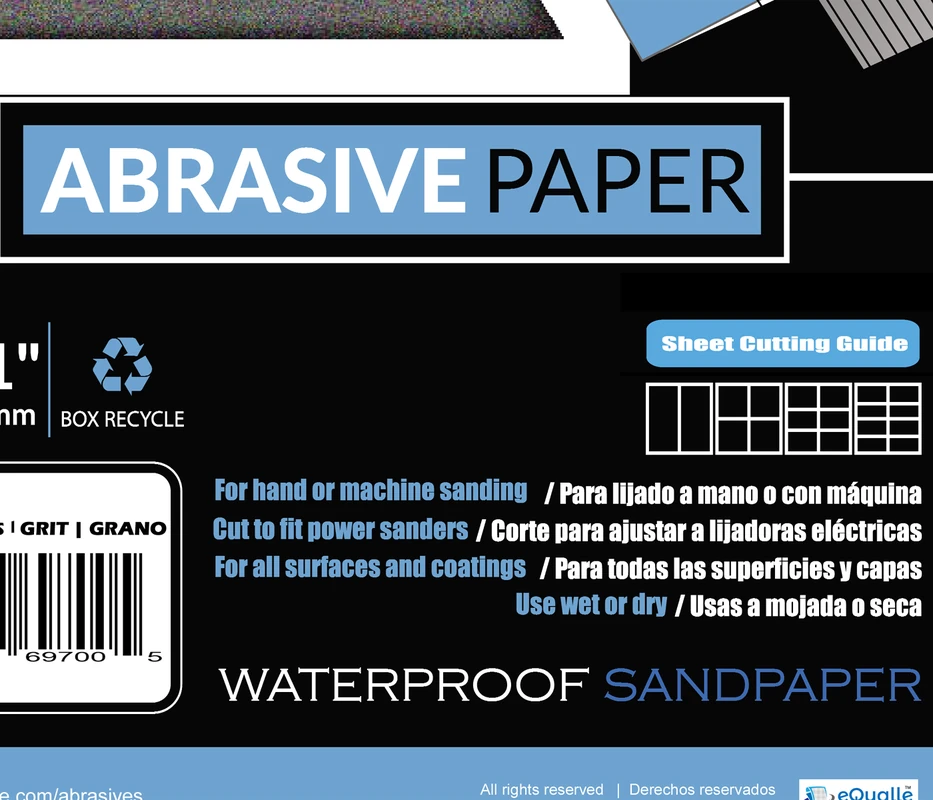
220 Grit Sandpaper Sheets (50-pack) — 9x11 in Silicon Carbide Abrasive for Wet or Dry Use — Refined medium-fine abrasive for final surface leveling on primed or sealed materials. Great for smooth touch-ups before finishing. (Professional Grade).
Frequently Asked Questions (FAQ)
Q: What exactly is a guide coat, and when should I use it?
A: A guide coat is a very thin, contrasting powder or mist applied before sanding. Use it whenever you need to level a surface predictably—after filler, over primer, on gelcoat, or even on hardwood tops—so you can see highs and lows as you sand.
Q: Dry powder or aerosol—does it matter?
A: Dry powder is cleaner, thinner, and less likely to clog discs when applied lightly. Aerosols can work but are easier to over-apply. The key is a near-zero build that reveals, not coats.
Q: Which grit should I use to start removing a guide coat?
A: On fillers or gelcoat, start at 120–180 depending on how much leveling you need. On primer, 180–240 is typical. Move up only when the coat fades uniformly with consistent, crosshatched passes.
Q: Can I use a guide coat on wood without staining the pores?
A: Yes—apply sparingly, prefer lighter colors on open-grain species, and vacuum thoroughly. For final stages on wood, a quick chalk rub or pencil grid can substitute to avoid residue deep in the grain.
Q: How do I prevent pigtail scratches during random orbital sanding?
A: Keep dust extraction strong, clean or replace discs frequently, use minimal pressure, and avoid overloading the disc. If you spot ghost spirals in the guide coat, step back one grit, clear contamination, and re-sand with fresh media.